DHS Panel on Security for Houses of Worship Begins its Work
November 16, 2022
(RNS) — On Rosh Hashana and Yom Kippur this year at Temple Emanu-El, a landmark Reform synagogue steps from Manhattan’s Central Park, a 6-by-11-inch flyer was placed at every seat, next to the prayer books, offering instructions on what to do in the event of an attack during one of the High Holiday services.
“If running from the threat is not an option,” the flyer read, “crouch down between the pews or hide behind a pillar. Make yourself as small of a target as possible. Remain quiet and still.”
A rise in antisemitic incidents over the last couple of years has prompted synagogues, and other Jewish institutions across the country, to focus on increasing their security measures and protocols. And synagogues are hardly the only houses of worship under threat in the U.S. FBI hate crime statistics show that incidents in churches, synagogues, temples and mosques increased 34.8% between 2014 and 2018.
The last major shooting at a religious site occurred in May, when a man killed one and injured five when he opened fire at a church in Laguna Woods, California.
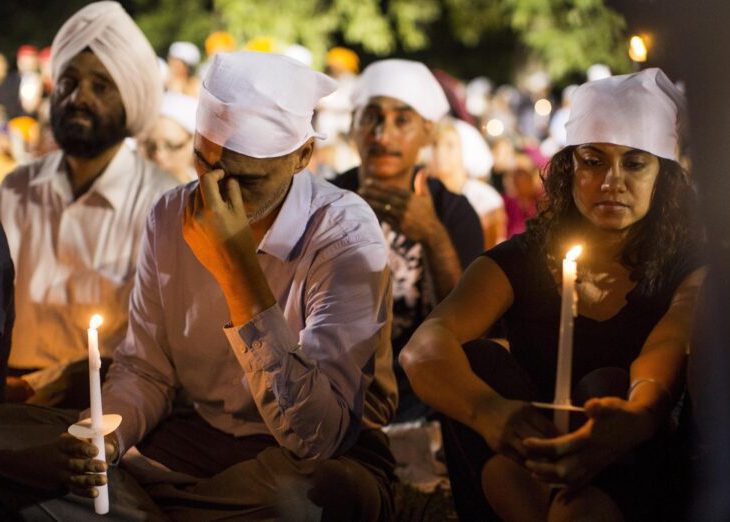
In July, days before the 10th anniversary of the deadly attack on a Sikh gurdwara in Oak Creek, Wisconsin, that killed seven and injured three, the Biden administration established the Faith-Based Security Advisory Council, inviting a group of 25 faith leaders and law enforcement experts to help guide the administration’s efforts to address violent attacks on faith institutions.
The council, which will make recommendations to the secretary of Homeland Security, Alejandro N. Mayorkas, convened for the first time in early October.
The group’s members hail from a variety of faith communities, including the African Methodist Episcopal Church, the Jewish Orthodox Union, the National Latino Evangelical Coalition, The Church of Jesus Christ of Latter-day Saints and the All Dulles (Virginia) Area Muslim Society. Law enforcement and security organizations represented include local police department chiefs, the InfraGard National Members Alliance and the National Voluntary Organizations Active in Disasters.
“You, as leaders throughout this country, can play such a pivotal role in our understanding of the challenges that we face in achieving close partnership and overcoming those challenges,” Mayorkas told the gathering at the Oct. 6 meeting, according to a transcript posted online. Besides meeting the safety concerns of houses of worship, Mayorkas said, the group will be enlisted to help build trust of DHS and ensure that the help the department provides will be equitable and fair.
Kiran Kaur Gill, executive director of the Sikh American Legal Defense and Education Fund and chair of the DHS council, echoed the secretary’s sentiments about the need for equitable access. “I can tell you that, certainly in our community, people found it difficult to access resources because of language barriers and unfamiliarity with the systems,” she said.
Kaur Gill said that for faith communities, the balance between securing their spaces and being welcoming can be difficult to navigate. “For the Sikh community, like so many other communities, there’s sort of this inherent tension between securing our houses of worship, and then following the fundamental tenets of our faith, which include being open and allowing anyone from any background to come in,” she said.
Kaur Gill and other members hope the advisory council can also look at why a threat exists in the first place, saying she wants the group “to look at underlying causes of why this is happening and figure out innovative ways that we can combat those issues.”
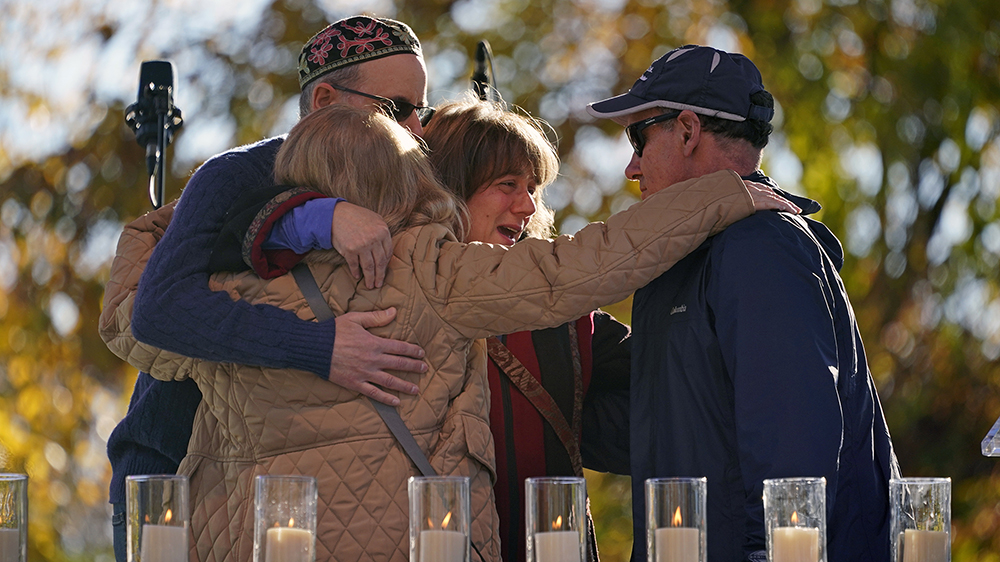
People hug after lighting a candle in memory of Melvin Wax, one of 11 worshippers killed four years ago when a gunman opened fire at the Tree of Life synagogue in the Squirrel Hill neighborhood, during a commemoration ceremony in Pittsburgh on Oct. 27, 2022. (AP Photo/Gene J. Puskar)
Rabbi Jonah Pesner, director of the Religious Action Center of Reform Judaism and a committee member, attributes the increase in violence upon houses of worship and other public spaces particularly to the spread of white supremacist conspiracy theories (he prefers to call them “conspiracy lies”), such as the “great replacement theory,” combined with easily accessible guns.
“My focus on this advisory committee is to get at the root of the problem,” said Pesner. “I don’t think we can spend our way out of white supremacy and gun violence; and antisemitism can’t get routed out with more security cameras,” he said.
Since 2016, DHS has provided nonprofits, including faith organizations, with funding for security measures through its Nonprofit Security Grant Program. Next year the program’s proposed funding is $360 million, a 44% increase from this year.
Pesner said the advisory council must be aware of the role of security and law enforcement in different communities. “We have to remember that law enforcement is a problematic entity for some communities of color … or in some cases may have actually been a threat,” he said, asking, “How do we really lean into everybody’s safety and everybody’s solidarity?”
Deputy Chief Tracie Baker, a 24-year veteran of the Arlington, Texas, police department, described building community with local faith-based organizations through the Arlington Clergy and Police Partnership, which brings together local faith leaders and law enforcement. This intentional partnering has yielded results, she said.
“I think because we are more proactive in our approach, when they (houses of worship) see something, they do contact us. We have ‘see something, say something’ just like all of the other agencies, but I think because of our relationship and us educating and getting information out there ahead of time, we’ve seen quite a bit of success here in our city,” she said.
Baker said it is crucial, too, that all faith communities feel they are getting the same access to help offered by DHS. “It’s just a matter of making sure that everybody sees and receives the same information and the same resources that we give other locations,” she said. “How can the council ensure that we go forward and remember everybody and not leave anyone behind?”
This article was produced as part of the RNS/Interfaith America Religion Journalism Fellowship Program.