I wasn’t looking to move to Svalbard, but I’ve recently been toying with the possibility. It’s a remote, string of Arctic islands in the northernmost part of the Kingdom of Norway, so I’d definitely have to pack extra vitamin D, and, with average temperatures rarely making it above freezing, I’d probably need to upgrade my winter coat.
But these are sacrifices I’m willing to make if it means I can live in a country with more polar bears than people. I’ve not had much interaction with wild creatures of the great outdoors, but if ad campaigns by multinational soda companies are to be believed, polar bears are not only super cute but they’re also super chill. Anything else I need to know about living amongst polar bears seems very Googleable.
Moving to Svalbard is the best solution that I have been able to come up with to deal with the problem of gun violence in this country. It’s not a perfect solution. I don’t have a Class B driver’s license which seems like it would help with the job hunt in the near Arctic, but I do have the can-do attitude of someone who can’t handle what we’ve come to accept as normal here.
In just the past week I’ve been accosted with how much gun violence has been normalized in this, my home country.
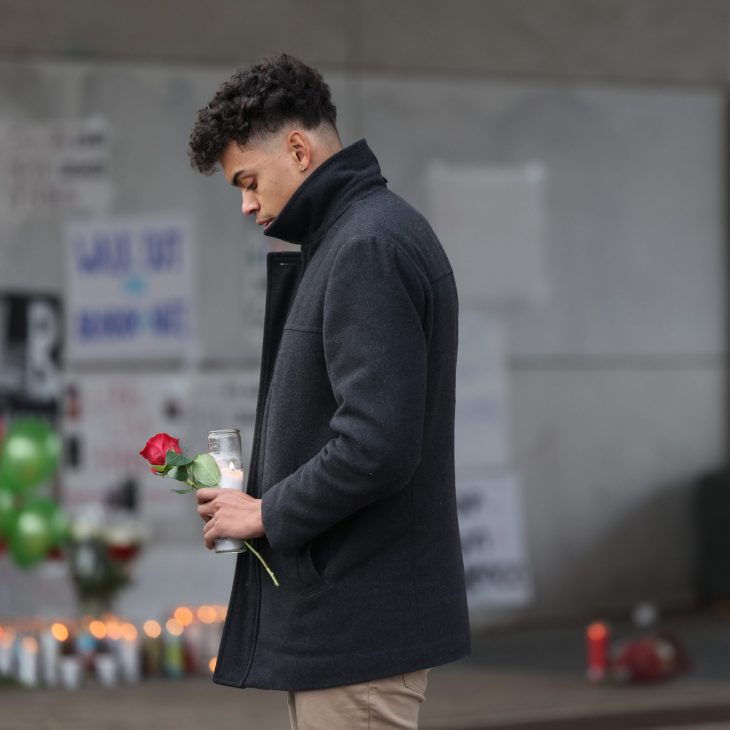
For example, last Friday, I got a flurry of texts. Hey, are you okay? Is your son okay? My stomach sank. No one asks that out of the blue unless something is not okay. Things were absolutely and totally not okay. During afternoon dismissal at my son’s Chicago high school, four students had been shot. Two of the students died, a 15-year-old and a 14-year-old. Two others are recovering from injuries.
Such avoidable violence leaves me confounded, makes me start checking out the local tourist attractions in Svalbard. The Global Seed Vault is housed there. Maybe they give tours?
Because it’s not just the avoidable violence. It’s also the way that potential for violence gets celebrated. Like the moment when, as I was helping my 14-year-old son with his homework, an ad for a gun popped up. The ad was sleek, doing a close up of the handheld weapon, the lighting just right to make it seem cool and irresistible. In typical fashion, I started questioning my son – is that an ad for a gun? On your school-issued computer? In a school account? I was rattled and felt deeply unmoored. I tried to take action, emailing the principal, planning with a friend about what a responsible next step might be, reaching out to the media. Parents seemed just as rattled as I was when I shared the story. But I was surprised at the response from others. They seemed less appalled than me, less rattled. Curious, their responses seemed to say, but not a problem.
During the same week, the nation memorialized the 10-year anniversary of the mass shooting at Sandy Hook Elementary School. I remember leaving work early that day, feeling hollowed out and overwhelmed with horror. I could not stop imagining a group of vulnerable kindergartners sitting scared and hoping for help that never came. That night I remember trying to find comfort in that horrific moment and landing on the sense that this will be a watershed moment in the fight against gun violence in this country. Ah, the optimism of 2012.
The complexity of our problems needs to be seen from a diversity of perspectives, experiences, and ideas.
As a planner and problem solver, I don’t see a solution to the gun violence that has reached epidemic proportions. Apparently, death by gun is now the leading cause of death for people under 18. A cause of death that has steadily risen for more than the past five years.
Not being able to assure my son’s safety is destabilizing. It peppers my mind with intrusive worst-case scenarios, tempts me to grasp too tightly to and exert any semblance of control I can manage. The fear of avoidable violence being visited on my son disrupts my sleep and leaves me weepy and weak.
This fear comes from feelings of uncertainty and powerlessness. Powerless as I watch the conversation about gun violence in America repeatedly devolve into an unproductive debate. Uncertain that we will ever treat this problem as anything more than hypotheticals, ideals, and ideologies rather than a concrete problem with concrete potential solutions.
Powerless and uncertain can be a difficult place to be.
But as an agnostic I remind myself that not knowing is okay, is actually something I value quite a bit. Sitting in uncertainty requires me to cultivate patience and hope, and to remember that as often as bad things happen, so do good things. Recognizing my powerlessness is a reminder that individually I can only do so much, but through relationships and community it is possible to transform our collective futures.
In my mind, this is the point of building interfaith relationships and bridging differences. Ethically and morally it’s just good work to do. But, from a practical standpoint, our problems are too real, too violent, too terrifying to be solved by any one person or single community. The complexity of our problems needs to be seen from a diversity of perspectives, experiences, and ideas. The solutions to our problems will only emerge from the insights of vastly different systems of belief and understandings of our obligations to one another.
Svalbard is not off the table for me — the option to leave has its own calming effect. But the reminder that a solution is possible, that the work of bridging differences can change what seems immutable, that bringing diverse experiences and thoughts to a problem can provide previously unimagined solutions, keeps me from packing a bag, buying a ticket, adding Norwegian to my Duolingo roster.
Maybe I am wrong about this, but I’m hoping, hoping, hoping that I am right.
LaTanya Lane is Director of the Interfaith Leadership Institute at Interfaith America.
Share
Related Articles
American Civic Life
Is This a Time for Bridgebuilding? 5 Leaders in Conversation
American Civic Life
American Civic Life
We Commemorate, We Commit: Out of Catastrophe, a Conversation on Connection and Repair