Rain Gardens are a Practical, Ecological and Theological Solution for Houses of Worship
February 9, 2022
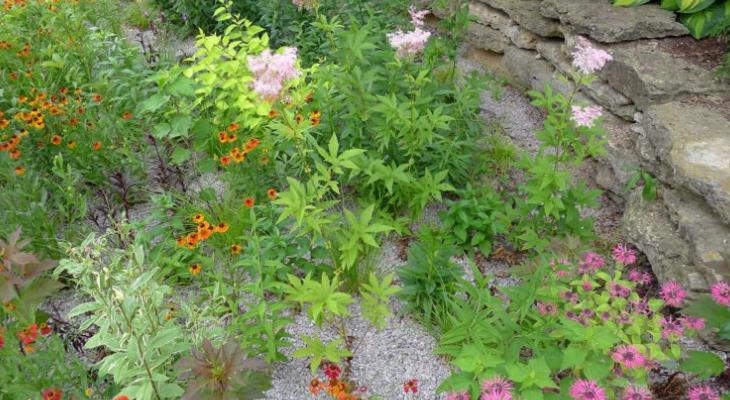
(RNS) — Showy goldenrod. Oxeye sunflower. Blue false indigo. When spring comes, it’s impossible not to notice the colorful ensemble of flowers and bushes outside the Sisters of St. Joseph’s convent in Brentwood, New York.
But there is something deeper going on than an eyeful of natural beauty. The sisters’ rain gardens, as their plantings are known in environmental circles, soak up rainwater that would otherwise collect in depressions around the convent’s 212 acres. Besides solving nuisance flooding, the rain gardens improve water quality thanks to an underground filtration system. They also feed the insect population, becoming sanctuaries for bees, butterflies and, in turn, attract and feed birds.
Rain gardens, which have deeper roots than grass, “not only soak up rainwater, but they also do a little bit of filtration of the contaminants in it, preventing them from entering drinking water,” said Amanda Furcall, a landscape ecologist who helped the sisters expand their green infrastructure.
Just as people think about roads and rooftops as completely impermeable, Furcall said, they think about lawns as permeable. “But long grass has really shallow roots, only a couple inches deep. And usually, if it rains, they can only absorb about a quarter-inch of rain,” she said.
Two years ago only 2,000 square feet of the Sisters of St. Joseph’s property was dedicated to a single large rain garden. Today, the Brentwood campus has six main rain gardens and several smaller ones.
Rain gardens are commonly installed along city sidewalks today for flood control, often preventing overflow of sewers during heavy rains. But in recent years houses of worship and other religious communities like the Sisters of St. Joseph adopted rain gardens as easy-to-build, low-maintenance ways to devote their sometimes extensive real estate to fighting climate change.
The rain gardens also satisfy a common theological thread running through many faiths: a commitment to treasure the earth created by God.
Share
Related Articles
American Civic Life
California Bill Could Make it Easier for Houses of Faith to Build Affordable Housing
American Civic Life
American Civic Life
Houses of Worship Grapple with the Future of their Online Services
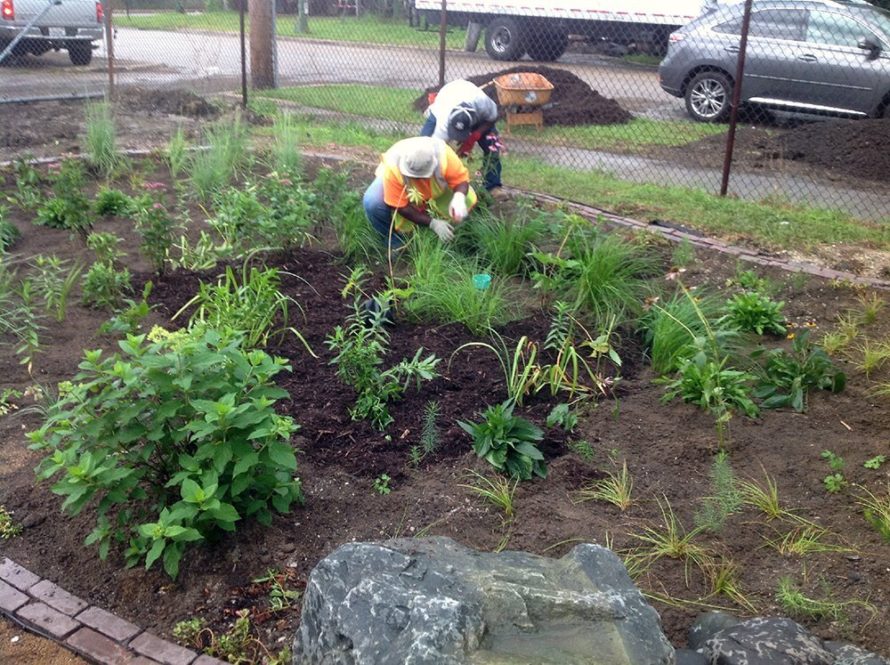
A rain garden is planted at New Mission Temple Church Of God In Christ in Chicago. Courtesy photo
At the Unitarian Church of Evanston, Illinois, whose Green Sanctuary Team has planted two rain gardens in the past 10 years, Sandra Robinson, executive operations director, said that the church first started thinking about planting rain gardens because the neighborhood around the church was prone to flooding.
“Building a rain garden soon became a priority,” Robinson said. “So we hired a company to come in and help us discern how it would be done and what plants would be used.”
The project was financed by donations from Marjorie Fisher, the founder of the Green Sanctuary Team. Today, a 500-square-foot rain garden, dedicated to Fisher, handles about 20% of the water collected from the sanctuary roof, said Robinson.
The church more recently completed a garden that redirects the remaining 80% of the roof’s drainage. According to Robinson, some underground pipes were engineered to divert the water to a remote part of the church’s lawn.
The rain gardens also satisfy a common theological thread running through many faiths: a commitment to treasure the earth created by God.
The rain gardens also satisfy a common theological thread running through many faiths: a commitment to treasure the earth created by God.
Planting gardens and saving water fits with one of the core principles that guide the Unitarian Church, Robinson said. The seventh unitarian principle calls for “respect for the interdependent web of all existence of which we are a part.”
The construction of rain gardens requires training and the support of experts. A few houses of worship have found it in Faith in Place, an environmental nonprofit based in Illinois with a mission of empowering people of diverse faiths “in advancing environmental and racial justice.”
The group has been supporting five houses of worship around Chicagoland in planting rain gardens since 2015: New Mission Temple Church, Greenstone United Methodist Church, New Life Covenant Church, St. Brides Church, and United Advocate Church of Christ. Ramont Bell, a retired AT&T engineer who works with Faith in Place, said that his team came up with a three-year maintenance plan and taught the churches how to maintain the gardens.
Deciding the best spot for a rain garden, Bell said, is the result of a series of calculations, usually figuring out how much water gathers in low areas or comes off rooftops.
“For each church where we planted a garden, we did calculations on the roof, on how many downspouts we could disconnect and redirect into the rain gardens,” he said.
Bell said that every year, depending on the amount of rain, the five rain gardens at the Unitarian church redirect between 600,000 and 900,000 gallons of rainwater that would otherwise go into the sewer system back into the soil.
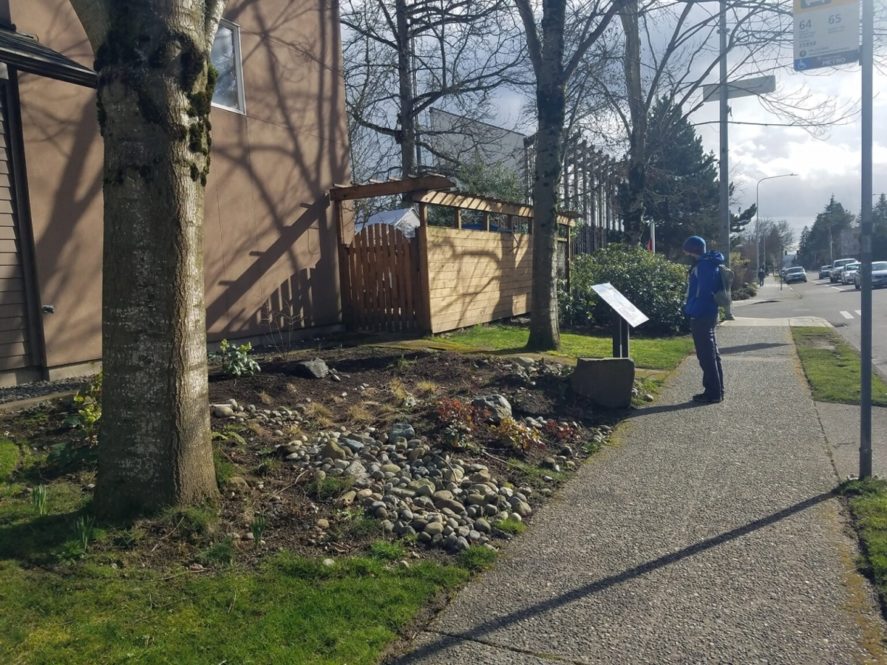
A rain garden outside Congregation Beth Shalom in Seattle. Courtesy photo
At Congregation Beth Shalom, a Conservative synagogue in Seattle, a rain garden installed in 2019 was intended to teach students at the synagogue’s religious school “through the lens of care for the environment,” said Deirdre Gabbay, an active member of the congregation.
Third and fourth graders were deeply involved in the rain garden’s construction, Gabbay said.
Decorated with rocks and colorful plants, the garden, she said, is strategically located close to a bus stop and just across the street from the public library and a Unitarian Universalist Church. As the rain garden drew the attention of passersby, it quickly became an opportunity for connection with the neighbors.
“It really is a beautiful reflection of who we feel like we are as a community,” Gabbay said. “We just love the rain garden.”
The Sisters of St. Joseph share this idea that commitment to the land is a commitment to their community. Sister Karen Burke, who coordinates the land initiatives and the sustainability department on Brentwood’s campus, said that the water management system falls within the ambit of the sisters’ land ethic statement, affirmed in 2015.
“We often talk about religious congregations owning property,” Burke said. “What we’d like to say is that we don’t own property. We hold property in sacred trust for the next generations.”
In addition to the rain gardens, the Brentwood campus boasts solar panels and fields that have been leased to local vegetable farmers.
But a major responsibility of owning this kind of property, Burke said, is to “preserve, protect, restore and cherish the integrity, biodiversity, balance and beauty of the land and all the species with whom we share it.”
Gabbay reasons that houses of worship are planting more rain gardens because they are a concrete action amid religion’s principles and abstract ideas.
“It’s just so tangible,” she said. “You can actually see how it works. Especially on a rainy day, you can see that the garden fills up like a little pond, and it just transforms the front yard of our building. It’s beautiful.”