Pope Francis Hopes ‘Reality Therapy’ of COVID-19 Overcomes Ideological Opposition to Vaccines
January 10, 2022
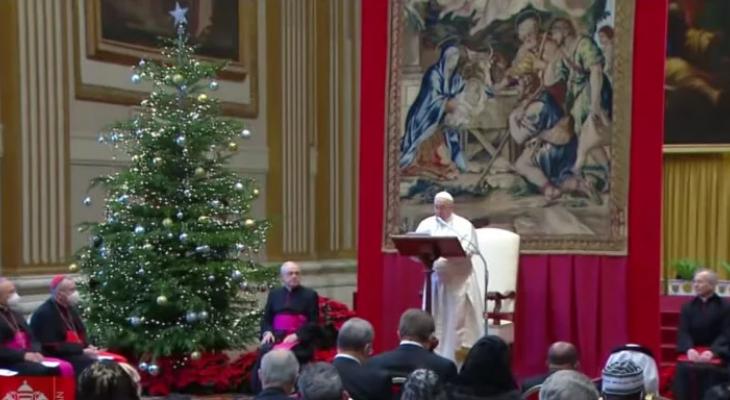
VATICAN CITY (RNS) — In his annual address to the Vatican’s diplomatic corps on Monday (Jan. 10), Pope Francis again voiced his support for global vaccination efforts, while condemning the “ideological divides” fueled by misinformation.
In the speech, in which the pope traditionally takes stock of the world’s most pressing issues, Francis called for “a manifold commitment on the personal, political and international levels” to seek immunity, but he stressed the individual’s responsibility “to care for ourself and our health, and this translates into respect for the health of those around us.”
Francis said “baseless information” and “poorly documented facts” have prevented people from getting the vaccine, but he also blamed ideological divides. “Frequently people let themselves be influenced by the ideology of the moment,” he said. He hoped that the “reality therapy” of the pandemic’s toll would lead people to “confront the problem head on and adopt suitable remedies to resolve it.”
But he also said that “a comprehensive commitment on the part of the international community is necessary, so that the entire world population can have equal access to essential medical care and vaccines.”
Francis again advocated for the waiver of vaccine patents, which would allow more countries to manufacture vaccines and is currently being discussed at the World Trade Organization, or WTO. The Vatican has supported the waiver, which was also backed by the United States, but is currently stuck in negotiations.
“I urge all states” negotiating at the WTO “to adopt a policy of generous sharing as a key principle to guarantee everyone access to diagnostic tools, vaccines and drugs,” the pope said, emphasizing the need for solidarity among states, especially toward poorer countries.
The pope also urged international cooperation on the plight of immigrants and refugees, calling them victims of “indifference,” both in Europe and in the United States. “There is a need to adopt a coherent and comprehensive system for coordinating policies on migration and asylum, with a view to sharing responsibility for the reception of migrants, the review of requests for asylum, and the redistribution and integration of those who can be accepted,” the pope said.
He singled out Europe and the United States, both faced with significant migration flows, urging them to take a “farsighted approach.” While acknowledging the difficulties that migration poses to countries, the pope said that “there is a clear difference between accepting, albeit in a limited way, and rejecting completely.”
In his speech, the pope bemoaned the state of diplomacy, saying that “multilateral diplomacy has been experiencing a crisis of trust, due to the reduced credibility of social, governmental and intergovernmental systems” at a time when it needs to answer global challenges posed by the pandemic, climate change and migration.
From the “economic and political crisis” in Lebanon to the war-torn countries of Iraq, Syria and Yemen, or the divisions in the Ukraine and Myanmar, or between Israel and Palestine, international cooperation is key, the pope said.
But even within countries, he added, there is a need to address internal friction and injustice.
“Profound situations of inequality and injustice, endemic corruption and various forms of poverty that offend the dignity of persons also continue to fuel social conflicts on the American continent,” the pope said, “where growing polarization is not helping to resolve the real and pressing problems of its people, especially those who are most poor and vulnerable.”
The final part of the pope’s speech addressed the need to foster community and education in younger generations, which, due to the pandemic, have found refuge in virtual realities and screens. “If we learn to isolate ourselves at an early age, it will later prove more difficult to build bridges of fraternity and peace,” the pope said.
“In a world where there is just ‘me,’ it is difficult to make room for ‘us,’” he added.
Claire Giangravé is a Religion News Service Vatican Correspondent.
Share
Related Articles
American Civic Life
A Look Back at the History of US Presidential Visits to the Vatican
American Civic Life
American Civic Life