Partisans Agree Muslims Face Lots of Discrimination
October 9, 2020
Musa al-Gharbi is a Paul F. Lazarsfeld Fellow in Sociology at Columbia University and an Interfaith America Racial Equity Media Fellow.
IFYC’s Interfaith Diversity Experiences and Attitudes Longitudinal Survey (IDEALS) found that inter-worldview friendships enhanced students’ orientations towards pluralism and increased their levels of respect for the faith traditions of their peers.
An ambitious new project, the American National Social Network Survey, finds that similar patterns hold for inter-partisan friendships. They moderate one’s own political convictions, increase openness to alternative political candidates and views, and reduce hostility towards members of the other party. Interracial relationships seem to have a similar effect on perceptions of race-related issues.
Regrettably, in terms of both race and political leanings, Americans’ social networks are incredibly homogeneous. People overwhelmingly associate with others who share their demographic characteristics and identity commitments. The report, unfortunately, did not discuss how common interfaith relationships were – but based on the homogeneity along other dimensions, one may expect they are also relatively rare.
There were a number of eye-popping data in the report. One image really jumped out to me, charting partisan differences in Americans’ perceptions of discrimination against different groups:
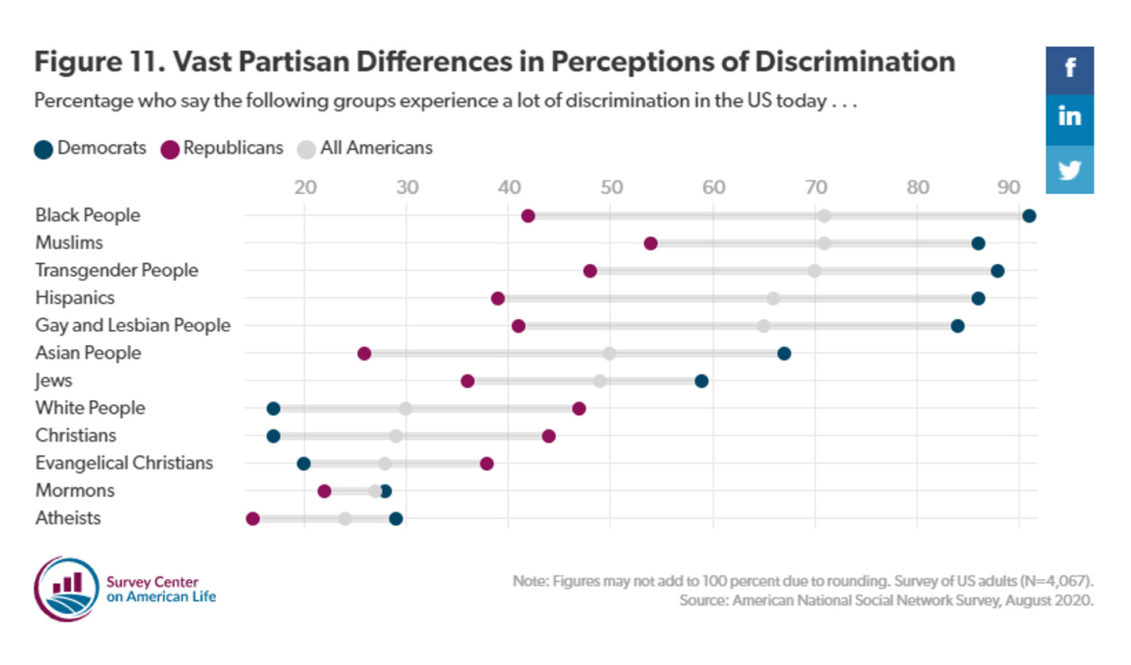
In fact, there is actually significant overlap between Democrats and Republicans as to who they perceive as the most persecuted groups.
Unfortunately, underlying this partisan consensus lies a stark reality: Muslims do face significant discrimination within the United States.