Our Interfaith Arkansas Pilgrimage: Settler Colonialism and Strange Fruit
November 23, 2020
“Southern trees bear a strange fruit,
Blood on the leaves and blood at the root,
Black body swinging in the Southern breeze,
Strange fruit hanging from the poplar trees.”1
Last summer, brimming with the steady optimism of the old world, my friend Lisa Doi and I took a trip to Arkansas. With an Interfaith Innovation Fellowship fund received from the Interfaith Youth Core, we recruited another adult chaperone and ten Japanese American and Palestinian American high school students. All claimed Buddhist, Christian, and Muslim identities called the Chicago area home and had parents who gave them permission to attend a weeklong trip billed as a “bridge-building pilgrimage” hosted by the Arab American Action Network and the Japanese American Citizens League.
Time congealed as we made the long drive South. I lost track of the number of megachurches, prisons, police stations and diners we passed along the way, buildings clinging more closely to the ground as we went. Flags boasting of lost causes began to proliferate. Youth ducked into rural gas stations with religious garb, prayer mats tucked under their arms, and we adults eyed one another nervously, ready to depart at any sign of trouble.
Our ultimate destination was the remains of Jerome and Rohwer concentration camps — former sites of imprisonment for thousands of Japanese Americans during World War Two. In the manner of all good road trips, heads nodded off in rest, fingers pinched fast food, earbuds kept the music pumping. Students swapped political views, ambitions for after high school, summer plans, favorite foods. More ancient stories emerged as well. Participants recounted their family’s experiences of displacement by the United States during world war two, or in the Nakba, the bloody tale of Israel’s founding.
On the drive from Little Rock to Rohwer, we gaped as a massive prison rose out of the ground beside the highway. I pulled the van to a stop and woke the students, rendered speechless by the spectacle unfolding just to our left. There, a disturbing, impenitent tableau: white overseers on horseback, carrying rifles, looking over Black men, chained together in a field of green vegetables.
“Pastoral scene of the gallant South,
The bulging eyes and the twisted mouth,
The scent of magnolia sweet and fresh,
And the sudden smell of burning flesh!”
The massive complex, we would later learn, was the Cummings Unit. Prisoners from this concentration camp infamously labor not only in the fields but also as house staff for the governor’s mansion in Little Rock. In her memoirs, Hillary Clinton defends this practice as “a longstanding tradition, which kept down costs.” She recalls these men as “emotional illiterates,” arguing that a firm hand was needed to keep them in line: “we enforced rules strictly and sent back to prison any inmate who broke a rule.”
Looking at those men on horseback who sat like white marble, plucked from another age, I remembered how the Black liberation theologian James Cone used to describe his birthplace: “Arkansas was a lynching state.” Lynching is among the most indelible forms of racialized violence carried out against Black Americans and other people of color in as a method of social control. Incarceration, the slow-motion strangling of the body and the spirit, may be seen as the infliction of the same kind of public cruelty, humiliation, and suffering unto death represented by the rope.
“Here is a fruit for the crows to pluck,
For the rain to gather, for the wind to suck,
For the sun to rot, for a tree to drop,
Here is a strange and bitter crop.”
The young people on this trip began to engage us in discussions about who, exactly, this system is set up to benefit. We could not have anticipated COVID-19, nor the Cummings Unit’s callous indifference to its population – described by investigative journalists as “punishment by the pandemic.” Yet activists for decades have warned about the ways that our methods of carceral control – reservations, prisons and jails, nursing homes – are particularly vulnerable to all manner of crises. What would it mean, we asked, to dispense with the prison as the primary means of control in our society?
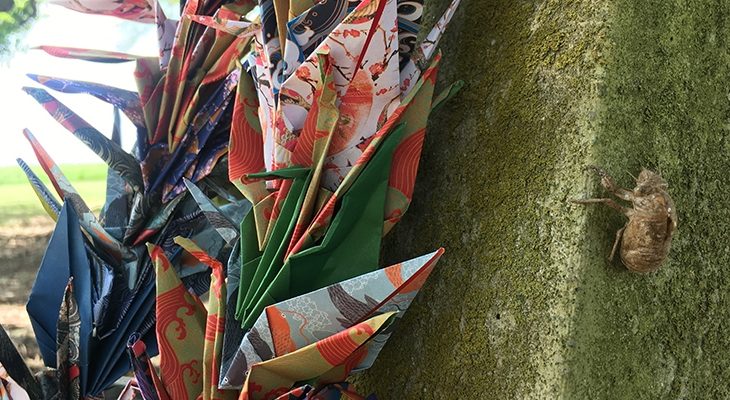
When we finally arrived at Rohwer, all that was left of the camp was a quiet cemetery, which persisted among fields of blooming edamame. My friend Lisa Doi observed that these were, indeed, strange fruit: a peculiar Japanese crop, here growing on land that has witnessed the displacement, disenfranchisement, dislocation of so many peoples. This scene, and the sights we saw along the way, challenged us to place our histories as immigrant-descended people of color into conversation with legacies of anti-Black racism and the assaults on this continent’s first nations peoples.
Undertaking this trip in the Trump era challenged me to think about our own narratives in a way that resisted the easy, decorative multiculturalism so ascendant during the Obama years. The moniker “interfaith pilgrimage” itself risks summoning this anemic image when we do not acknowledge the stolen land on which we sojourn and seek to create meaning.
The artist Banksy tells a story about painting the separation and land annexation wall that snakes through Bethlehem, slicing neighbor from neighbor. “You paint the wall, you make it look beautiful,” an old man says to him during a mural-making session. “Thanks,” the vandal replies. The elder shakes his head, no: “We don’t want it to be beautiful. We hate this wall. Go home.”
I left Rohwer feeling all of this inherent tension – each of the brittle contradictions that the writer of “Strange Fruit” must have felt about the bodies littering the Southern landscape – blossoming growth alongside a chilled culling, unspeakable brutality heralded by a terrible natural beauty, lives twisted into bleak poems of eternal silence.
1All lyrics from artist Billie Holiday’s song “Strange Fruit”
Kenji Kuramitsu is a clinical social worker, writer, and spiritual care professional who currently serves as psychotherapy groups coordinator at an LGBTQ health care provider in Chicago, and a 2020 Interfaith America Racial Equity Fellow.