Natural By Nature, Pagans Expect Some Digital Rituals To Survive The Pandemic
March 17, 2021
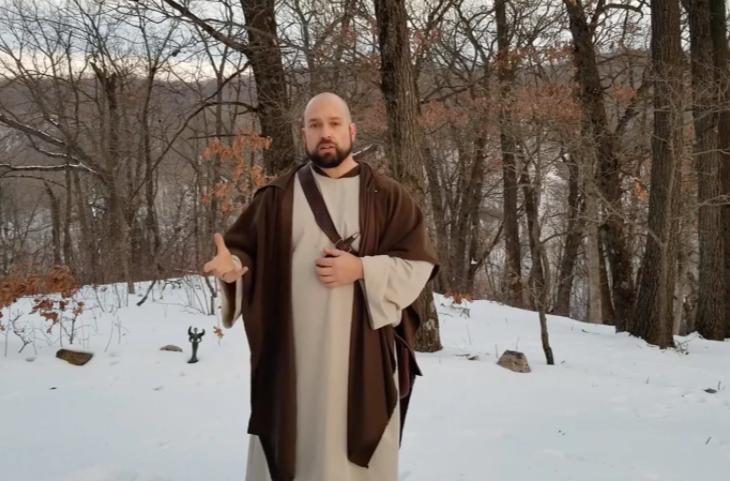
(RNS) — Standing on a snowy, wooded ridge in Wisconsin in early February, the Rev. Bo Nelson of Circle Sanctuary began a group online meditation by instructing his viewers to close their eyes, slow their breathing and listen to the poetry of the wind. He led them in a visualization of a large tree symbolizing deep community connectivity.
The virtual gathering, honoring Imbolc, one of the eight major sabbats common to modern pagan religions, is similar to many events that pagans and nearly every other spiritual community have turned to in order to keep connections alive during the pandemic.
But with the end of the pandemic on the horizon, organizations such as Circle Sanctuary are assessing the digital experience to determine whether their newfound reliance on technology has offered unforeseen benefits.
Creating effective, deeply natural rituals for use over a digital format has required thought and energy, the Rev. Tiffany Andes, another chaplain with Circle Sanctuary, said. “As a ritualist, it has been enormously challenging to find a way to translate the in-person embodiment of ritual to online in ways that are meaningful to people and help them feel connected.”
Despite the extra work, these digital rituals have proved too useful not to continue, especially for teaching remote members, such as the many active-duty military living outside the U.S. “We have too many students spread out over various geographic locations to not do that,” said Andes.
Prior to the pandemic, many pagan organizations were already using digital media to enhance their programs, from distance learning to social forums. In 2017, the Pagan Federation in the U.K. began streaming group rituals for members unable to attend live events due to mobility limitations or illness.
Virtual gatherings have their own virtues, as well. “Having used online resources for the past year has allowed us to think of community in new ways,” said Andes.
As a small religious population, pagans often do not have the benefits of a local, physical religious community. Social media and streaming platforms can and have been giving them a critical mass.
Pre-pandemic rituals at Mother Grove Goddess Temple in Asheville, North Carolina, were limited to 15 guests due to space limitations. Since the pandemic, the group has attracted an average of 50-65 attendees for its online rituals, with as many as 150 on some days.
H. Byron Ballard, a senior priestess with the temple, said, “I get gracious comments about how connected they feel to each other, even saying they can feel the presence of the other people in the circle.”
According to Ballard, “There are so many people who don’t have home communities nearby and are curious and hungry for ritual, instruction, and companionship. If I can help supply those things, it’s more than worth it to keep these on my schedule, even after we can meet in person in our temple or in a park.”
Not everyone feels gathering digitally has been a boon.
“Zoom events are better than nothing, but I think it’s clear that we’re all looking forward to returning to somewhat more typical events,” said David Dashifen Kees, an initiated priestix with the Firefly House in Washington, D.C., a technology professional as well as a student at the Iliff School of Theology.
“I’ve noticed that some of our more active members from the pre-pandemic era have distanced themselves from House activities, and some visitors are only present once or twice and then we don’t hear from them again,” Kees said.
It is unclear whether this variability has been caused by the instability in people’s lives or a sense that online rituals are spiritually ineffective.
But, Kees admits that Firefly House has been attracting a larger than a normal number of attendees and thinks “it will prove an interesting challenge to see how to best include some of these new friends as things return to a more familiar format.”
After the pandemic, Firefly House leaders hope to use a hybrid model, capitalizing on what they have learned over the past year and hosting some holidays live and others online.
“I hope to (also) consider how we might be able to include distant friends in face-to-face rituals by hybridizing them, as well. We’ve gained some skills in recording and editing that may prove useful in ways we have not yet imagined,” Kees added.
(Heather Greene is a freelance writer and editor and is the author of the book “ Lights, Camera, Witchcraft: A Critical History of Witches in American Film and Television,” to be released in October 2021. The views expressed in this commentary do not necessarily reflect those of Religion News Service.)
Share
Related Articles
Higher Education
American Civic Life
The Pandemic Changed Death Rituals and Left Many Longing for Closure
American Civic Life
Imbolc’s Celebration of Hearth and Home Resonates with Pagans in a Pandemic Year