Latino Communities Across the US Celebrate the Tradition of the Posadas
December 24, 2022
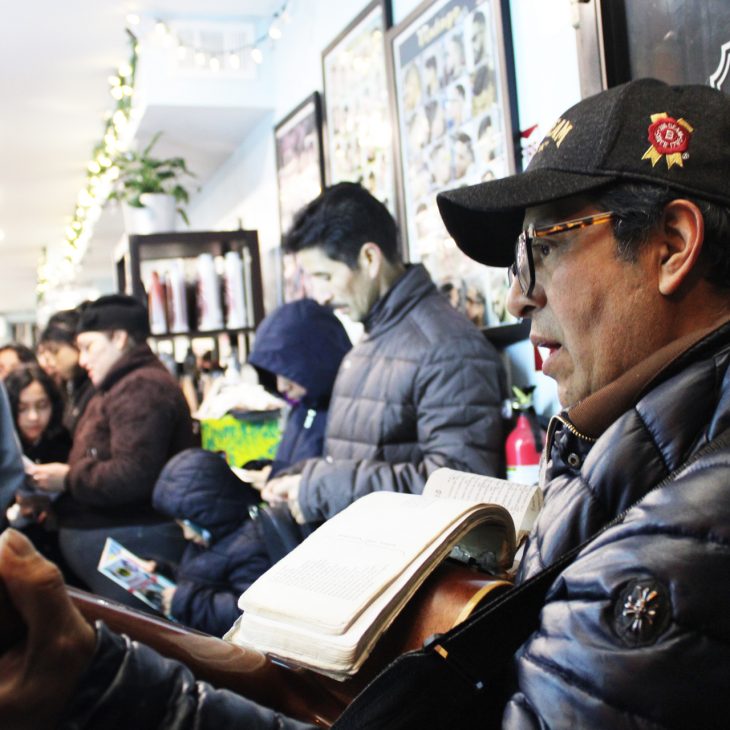
PHILADELPHIA (RNS) — On a recent night, a group of people bundled against the frigid December air sang in Spanish outside the glowing windows of a hair salon in South Philadelphia.
In song they asked for “posada,” which means lodging, and refuge. Inside the warm salon, another group of about 50 people sang the part of the innkeepers of Bethlehem, telling the peregrinos, the pilgrims knocking at the door, that there was no room for them. After several verses, the pilgrims were welcomed into the house with music, as steaming cups of ponche, a cinnamon-flavored drink filled with pieces of fruit, were pressed into their hands.
The scene was a reenactment of the Bible story of Mary and Joseph traveling through Bethlehem, looking for a safe place to stay. The Gospel of Luke tells the story of how, after being turned away at the inn, they found refuge in a barn, where the baby Jesus was born.
It’s a story that has been celebrated with the tradition of las posadas, practiced by Catholics in Mexico and Guatemala. For the nine nights before Christmas, people gather at different houses to pray, sing and reenact this journey that is at the heart of the Christmas story.
It also is a narrative that has found resonance for the immigrant communities who celebrate the tradition in a new country.
On another December night, more than 40 people gathered at a row house in Norristown, Pennsylvania, about 40 minutes outside Philadelphia. The celebrations were similar to the other group’s posadas, held just 20 miles away, full of prayers, singing and celebrating with a shared meal — but here the language being spoken was Q’eqchi, a Mayan language of northern Guatemala. As celebrants sang, Christmas lights blinked over a Nativity scene and incense filled the air.
The evening ended with more cups of ponche being passed around, along with tamales, the corn cake dish traditionally eaten on Christmas Eve or at posada gatherings throughout Guatemala.
Bernardino Caal, who hosted the posada that night, said the tradition of las posadas has been important to him since his childhood in Cobán, Guatemala. The posadas were a time when his family, who had few resources, stepped back from harsh daily routines to celebrate. Posadas, he said, also parallel his and other immigrants’ journeys to the U.S. with that of Mary and Joseph’s journey to Bethlehem. “They represent us as immigrants,” he said.
Caal said Q’eqchi celebrants feel an added kinship with the story of San José and Santa María walking from door to door in search of room and refuge. “They also walked until (they found a place) where they were able to live,” Caal said.
The Rev. José Quintana, from San José Obrero parish in Wyoming, Michigan, said this connection between immigration and the journey to Bethlehem has made the posadas tradition popular among Catholic Latinos beyond those from Mexico and Guatemala.
In his current parish, and in previous assignments in Michigan, people from Cuban, Dominican and Puerto Rican backgrounds join in the posada celebrations. “Really all of these communities in the U.S., we’ve arrived to ask for posada,” he said. “We’ve asked in different ways. A place to live, a place to be safe, a house, a job,” he noted.
The story of Joseph and Mary’s journey to Bethlehem is representative of the “human reality,” Quintana said. “Humanity has always migrated, from country to country, from continent to continent, from town to town, from job to job, always looking for a better life.”
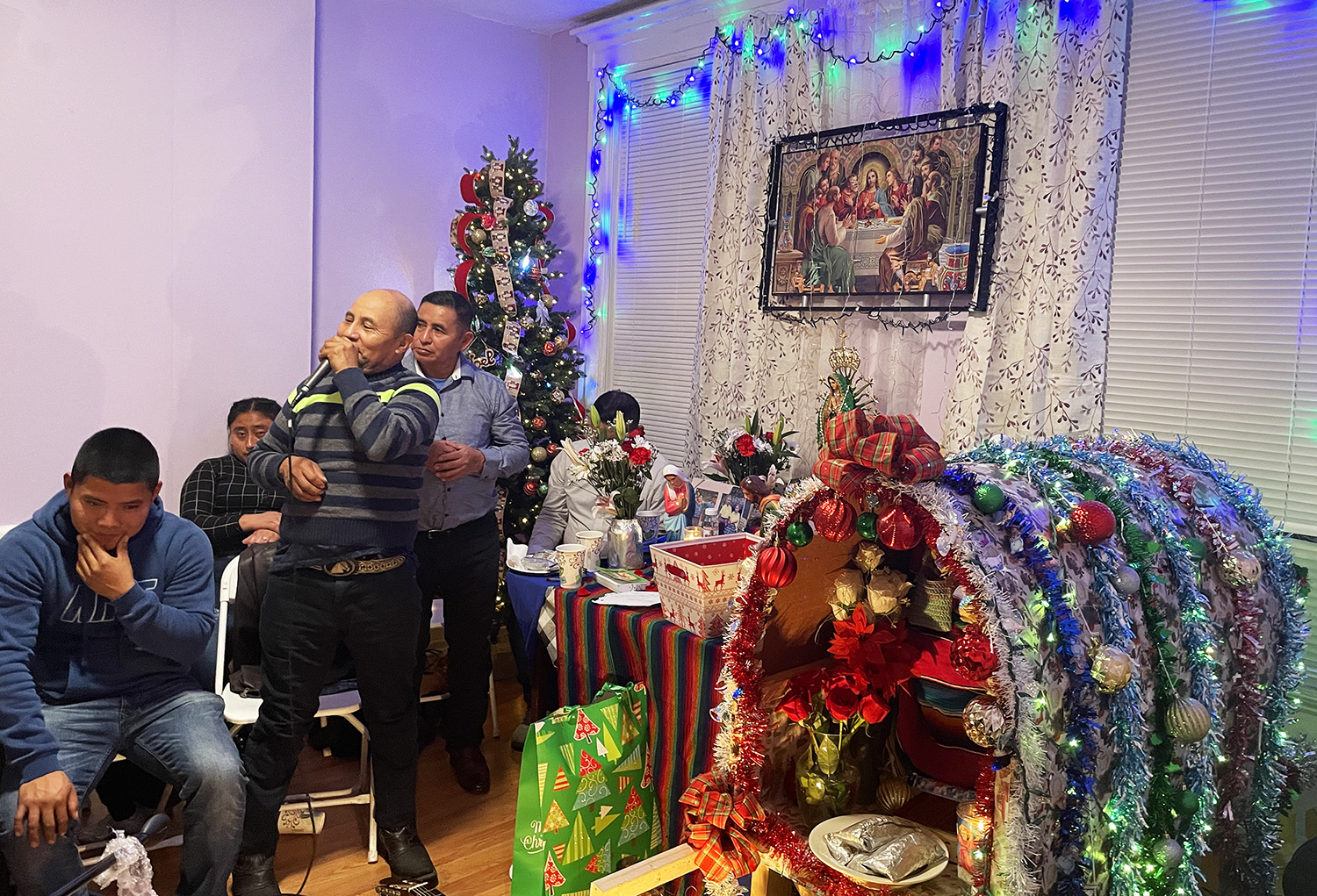
Members of the Catholic Q’eqchi community gather at a home in Norristown, Pennsylvania, on Dec. 18, 2022, to celebrate the tradition of las posadas. RNS photo by Emily Neil
Celebrating the posadas in the U.S. is also a way for Mexican and Guatemalan immigrants to connect their children, some of whom were born and are growing up in the U.S., with their cultural traditions.
Leticia de la Cruz González, the owner of Kala’s Hair Salon who hosted the posada in South Philadelphia, said her children, now 10 and 13, have always accompanied her to posadas held by her church, Annunciation of the Blessed Virgin Mary, where she has attended Mass since moving to the city from Mexico 16 years ago.
“Está padre” — “it’s cool” — said Patricia González, from Mexico City, as she watched her daughters at the gathering at Kala’s, recalling her own memories of going out to posadas as a young girl. “It’s part of the beauty of our culture, the unity,” she said.
By her side sat Connie Cirka, from Bogotá, Colombia, who was attending her first posada that night thanks to the invitation from De la Cruz, who has been Cirka’s hairdresser, and friend, for more than a decade.
The pre-Christmas tradition in Colombia, called the novena, is slightly different, she said, but similar enough to the posadas that they recall “one of the best memories I have from my childhood,” she said. “The family atmosphere. The unity. It was a time we all waited for.”
Reyna Casarez, a community leader in South Philadelphia, said the posadas are an important way for her to share how Christmas is celebrated in Mexico with her daughter, who was born in the U.S.
“The importance of the posadas is that it connects me to the most important moments of family gathering and spiritual communion,” she said.
Casarez recalled her first Christmas in Philadelphia, in 2007, as cold and sad. Many immigrants, she said, become isolated with work and the struggles of daily life, and miss family members they have left behind. It’s difficult enough to find time to gather with their own household. Posadas are an antidote to this isolation, allowing the Mexican community to cultivate community.
“It’s a way to connect us with our family in Mexico,” she said.
A sense of community is even more rare, Marcos Caal said, for Mayan Indigenous immigrants who arrive in the U.S. and speak neither English nor Spanish.
Caal, who lives in North Philadelphia, said this is the second year he has helped organize the posadas in Q’eqchi around the city and its suburbs. Since moving to North Philadelphia in 2018, Caal has sought out members of the Q’eqchi community to plan gatherings for as many as 60 people at a time. He also has asked his family members in Guatemala to send the hymn books in Q’eqchi from their parishes to pass around at the posadas and at other gatherings.
When they first discovered the local Q’eqchi community, Bernardino Caal said, he and his family “felt very happy, because once again we listened to the Word of God and shared the Word of God in our language, Q’eqchi.”
“And we felt everything that is our tradition, our culture, amongst ourselves.”
This article was produced as part of the RNS/IA Religious Journalism Fellowship Program.