For President Joe Biden, an Inauguration Filled With Faith
January 21, 2021
WASHINGTON (RNS) — President Joe Biden began Inauguration Day the same way he did Election Day and most Sundays in between: He went to church.
But this time, he took America with him.
It was shortly before 9 a.m. when Biden and Vice President Kamala Harris filed into the pews of the Cathedral of St. Matthew the Apostle, also known as St. Matthew’s.
“As you have done so often in your public and private life and during the campaign, Joe and Jill, you ground this day in your faith and in the familiar readings and prayers of these sacred rituals,” the Rev. Kevin O’Brien, a Jesuit priest and president of Santa Clara University said during his homily.
“My deepest prayer for you today, as a priest, citizen, and friend, is that you always remember that the Lord is near and no matter the sound and fury around you, that God wants to give you peace, a deep-seated peace that will sustain you.”
The group sat and listened to performances from violinist Patricia Treacy and the gospel choir of St. Augustine, a historic Black Catholic church in Washington. Also among the musical numbers: Renée Fleming singing “On Eagle’s Wings,” the same hymn Biden mentioned in his campaign victory speech.
It was an appropriately spiritual beginning to a faith-infused day and what is shaping up to be an unapologetically religious presidential term for Biden, the second Catholic president in U.S. history. And unlike his predecessor Donald Trump, who spoke often of Christianity being under fire, Biden spent Wednesday invoking faith as a tool for healing and unity.
Indeed, unity was literally the theme of the day, with Biden baking it into virtually every aspect of his inauguration, including the church visit: At the president’s invitation, lawmakers from both parties — Sens. Mitch McConnell and Chuck Schumer as well as members of Congress such as Nancy Pelosi, Kevin McCarthy, Roy Blunt, and Steny Hoyer — sat in the pews with him.
Unity came up again hours later at the U.S. Capitol, when the Rev. Leo O’Donovan, a Jesuit priest and former president of Georgetown University, delivered the invocation for Biden’s formal inauguration ceremony.
“We come (to God) still more with hope and with our eyes raised anew to the vision of a more perfect union in our land,” O’Donovan said. “A union of all our citizens to promote the general welfare and secure the blessings of liberty to ourselves and our posterity. We have people of many races, creeds, national backgrounds, cultures, and styles.”
After referencing Solomon and the Book of James, he cited Pope Francis’ recent encyclical, “Fratelli Tutti,” in which he wrote about the need to dream together: “By ourselves we risk seeing mirages. Things that are not there. Dreams, on the other hand, are built together.”
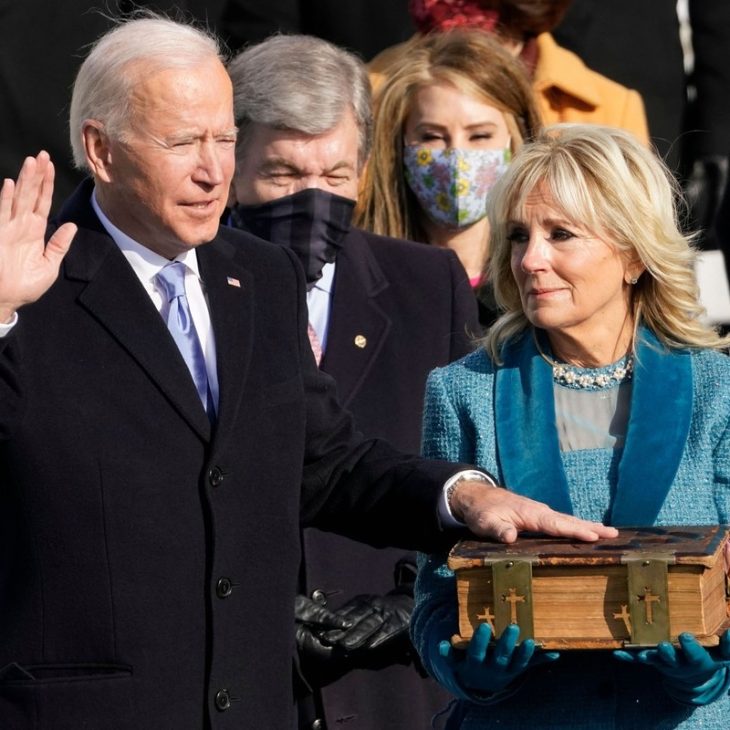
After Biden placed his hand on his family’s 127-year-old Bible a few minutes later and took the oath of office, it was the newly minted president’s turn to speak — or, perhaps more accurately, preach: He launched into a speech that was characteristically filled with religious references and appeals to the divine.
Biden said his “whole soul” is invested in the project of “bringing America together, uniting our nation.” He insisted “history, faith and reason” will show “the way of unity.” He invoked St. Augustine, who said “a people are a multitude defined by a common object of their love.”
“What are the common objects we as Americans love, that define us as Americans?” Biden asked. “I think we know: opportunity, security, liberty, dignity, respect, honor, and, yes, the truth.”
Biden encouraged the American people to overcome future challenges, speaking of “better angels” and insisting his fellow citizens will be “sustained by faith, driven by conviction, devoted to one another and the country we love with all our hearts.”
Finally, he deferred to Scripture as he acknowledged America’s collective mourning over the more than 400,000 deaths caused by the novel coronavirus.
“As the Bible says: ‘Weeping may endure for the night, but joy cometh in the morning.’ We will get through this together!” Biden declared.
But Biden, who has long referenced faith as a guide through his own grieving process, also led the country in a moment of silent prayer to remember “400,000 fellow Americans: moms, dads, husbands, wives, sons, daughters, friends, neighbors and co-workers.”
Despite the country grappling with what he called a “time of testing,” Biden remained defiant that Americans can prevail, asking those listening to “add our own work and prayers to the unfolding stories of our great nation.”
Country singer Garth Brooks offered a performance of the hymn “Amazing Grace,” asking those in attendance and at home to sing along.
The God-talk continued after he finished. Amanda Gorman, the United States’ first youth poet laureate, delivered a poem in which she referenced Micah 4:4 — “everyone will sit under their own vine and fig tree, and no one will make them afraid.”
She was followed by the Rev. Silvester S. Beaman, pastor of the Bethel African Methodist Episcopal Church in Wilmington, Delaware, who offered a soaring benediction in which he called on America to “befriend the lonely, the least and the left out” and “love the unlovable.”
“This is our benediction,” he said. “That from these hallowed grounds, where slave labor built this shrine and citadel to liberty of democracy; let us all acknowledge from the Indigenous native American; to those who recently received their citizenship; from the African American to those whose foreparents came from Europe, and every corner of the globe; from the wealthy to those struggling to make it; for every human being, regardless of their choices, that this is our country, (and) as such teach us, oh God, … to live in it, love in it, be healed in it and reconciled to one another in it.”
And just in case anyone thought Biden’s public Catholicism was a one-off, the president closed out his day with a subtle signal there is more to come. As he sat down in the Oval Office and spoke with reporters for the first time, eagle-eyed journalists noted an array of photographs behind him.
Most are of his family, but at least one depicts him shaking hands with someone else: Pope Francis.
Share
Related Articles
American Civic Life
American Civic Life
American Civic Life