Five College Campuses That Managed to Bridge Differences
February 4, 2022
IFYC is pleased to be partnering with Greater Good Science Center. This article was originally posted on Greater Good Magazine and reproduced here with their permission.
Most colleges and universities provide an opportunity to meet people who have different faiths, politics, identities, and life experiences. If the campus culture fosters belonging, this diversity exposes students to new ways of thinking. It expands students’ outlook about the world around them, and even changes the way they see themselves. That is what the college experience should be all about!
But this diversity can also present enormous challenges, especially in today’s climate of worsening division and polarization—whether it’s about mask protocols or vaccinations for COVID-19, or demands for the campus to do more on racial justice. Global issues like the Israel-Palestine conflict can find their way onto an American campus and lead to interpersonal conflict across individuals and groups. Sometimes that conflict isn’t productive, and becomes harmful or violent—arguments turn into lawsuits, property damage, or worse.
A 2017 survey of more than 3,000 college students, conducted by Gallup and the John S. and James L. Knight Foundation, found that 61% of students believe that “the climate on their campus prevents some students from expressing their views.” It’s not just students who are experiencing these ruptures on campuses across the country—so are faculty, staff, and administrators.
This is why the Greater Good Science Center created the Bridging Differences course with a special emphasis on higher education. The goal of the course is to teach research-based strategies for better relationships, dialogue, and understanding across divides—and though we created it with campuses in mind, the course is relevant to anyone navigating conflicts and differences.
We’ve heard from campus leaders across the country that a course like this is timely, beneficial, and necessary. Out of these conversations, we surfaced five times when campus leaders succeeded in building bridges between antagonistic groups. We hope they’ll provide you with some inspiration for building bridges, wherever you live and work.
1. Navigating controversial topics at an Oregon community college
Share
Related Articles
Higher Education
American Civic Life
Higher Education
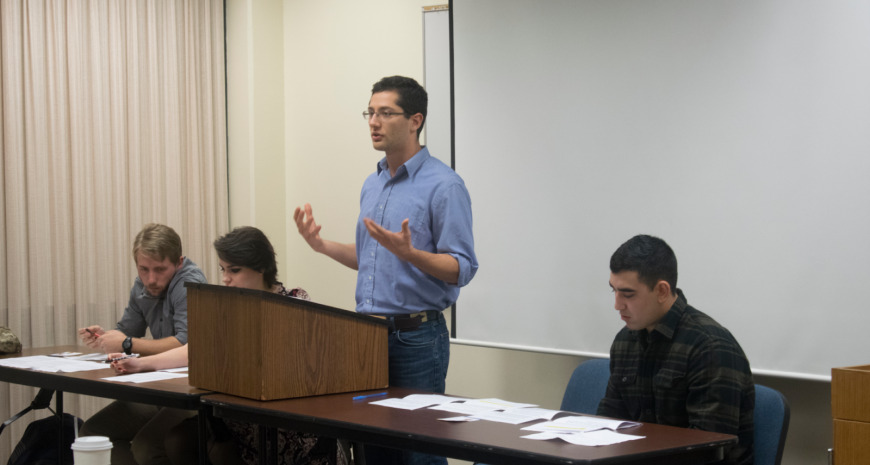
Four students debate the art piece at Linn Benton Community College. © Josh Stickrod for The Commuter, a weekly student-run newspaper in Albany, Oregon
A few semesters ago, Linn Benton Community College in Oregon put up a public sculpture by a local artist that depicted two naked men holding each other. It sparked a controversy on campus—the local newspaper wrote about it, the Board of Education and parents got involved, and students were split into two factions.
“Some people thought it was very bold and in support of the LGBTQ community,” said Mark Urista, who teaches public speaking and argumentation. “Others thought it was inappropriate and a threat to their morals and values.”
When a big donor threatened to stop contributing to the school, “it turned into a full-on crisis,” Urista said.
Like most community colleges, Linn Benton has a very diverse student body, and it sits between two politically divergent counties: Linn County, which has voted for a Republican U.S. president since the 1970s; and Benton County, which has voted for a Democratic U.S. president since the 1980s.
“I thought it would be such a great topic for my argumentation class, but tensions were so high that I wasn’t sure if I should bring it up,” Urista said. “After one of my classes, two students came into my office and said, ‘We think the artwork is inappropriate and we want to debate it in class.’”
For Urista’s class, students must be prepared to argue both positions. Then, on the day of the debate, students flip a coin to decide whether they are for or against the topic—in this case whether the art piece should be kept up or removed, and why.
Before the debate, the two students created arguments that supported their own beliefs about why the art piece should be taken down. But they also pushed themselves to consider why it should stay up—even though this was in opposition to their views.
On the day of the debate, the two students flipped a coin and had a spirited debate. By the end, the whole class got out of their seats and applauded—it was one of the only times in Urista’s career that he’d ever seen a response like that to a debate.
“Afterward, the students told me, ‘You know Mark, we aren’t fans of the art work but we do have an issue with censorship,’” he said. “‘If we took it down, it could open the door for other things to be censored, too.’”
The debate made such an impact that Urista and the two students decided to do another one with a larger audience. They recruited two additional students and hosted a well-attended campus-wide debate.
In the end, the students of Linn Benton were able to have a productive dialogue by embracing bridging practices such as perspective taking and giving, and by providing an avenue for students to argue both sides. The conversation led to a new policy for racy art work that warned students they would see something that might feel inappropriate to their culture or beliefs. They formed a Debate Club to tackle similar issues on campus, and administrators at Linn Benton Community College—all the way up to the president—made public statements about the need for understanding and relationships across differences.
“This is exactly the kind of thing that should be happening on a college campus,” Urista said.
2. Bridging campus and community at Bethel University
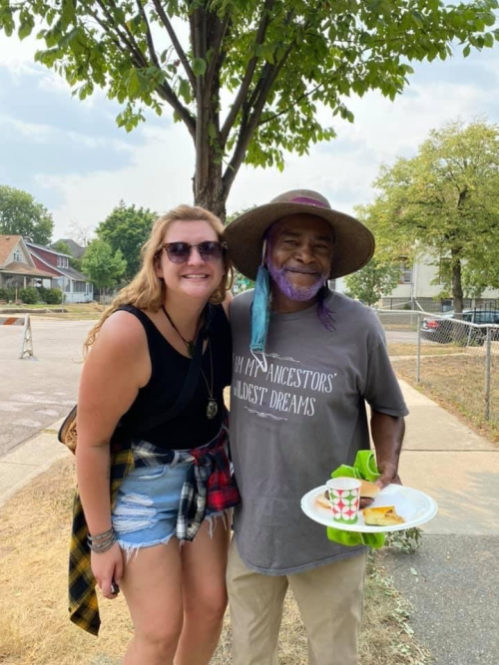
Carrie Olinger (Bethel student) and Melvin Giles (co-facilitator of the Urban Farm and Garden Alliance) © Tenden Brekke
Tanden Brekke works as the assistant director for community engagement at Bethel University, a private, evangelical Christian university. For more than 20 years, the university has run programs with Frogtown, a neighborhood in St. Paul just a few miles south of the campus.
While Bethel is predominantly a white and Christian institution, the Frogtown neighborhood is composed of people with a diversity of identities, including faith, race, and economics. Frogtown has also been negatively impacted by policies that have further marginalized people, especially communities of color and the poor. At the same time, Brekke said, Frogtown has emerged as a leader in addressing social injustices.
“Initially, there was some white saviorism at play with this engagement,” Brekke said. “It was this idea that ‘we need to contribute to the community because they need our help.’”
One of Brekke’s predecessors acknowledged the importance of combating that one-directional saviorship in favor of listening and coming from a place of humility. Through this process, they established a more mutual relationship, which transformed the community engagement program from “what can we do for them?” to “what can we do for each other?”
Through the Urban Farm and Garden Alliance, students work full-time in the Frogtown community during the summer to learn about urban agriculture, food justice, and environmental racism. This exposes many of them to communities they’ve never interacted with, and it expands their views. Sometimes, there is a conflict between students and community members.
For one student who felt challenged by Black elders, said Brekke, “it was empowering for that student to realize what it means to be white, to follow the leadership of people of color, and to claim their own voice in this process.”
It’s clear that students are taking away a lot from these community engagement projects, but Brekke said the trickier part is ensuring Bethel is also having a positive impact on the Frogtown community.
“We spend a lot of time trying to listen and being honest about what we can and can’t contribute,” Brekke said. “Bridging is also internal work because we have to be willing to ask ourselves what it means to be Christian, and be willing to be changed by others . . . which can feel exciting, challenging, and fearful.”
3. Mindfulness and emotional regulation skills for students in Pennsylvania
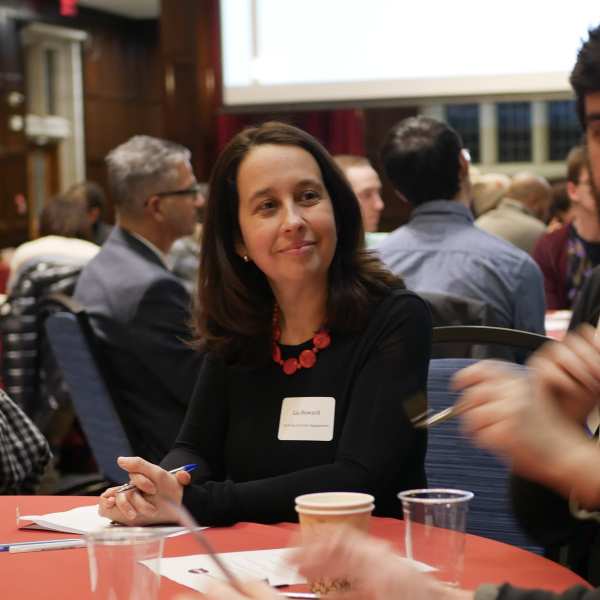
Lia Howard © Photo by Don Henry
Before teaching at the University of Pennsylvania, Lia Howard taught a big introductory class on American politics at Saint Joseph’s University. It felt like a “normal” academic course for Lia until everything shifted during the 2016 presidential election season. Topics that hadn’t felt emotional before now created a visceral tension in the classroom.
“I’d write a quote from James Madison [and the classroom] would erupt into anger,” she said. “There was so much emotion in the room and it was qualitatively different to teach political science after the 2016 elections.”
That semester changed everything for her. She realized that the civic fabric for the country needed repair, so she transitioned from being a full-time faculty member to a nonprofit that works on constructive dialogue efforts.
Now at the University of Pennsylvania with the Stavros Niarchos Foundation Paideia Program, she’s teaching a class on political empathy and deliberative democracy. In the class, she’s pairing students and creating a space for them to have a dialogue about their diverse experiences of living in this country.
In one assignment, students go on a walking tour in Philadelphia with a peer and immerse themselves in the city. They have conversations about what they’re seeing and hearing, and what it’s bringing up for them.
In another assignment based on the book “Our Patchwork Nation“, students explore the country’s complex cultural and political landscape by “taking on” the views of people who are different from them. For instance, a student might deeply absorb the mindsets and behaviors of a community that is connected to the military, or those working in agriculture on rural lands.
Howard infuses mindfulness and wellness into the curriculum, and she’s trying to norm the conversations to ensure they’re productive. As she learned during the 2016 elections, teaching a course on politics is full of emotions—and students must develop individual techniques like self-distancing so they can self-regulate when activated by heated topics, and learn to communicate across differences with compassion. These are 21st century skills that students can take into their work and life.
“With the class, the purpose is to get students to see they’re connected deeply to other people,” she said. “They can’t just ‘turn off’ because they don’t agree, they have to try to listen, care, and be connected to each other.”
4. Negotiating power imbalances during a pandemic
Since early 2020, the COVID-19 pandemic has reshaped the social and political landscape of college campuses. Universities shifted classes online, debated mask and testing and vaccine policies, and aligned with or defied local and national regulations. Even at the administration, faculty, and staff levels, there was heated debate about what universities should do in response to the pandemic.
Jacqueline Young, a project manager at Howard University, said it has been a tense and difficult time for her campus and many others across the country.
“Some faculty had more power to push back and say, ‘I’m not coming back to teach and I’m going to go online,’” Young said. “While I felt like some staff members didn’t have as much of a voice that we could or should have.”
While everyone was hearing about COVID-19 protocols through initiatives like town halls, Young said, many sessions were done in silos—one call for staff, and another for faculty.
Like most campuses, even before COVID, there’s sometimes this unspoken and unconscious hierarchy that exists between faculty and staff. Even if you come together for a social event like a holiday party, the work that faculty, staff, and administrators do is not always integrated well.
“Being in academia and not being the Ph.D. person can make you feel like an outsider,” Young said.
Still, Young found ways to bridge on Howard’s campus between staff and faculty. She pitched an idea called “What’s Really Happening in the Virtual Classroom?” During the staff-organized session, faculty from across the university spoke about the challenges they were encountering while teaching in the virtual classroom, with the goal of learning from one another, building compassion and sympathy, and swapping best practices.
The program was successful at raising attention to needs across the university, from counseling to new technology. Something that came up from faculty that Young mentioned in particular: the need for more staff.
“It sparked a more public conversation about how the coronavirus was impacting teachers, students, and especially the staff who support them,” she said.
Young wants to see more bridging opportunities that bring together staff and faculty at universities.
“COVID exposed a lot to all of us about how we communicate,” she said. “Bridging should become a norm on campuses everywhere so people come together across their differences, which includes the occupation they hold.”
5. Deepening diversity, equity, and inclusion efforts in California
“I met yesterday with a group of college leaders who I greatly respect to discuss last week’s senseless killing of George Floyd by police officers in Minnesota,” wrote the president of California’s Sierra College in June 2020. He continued:
The intent of the meeting was to determine what we could do, what steps we could take, to address the pain many of our students, staff, and faculty are experiencing. Pain caused by injustice in not only the case of George Floyd but other recent tragic deaths, including Ahmaud Arbery and Breonna Taylor, among far too many others, that has created continual and compounded trauma for so many.
The intent of the meeting was to determine what we could do, what steps we could take, to address the pain many of our students, staff, and faculty are experiencing. Pain caused by injustice in not only the case of George Floyd but other recent tragic deaths, including Ahmaud Arbery and Breonna Taylor, among far too many others, that has created continual and compounded trauma for so many.
Later, the college released data demonstrating that Black and Brown students are disproportionately being called in for conduct by campus security. The college was effectively naming their participation in racist systems, and encouraging everyone across the campus to exercise their power to respond and enact change.
Megan D’Errico, an associate dean for Sierra College, has been involved with figuring out what kind of action to take—and she’s found that it starts with utilizing bridging skills like challenging our views and active listening.
As a result of that effort, the college launched campus-wide initiatives, such as shifting its hiring practices and devoting more resources to Black student success. They’re sitting down with Black students to hear their stories, and finding ways to amplify their voices. They are also synthesizing the data.
During a planning session to take an initial look at the stories and data they were gathering, D’Errico led an exercise she learned from the Bridging Differences course to challenge the views of faculty, staff, and administrators.
The exercise helped participants focus on individuality rather than group identity and supported them with challenging their unconscious biases. They became more curious and open before jumping into the work, and D’Errico said it was also a great way to get to know each other as colleagues in a deeper way.
When reviewing data for diversity, equity, and inclusion (DEI) efforts, the bridging practice of challenging our views and assumptions is critical. This prevents the solutions from being too generalized, or based on stereotypes or stigma about a certain student population group.
The outcome of the planning sessions was a week of campus programming focused solely on Black student success. Throughout this effort, everyone is being asked: What can you do based on the role or position you have on campus? Whether they’re a part of student services to the faculty, or if they’re students themselves, everyone has a role to play to advance the mission of Black student success, D’Errico said.
These are just five stories of bridging happening in higher ed across the country. For this academic year starting last fall, the Greater Good Science Center has been bringing together more than 50 other leaders like the five mentioned in this story—from other diverse campuses including faith-based institutions, Historically Black Colleges and Universities, and private and state universities to community colleges. These stories demonstrate what so many are feeling on campuses everywhere—a complex and sometimes tense culture where bridging is a required act from all, including faculty, administrators, staff, and students.
What’s happening in higher education is a microcosm for society. If we can figure out ways to bridge effectively in these formative spaces, we might discover tools and insights into how heterogeneous groups around the world can work, live, play, and pray together.