Faithful Mormons Won’t be Happy with Hulu’s ‘Under the Banner of Heaven’
April 26, 2022
(RNS) — “Under the Banner of Heaven,” a new Hulu miniseries with an all-star cast that debuts Thursday (April 28), may not make many members of the Church of Jesus Christ of Latter-day Saints happy. But then again, neither did Jon Krakauer’s 2003 bestseller on which the seven-episode show is based.
The miniseries closely tracks Krakauer’s account of the gruesome 1984 murders of 24-year-old Brenda Lafferty, played by Daisy Edgar-Jones of “Normal People,” and her 15-month-old daughter near Salt Lake City, Utah. Like the book, it explores the underworld of Mormon fundamentalism and polygamy, following the descent of a family of brothers into madness, misogyny and violent religious extremism.
But Hulu adds a fictional element in the character of Detective Pyre (pronounced “Pie-ree”), a devout mainstream church member whose investigation loosens the moorings of his conventional, taken-for-granted Mormon faith. Andrew Garfield shines in this role, totally believable as the good-natured detective, returned missionary and family man.
I approached the series with some wariness. I read Krakauer’s book nearly two decades ago, but it’s famously replete with historical errors and misleading generalizations, causing the LDS church at the time to issue multiple statements of protest or clarification. Some professional historians likewise challenged Krakauer’s source material and his conclusions — most especially his general idea that if Mormonism could be proven violent in the 1830s or 1840s, it must certainly still be violent in 1984, when Brenda Lafferty was killed, and in the post-9/11 era when “Banner” was published.
Krakauer’s book routinely violated the basic premise of the study of history, which is to carefully chronicle change over time. Historians don’t get the luxury of pinpointing a few watershed moments from the distant past and holding them up as “proof” of this or that current event, as though nothing had occurred in the interim. Yet that’s what Krakauer’s book did repeatedly, drawing direct lines from Joseph Smith’s or Brigham Young’s actions to the 1984 slaying of Brenda Lafferty and her child.
More than any specific historical inaccuracy, however, was the book’s underlying theme: that religion is profoundly illogical and often dangerous. “Faith is the very antithesis of reason, injudiciousness a crucial component of spiritual devotion,” Krakauer wrote. “And when religious fanaticism supplants ratiocination, all bets are suddenly off. Anything can happen.”
“Faith is the very antithesis of reason.” Think about that. This means that in Krakauer’s view, it’s not just violent extremists like the Lafferty brothers who are to be feared. It’s not even just Latter-day Saints. It’s all of us, anyone who dares to believe that God may inspire people, speak to them or guide their actions.
Those common elements of faith are totally irrational, according to Krakauer — and therefore dangerous seedbeds for violence. (Never mind that some of the greatest atrocities of the 20th century occurred in state systems that did not countenance religion. It would be news to Stalin’s millions of victims that religion was to blame for their deaths.)
I hoped, in the almost 20 years between Krakauer’s book and Hulu’s miniseries, that these basic misconceptions about religion would be challenged and found wanting. It was encouraging to hear that one of the creators of the miniseries, Dustin Lance Black (who won an Academy Award for best original screenplay for “Milk”), grew up as a Mormon and had made an effort to talk to church members and leaders about the proposed series when it was in development.
Mormons “get stereotyped so often,” Black told reporters in a press conference last month. So, he said, he asked church leaders and members if there was anything they wanted to be corrected from Krakauer’s book, and he then doubled down on efforts to draw a clear dividing line “between fundamentalists and members of the LDS Church.”
In that, I think he succeeded. It’s crystal clear throughout the series that there’s a major difference between fundamentalists (who practice polygamy and are depicted in the series as wearing pioneer clothing and living in compounds) and the more mainstream members of the LDS church in the early 1980s.
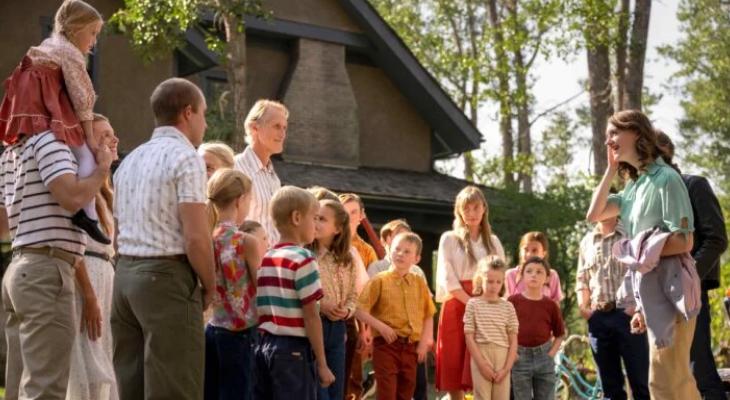
The latter are shown in tidy nuclear families as they do mundane things like kneel for family prayer or meet with the bishop to prepare their eight-year-old children for baptism. They own Cabbage Patch dolls and play board games. Local LDS leaders are depicted as being horrified by polygamy, excommunicating any mainstream Mormons who try to practice it.
In fact, the series does a good turn by showing that even within the LDS church, there’s some diversity. Brenda’s parents are strong Mormons, but they encourage her to get an education and delay getting married. They’re suspicious of the youngest Lafferty brother she brings home to meet them, thinking that his uber-conservative family sounds controlling and would try to limit her choices; tragically, of course, they’re all too right.
Yet, my overall impression after viewing the first five episodes available to reporters is that despite some added nuances, the series hews closely to Krakauer’s basic premise: that religion is built on a decaying foundation of violence and a hunger for power. The show adopts Krakauer’s breathless manner of cutting back and forth between the distant past and the immediate present. There’s a dizzying interplay of short clips from the days of Joseph Smith and Brigham Young, with the latter depicted as one-dimensional.
Emma Smith (Tyner Rushing), who objects to both her husband’s practice of polygamy and to the cartoonish Young, comes off as a hero as she tries to keep Smith on the straight and narrow. She refuses to countenance either polygamy or violence.
Share
Related Articles
American Civic Life
Is This a Time for Bridgebuilding? 5 Leaders in Conversation
American Civic Life
Faith Based Efforts Work in Vaccine Uptake: Now Let’s Make it Easy
American Civic Life
We Commemorate, We Commit: Out of Catastrophe, a Conversation on Connection and Repair
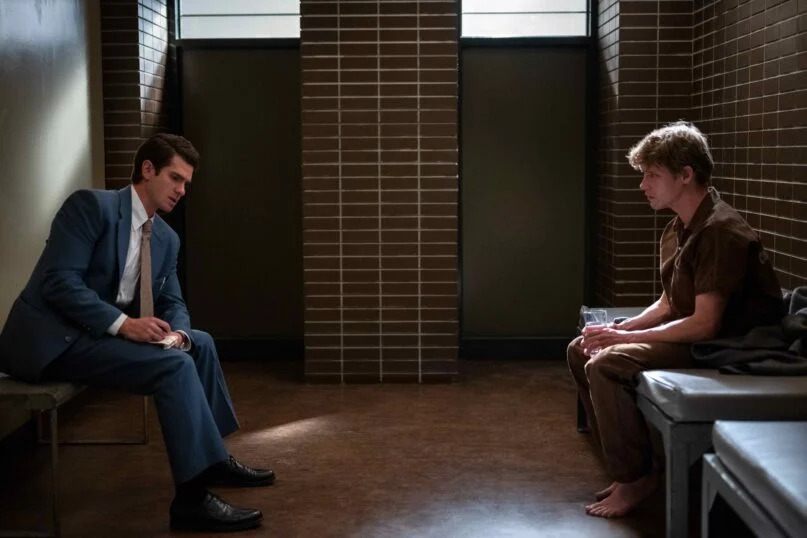
Andrew Garfield as Jeb Pyre, left, and Billy Howle as Allen Lafferty in the miniseries “Under the Banner of Heaven”. (Photo by Michelle Faye/FX)
The overall message from these flashbacks is that Mormon history is not as saccharine or as faith-promoting as church members like Pyre have been taught to believe. As a born investigator, Pyre goes down the rabbit hole to find out more, despite being warned by his bishop to stop digging in the past. The bishop advises him to “put the things you don’t understand on a shelf” and follow the prophet.
The “shelf” language comes up frequently by the fourth episode, its own kind of historical anachronism. That is contemporary phrasing used by people whose testimony of Mormonism has been shaken, or who have left the church because of various historical or theological problems they’ve encountered.
Pyre, then, undergoes a recognizably 21st-century Mormon faith crisis set in 1984. I can’t comment on what will happen in the final two episodes of the series, having not viewed them yet. But it seems likely that the seeds of doubt he is now experiencing — about not only the troubling aspects of Mormonism’s past but also the way church leaders all around him seem to be conspiring to impede his investigation — will result in a full-blown rupture with his faith.
I would not be surprised if this character either leaves the church or stays Mormon in name only, putting a brave face on for his wife and daughters. As the series has depicted him so far, his earnest goodness and thoughtful inquisitiveness have no place in a religion in which the default mode is violence and suppression, even though the church obscures those impulses beneath a carefully curated exterior veneer of love.
At one point, Pyre invokes his status as the priesthood holder in his home to declare that his planned course of action on something is final and his wife must go along. You can tell he hates himself for it — and that when the tension between what his religion expects of him and what his family needs from him become irreconcilable, he will choose his family, because he’s a truly good person.
In the press conference in March, Black suggested that he has seen people be severely punished for speaking out against LDS church leaders. “In Mormonism it’s incredibly dangerous,” he said, noting that people can lose their families and their communities, not just their church membership.
Then, he said something else that caught my attention: that if you do a deep creative dive “into any religion, but particularly Mormonism,” the result is either going to be a musical comedy or it’s going to take a dark and violent turn.
I don’t agree that these are the only options. And while “Banner” as it’s presented on Hulu features outstanding dramatic performances and is a first-rate production, as a person of faith I was left with the same wary bewilderment I felt after reading Krakauer’s book. There’s a world of nuance missing here, in which it is possible to remain a believing member of a religion and not be inherently irrational or prone to violence.