Faith and the COVID-19 vaccine: ‘Muslims were among the first to believe in vaccines’
January 22, 2021
(RNS) — Millions have already received the COVID-19 vaccination, and President Joe Biden has promised 100 million vaccinations in his administration’s first 100 days. Already, however, fears that resistance to taking the shot would become an obstacle to the vaccines’ effectiveness are coming true. In early January, some 50% of front-line workers in Los Angeles were refusing the vaccine. In Ohio, 60% of nursing home staffers declined when offered a dose.
It’s well known that faith leaders can change minds about public health measures by showing their support. “Congregants are more likely to trust not only their leaders but also those who share their faith, particularly people from their own tradition,” wrote Elaine Howard Ecklund, a Baylor University researcher, in a Religion News Service op-ed last year.
To explore what American clergy are doing to support the vaccine effort, Rabbi Julie Schonfeld, the former CEO of the Conservative Jewish movement’s Rabbinical Assembly and now a master’s candidate at the City University of New York’s School of Public Health interviewed a series of faith leaders about their tradition’s views on public health and vaccination and asked what they are doing in the vaccination effort.
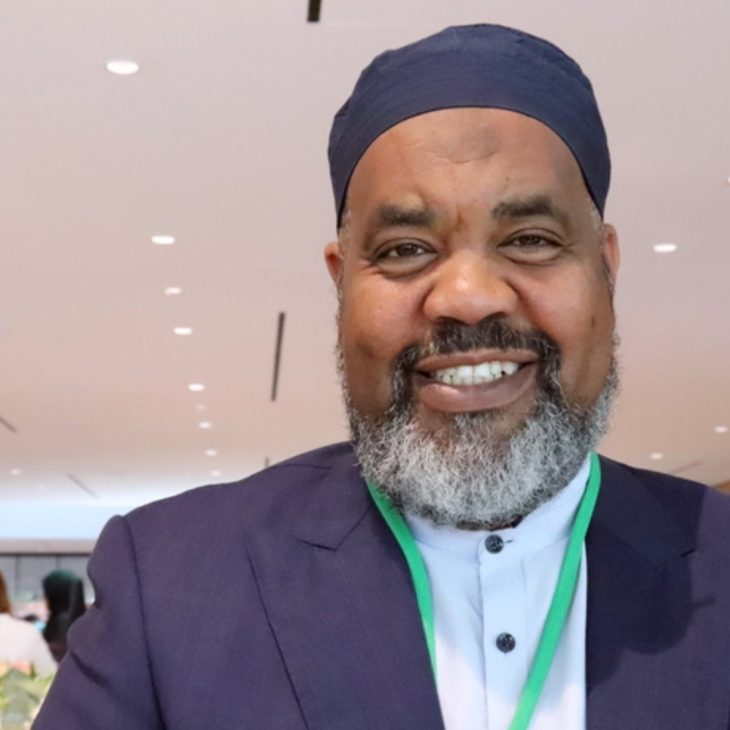
The series begins with Imam Mohamed Magid, a former president of the Islamic Society of North America. Magid is the executive imam of the All Dulles Area Muslim Society Center in Sterling, Virginia, one of the largest mosques in America, with about 5,000 families in seven branches across the Washington, D.C., metropolitan area.
This interview has been edited for clarity and length. View the entire half-hour interview here.
Could you tell us a bit about the Islamic point of view on health?
One of the highest objectives of Islamic law is to preserve and protect human life. We consider every human life a precious creation of God Almighty. At ADAMS, among our many programs is a community clinic, where we provide for those who cannot afford health care — not only Muslims but people of other faiths as well. Our health care department also does seminars and health awareness, and training. So ADAMS addresses all the aspects of human life, mental health and physical health. One of the biggest rooms in our mosque, actually, is the basketball court.
What’s the history of Islamic thought about vaccination in particular?
Muslims have done preventive medicine throughout history, and Muslims are among the first people to believe in the idea of vaccination. Unfortunately, later people associated vaccines with colonization, and African Americans in this country associated them with their communities being used as guinea pigs. But the idea of preventing harm comes from the Prophet Muhammad, peace be upon him, who said, if there’s any contagious disease in a city, you should not enter that city or leave it. If you contract that sickness, you should not go on to spread it. This is the theological foundation for vaccination.
You note that there are historical concerns about vaccination. How do you help people grapple with those episodes?
First of all, there is more transparency than ever before. Leaders from faith communities and different ethnic communities have made sure to ask difficult questions during this process. All our questions have been answered, and the answers are very satisfying. This is safe. We should not have any doubt in our hearts about the benefit of this vaccine to ourselves and to others.
If I’m correct, you have put your name on the list to receive the vaccine yourself.
Absolutely. I put my name on the list and my colleagues at the mosque, the other imams, we’ll go together and record it on camera as we take the vaccine.
Can you tell me what you know about the vaccine‘s halal status?
Two major Islamic scholars’ councils in America have studied this and we have come to the conclusion it is halal. It is lawful. There is nothing wrong with taking it. By taking the vaccine you actually get rewarded by God Almighty for preventing harm to others. Remember, there’s a verse in the Holy Quran as well as in the Old Testament: If you save one life, it is as if you have saved the life of all humanity. You’re doing the most honorable act of worship — the most sacred act of worship is protecting life.
I’m hearing that at some health care facilities, people who work there are still reluctant to get the vaccine. Has anybody come to you with that dilemma?
I have spoken to young people who think, “I’m young, and even if I got it, I would get over it,” and so forth. But we have young people in their 30s who have lost their lives. Number two, it’s not about you. Think about the elderly person you meet in the grocery store. Think about the elderly person that may be a family member that you meet in a social gathering. Think about people who might have a compromised immune system. The teaching of Islam in the sayings of the prophet, peace be upon him, is that no one will have true faith until he or she has the same love for others as they have for themselves.
A lot of people who have not contracted COVID are nonetheless living with a lot of anxiety and isolation. Many have suffered financial or career setbacks. What can we do to help each other and to strengthen ourselves?
This past year has not been an easy year. One of the most difficult things is that many people couldn’t visit their loved ones in the hospital. Some couldn’t even be there when they have been buried. People without steady jobs have had a financial hardship. Life is full of tests and many transitions, but we as a community — I’m talking about the community at large, Muslims, Christians, Jewish, Hindu, Bahai’s, Buddhists — we have to remember that when we show our neighbor that we care when we share our resources by buying extra groceries for the food bank, by giving a call to somebody who feels isolated, we are really showing the best of our religion, the best of our faith.
I’m very optimistic, and I believe that we shall overcome this, but it’s the memory of those we lost within weeks from the sickness, that will be with us for years to come. We will also be recovering from financial difficulties, so we have to have each other’s back. This is a saying in Islam, but also in the Gospel of Matthew and I think also in Judaism that says we should care for others as if we are the presence of God.
These are the principles that make faith meaningful. I don’t think I will be the same after this time. All the theology of humanity being one family has come into play. Regardless of social status, regardless of the power you might hold, all of us have become vulnerable. By protecting one person in a far corner of the world, we are protecting ourselves. We are one body, say the teachings of the Prophet Muhammad, peace be upon him, and if part of it aches, the rest should respond “with sleeplessness and fever.”
View the entire interview with Imam Magid here.