
What Do Church-Going Americans Really Believe? It’s Complicated.
November 30, 2022

Every two years Ligonier Ministries issues a State of Theology survey aimed at exploring Americans’ beliefs on a broad range of theological issues. The website for the State of Theology survey includes a great data explorer that allows people to easily analyze and visualize their data along the lines of ethnicity, geographic region, religious affiliation, gender, education, income and more. Interested parties can also explore data from previous surveys, going back to 2014, and compare results in the U.S. to a 2018 survey they carried out in the U.K.
Their latest report provides many surprising insights about how contemporary U.S. Christians understand Christianity.
For the purposes of this essay, let’s look specifically at Americans who attend religious services once per week or more. Although 63% of Americans self-identify as Christian, less than half of U.S. adults (or roughly two-thirds of American Christians) are affiliated with a specific place of worship, and only about a third of all Americans (roughly half of all U.S. Christians) seem to regularly attend religious services.
Strikingly, the Ligonier data suggests that even among those who regularly attend church, many seem to view this participation as non-essential to the faith. Although 64% of regular churchgoers view it as an obligation for Christians to join a local church, most (55% also believe that worshipping privately is a valid replacement for regularly attending religious services.
Nonetheless, focusing on those who attend religious services at least once per week – highly-engaged believers who are more plugged into a religious community and religious traditions – are perhaps the most revelatory about the state of Christianity in the U.S. today, and how things may trend downstream.
On the Nature of God
Contemporary American churchgoers have somewhat contradictory beliefs on the nature of God.
On the one hand, 91% assert that God is a perfect being and cannot make mistakes. However, most (56%) simultaneously assert that God learns and adapts to different circumstances. On the surface, it is unclear how a perfect and omniscient Being could learn and grow. Nonetheless, frequent churchgoers are more likely than other Americans to endorse a belief that God learns and adapts.
Likewise, 94% of Americans who regularly attend religious services assert that there is one true God in three Persons: the Father, the Son and the Holy Spirit. Nonetheless, more than 70% of respondents simultaneously view Jesus as the first and greatest being created by God (and therefore, implicitly, not co-eternal with God). Churchgoers are substantially more likely to believe this than the general public. More strikingly, nearly half (47%) of Americans who regularly attend religious services view Jesus as a great teacher but do not view him as God incarnate. This is not much different from the share of the general U.S. public who feels the same (53%).
It’s not just Jesus who is viewed as a lesser entity than God (the Father). Sixty-one percent of U.S. churchgoers describe the Holy Spirit as a divine force but not a personal being. In this, the views of people who regularly attend church seem to be roughly identical with those of the general public. But of course, to view the Holy Spirit as an impersonal force is in tension with the core trinitarian belief of one God in three persons.
What’s more, many regular churchgoers view the Holy Spirit as a potentially malign force. Nearly a third (30%) asserted that the Holy Spirit can compel people to take actions that are forbidden by the Scriptures. In fact, those who frequently attend religious services were much more likely to embrace this possibility than those with lower levels of religious participation.
In short, although frequent American churchgoers near-unanimously embrace the idea of the Trinity in the abstract, it nonetheless seems as though God the Father is ultimately who they seem to have in mind when understanding God as a perfect, eternal, and personal Being. Jesus seems to be viewed as distinct from God per se, and not necessarily co-eternal with God (instead, he was created by God). The Holy Spirit seems to be broadly understood as a means through which God executes His will rather than being a personal entity in the same sense as God the Father.
The Bible
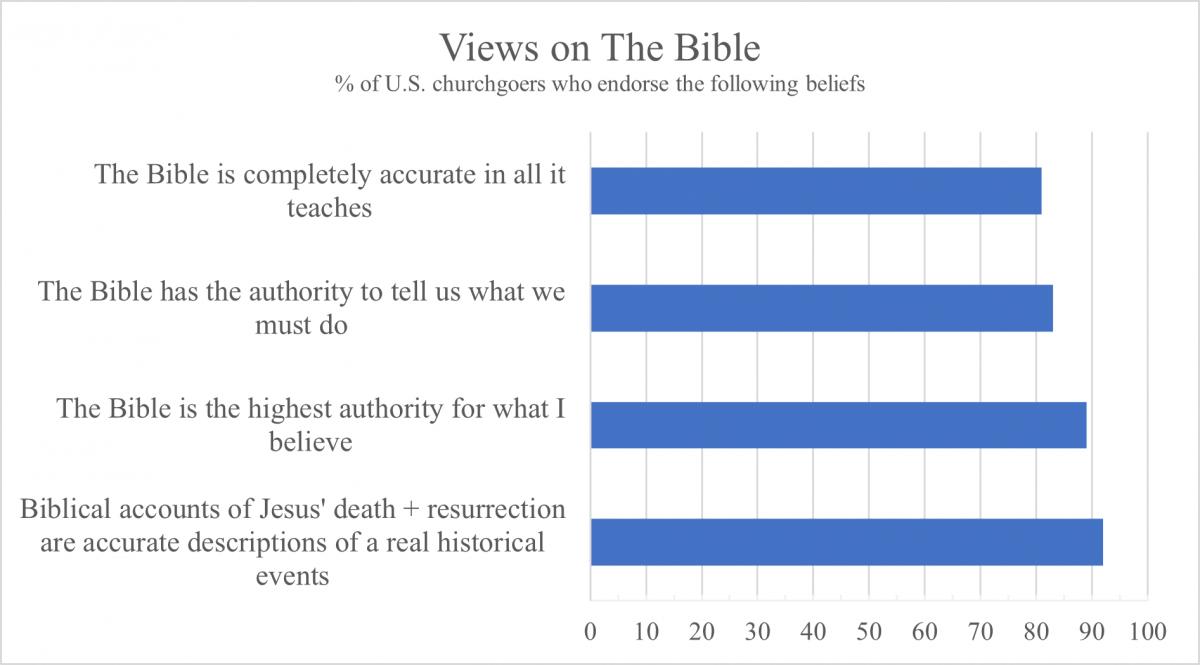
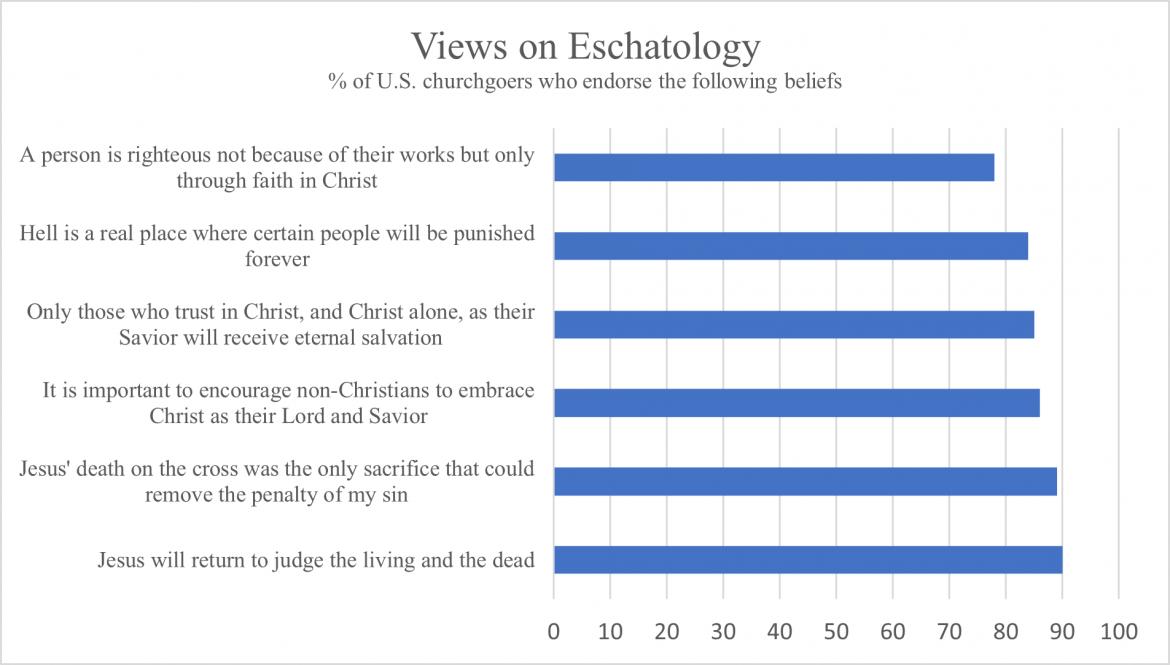
On the whole, Americans who regularly attend religious services express strong faith in the Bible:

Musa al-Gharbi
Musa al-Gharbi is a Paul F. Lazarsfeld Fellow in Sociology at Columbia University and a Daniel Bell Research Fellow at Heterodox Academy. His work explores how people talk about, think about, and produce a shared understanding of various social phenomena. His first book, “We Have Never Been Woke: Social Justice Discourse, Inequality, and the Rise of a New Elite,” is forthcoming with Princeton University Press. Al-Gharbi is also committed to public engagement. He is a columnist with The Guardian, and his research and writing has been featured in The New York Times, The Washington Post, The Wall Street Journal, NPR, The Atlantic, New Republic, The Nation and many other outlets. Readers can connect to his research, social media, and public writing via his website: musaalgharbi.com.