Building Community in Quarantine
November 18, 2020
One of the first Hebrew words I learned was bidud, which means isolation or quarantine. An Israeli friend told me that the root word for this is “alone” or “loneliness.” He found it darkly hilarious that this is the vocabulary I acquired when in other years I would have been more likely to first learn L’chaim or the pleasantries of daily life. I probably do not need to explain why this is the first word I learned; it is 2020, after all.
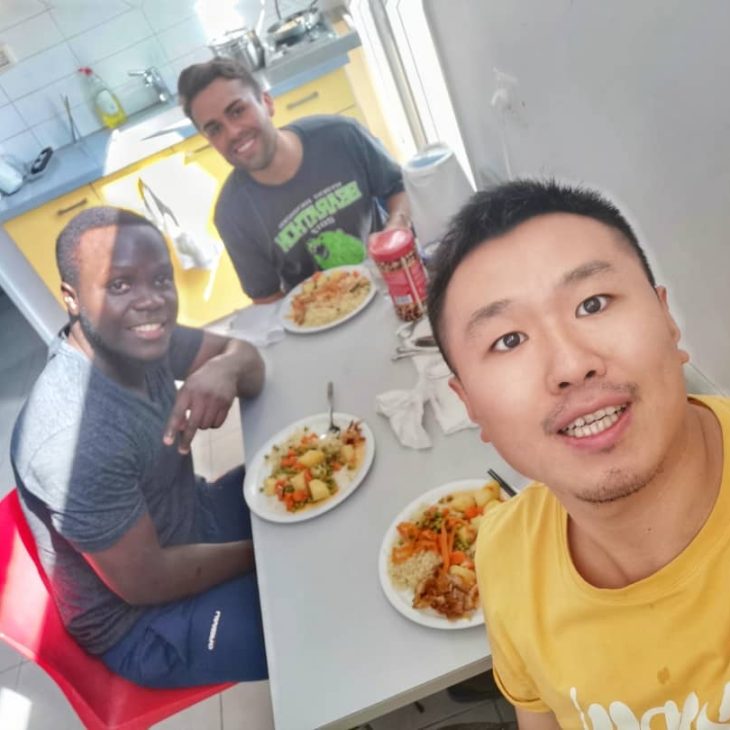
I have come to Tel Aviv to pursue graduate studies in Conflict Resolution. Like anybody else entering the country, I was subject to a compulsory 14-day quarantine. The irony is that, though I was locked in an apartment with two total strangers for two weeks, the feelings of loneliness I have felt since the onset of the global pandemic, subsided a bit while I was in quarantine with no responsibilities but my civic duty to isolate to prevent the spread of the COVID-19 virus. I have discussed the irony of this with my classmates: a period in government-mandated quarantine–two weeks where you don’t need to social distance or mask because you are inside–offered a respite from the chaos of this time. More meaningfully, it meant the chance to get two know two new people from the other side of the world. As I would come to find out, my time in bidud was not so lonely after all.
When you’re locked up with strangers in an old university dorm with poor Wi-Fi, you talk about religion. It’s inevitable: we had all the time in the world. The first afternoon after arriving in the country and crashing for hours, I sat at the breakfast table chain drinking instant coffee with one roommate, Xiaomin, a 32-year-old recent divorcee from Beijing, China. I asked him to tell me about himself, and he told me about a months-long motorbike trip he took around the Chinese countryside, just before the pandemic began. He then asked to see pictures of my family and friends. I showed him and he noticed that on my phone case I have a small sticker from my alma mater’s interfaith group: Baylor’s Better Together BU. It’s a small green and gold heart filled with symbols representing a plurality of worldviews: the secular humanist logo with the jumping person, the Magen David, the cross, the Sikh Khanda, and the star and crescent. He said it was beautiful. Then he told me his story.
Xiaomin has endured difficulties in his home country for his Christian faith. He told me how his community gathers discreetly in restaurants or the home of their pastor for worship and study. He explained that he is aware that government officials follow them around sometimes when the few dozen members of his congregation meet. I asked him if he was Protestant or Catholic, or something else. He then explained that in China there are two ways to be Christian: you attend a church that the government endorses and surveils, or you meet unofficially for more freedom in what you speak about. His family chose the latter. Because policies and government interference make it challenging for Christians, Muslims, and others to gather in China, he is keenly aware of the faults of his government.
I must confess that before our conversation, I assumed that Chinese citizens were not willing to criticize their government. This was uninformed and untrue thinking; Xiaomin is aware of how the government has impeded his freedoms and those of other faiths. In a similar way, I also told him I–as an American–held socialist ideas in high esteem, and he was equally stunned. As we talked more and shared our stories, I wanted to tell him that I am queer. I once again was wrongly afraid he’d be bigoted simply because of his home country. I was proven wrong. I told him about the Roman Catholic faith, and about the beauty and transcendence, I find in my tradition, and about the ways in which queer people like me are abandoned by the authority structures and leadership in our Church. He understood.
Our other roommate was named Cecil, a Ph.D. student in Biology from Kenya. He had to work much of our time in bidud, so, we did not speak nearly as much. He did come join Xiaomin and me for coffee. At one point, we discussed the tension between anti-Muslim discrimination in Kenya and unequal protection under the law for Muslims there–and also the tragedy that terrorists claiming Islam as their motivation have wrecked in recent attacks in the country. He explained some of the nuances of ethnic identity in Kenya as Xiaomin and I listened, nodding. They both had seen news coverage of the tragic extrajudicial murders of Black Americans this year by police. We discussed the ways in which justice desperately needs to be served. We mourned together the oppression and violence done in the name of belief and power in our different countries. At some point, the conversation came to a lull. We, three people from distinct cultures and backgrounds, had found it easy in the forced confines of quarantine to spill our hearts.
As it grew dark outside, I decided it was time to drink more instant coffee. The fact that Cecil put more milk and sugar than coffee in his mug and Xiaomin preferred tea was a point of tension I found difficult to overcome. Nonetheless, we bridged our differences and at Xiaomin’s instance, played game after game of backgammon late into the night. Never before or since bidud, have I played such fiercely competitive backgammon.
Kyle is an alum of the Interfaith Youth Core. He was an active member and in leadership at Baylor University’s interfaith group, Better Together BU. He is a current Fulbright scholar pursuing a graduate degree in Conflict Resolution and Mediation at Tel Aviv University. Kyle is on Twitter @kydesro.
Share
Related Articles
American Civic Life
American Civic Life
American Civic Life