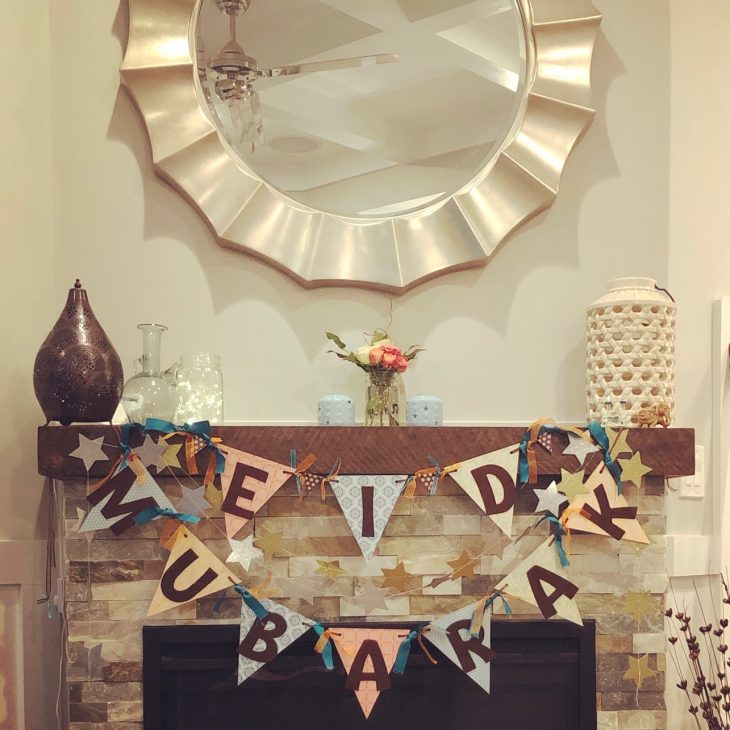
This year on Eid morning my family gathered in our living room where our children waited eagerly to open their gifts. They tore open their presents and ate cake for breakfast. Then instead of rushing out the door to attend our community’s Eid prayer, we stayed home. With no Eid services to attend, there was no urgency to rush or to panic over missed morning alarms. Instead of going back to our day, we innovated. My husband led our family in Eid prayer, followed by my delivery of a sermon about the Prophet Muhammad. As our family celebrated the close of Ramadan while sheltering-in-place, the lessons I’ve learned from this month have been on my mind.
Resiliency, it’s in our DNA.
Humans are resilient. My community is resilient. My children are resilient. Even when it was hard to be in physical community with one another, this month has been about keeping community intact. As Ramadan began, Islamophobic remarks from the White House about whether Muslims would respect Covid-19 guidelines spread on the news waves. Meanwhile, Muslims around the country hunkered down in their homes to observe the month while sheltering-in-place. All the mosques that I have ever visited in the Chicago-land area have been closed for almost two months. There were no communal prayers, iftars or Eid services hosted. But my people innovated. Mosques and communities hosted car parades to mark the occasion with socially distant ways to see community.
In my family, we typically host an “Eid Treasure Hunt” with gifts scattered across our home for all the children in our extended family. This favorite gathering did not happen this year. Instead we opted to mail our Eid gifts to cousins across Illinois and set up a mini-treasure hunt for our kids on Eid morning. It did not fulfil the gap of being in company with beloved family members over good food and even better conversation. But ways of virtual connection are not new to us. We are immigrants, with family spread across five countries and three continents. Using virtual tools to stay connected has always been part of our family story. But now we use those tools to gather collectively as a larger group. This Ramadan, we hosted our first family Zoom call with family from the U.S., Canada, U.K., U.A.E. and India. And what a joy it was.
My people show up, especially in times of need.
Muslim doctors, nurses, chaplains and many other “essential” professionals are serving on the front lines against Covid-19, fulfilling critical responsibilities while risking their own health. Mosques and Muslim organizations across the United States have been serving the needs of their communities through food deliveries for families in need. In Chicago, the Inner-City Muslim Action Network (IMAN) has distributed thousands of meals kits on the south side of Chicago through building partnerships with Chicago Beyond, Team Englewood and R.A.G.E. (Resident’s Association of Greater Englewood). And ICNA Relief has served 71,000 families impacted by the Covid-19 crisis through food and grocery delivery, rent assistance, telemedicine, and more.
As large numbers of us have been sheltering-in-place this spring, there has also been a rise in reports of domestic violence across the country. The Peaceful Families Project, a national nonprofit focused on preventing domestic abuse, has compiled a national directory to help victims access services listed in a central location.
Muslim women, creative and amazing.
Yes, you can read that again. Ramadan in quarantine has refreshed an ongoing conversation on how many American Muslim spaces are gendered – news to no Muslim woman – and how women have navigated these circumstances for decades. Conversations on the use of technology and accessibility have come to the forefront due to the COVID crisis. Hind Makki, Founder of Side Entrance, an award-winning website that documents the reality of women’s prayer spaces in Mosques, writes that this new virtual reality is facilitating needed shifts in Mosques and Muslim spaces.
This Ramadan several women-only qiyams, late-night communal prayers, were hosted during the Night of Power, one of the holiest nights of Ramadan. Being a mother of three small children has meant that, for many years, I have not been able to attend any in-person qiyams. But as the gatherings went virtual this year, I was able to participate in one of the most meaningful prayer experiences I’ve had all year. In a space created by women, led by women, intended for women. In the absence of qiyam, the Rahma Foundation hosted virtual gatherings attended by over a thousand female participants. We listened to short wisdoms shared by scholars, including from my own mentor Dr. Ingrid Mattson. We prayed in our respective spaces. And we listened to the Quran’s recitation as a community.
We find meaning, even in isolation.
“And which of the blessings of your Lord will you deny?” (Quran 55:18). I have often thought about this verse throughout this isolation. Even with all of the annoyances, pressures and struggles of social isolation, many of us are blessed with so much. My family has a home to shelter in, access to resources we need, and jobs that allow us to work from home. Even if that should change, we have a network of family and friends to lean on. And so far, our family have personally not faced infection with Covid-19. I am grateful for so much, and for the opportunity to find meaning in isolation. Ramadan in isolation has given us a chance to slow down from the chaos of our regular routines, to enjoy the moments we have together, and to savor the moments we have alone in prayer. It has given us the opportunity to show grace and gratitude for the blessings that we cannot deny.
Share
Related Articles
Higher Education
American Civic Life
American Civic Life