A Pro-Democracy Faith Movement is Forming. Will It Be Enough?
December 17, 2021
(RNS) — Pressure on congressional Democrats to pass historic voting rights legislation has been mounting for weeks. Activists have been marching in the streets outside members’ offices in Washington. Progressive interest groups are calling on Congress to pass two pending bills, the John Lewis Voting Rights Advancement Act and the Freedom to Vote Act.
They are agitating for Democratic senators to take the possibly explosive step of abolishing the chamber’s sacrosanct filibuster rule to overcome Republican opposition to measures aimed at protecting the integrity of the electoral system.
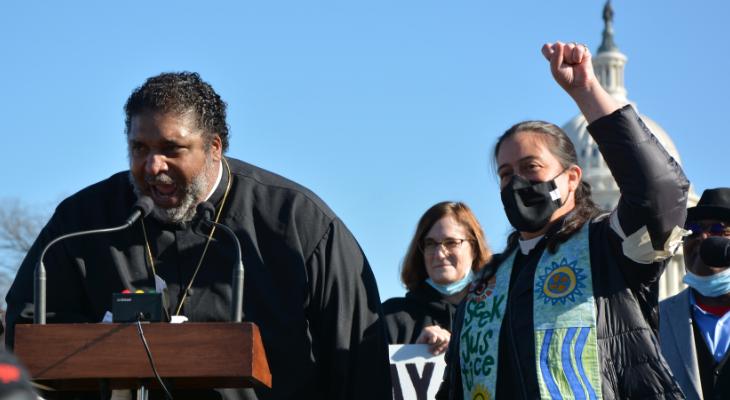
Some of those marching have been wearing clerical collars. This week, Unitarian Universalist Association President the Rev. Susan Frederick-Gray raised a fist as she was arrested with a sacramental stole draped around her neck.
Faith groups are no strangers to debates and movements that expanded the franchise. Religious leaders were instrumental in bringing about the 19th Amendment a century ago and the Voting Rights Act of 1965.
But the sight of clergy being detained by Capitol police is still startling. In the past few decades, denominations and religious interest groups have largely stayed out of arguments about political reform and democracy. A lack of a clear theological rationale and lack of expertise in constitutional law have been obstacles. More pertinent, perhaps, is that, for some, American democracy, for all its annoyances and foibles, has functioned reasonably well.
But suddenly American democracy is not functioning very well. Religious people and organizations have had to decide where they stand.
Some of the most basic structural features of the U.S. system are undemocratic by design: the Electoral College, the Senate and unelected and life-tenured federal judges. These were seldom challenged, and certainly not on religious grounds. But the Electoral College overruled the will of voters in 2000 and 2016. The Senate minority’s prerogative makes majority rule increasingly impossible. As the legislative process has broken down, unelected Supreme Court justices are routinely called on to settle matters of not only law but policy.
Share
Related Articles
Interfaith America Interview
American Civic Life
American Civic Life
Faith Based Efforts Work in Vaccine Uptake: Now Let’s Make it Easy
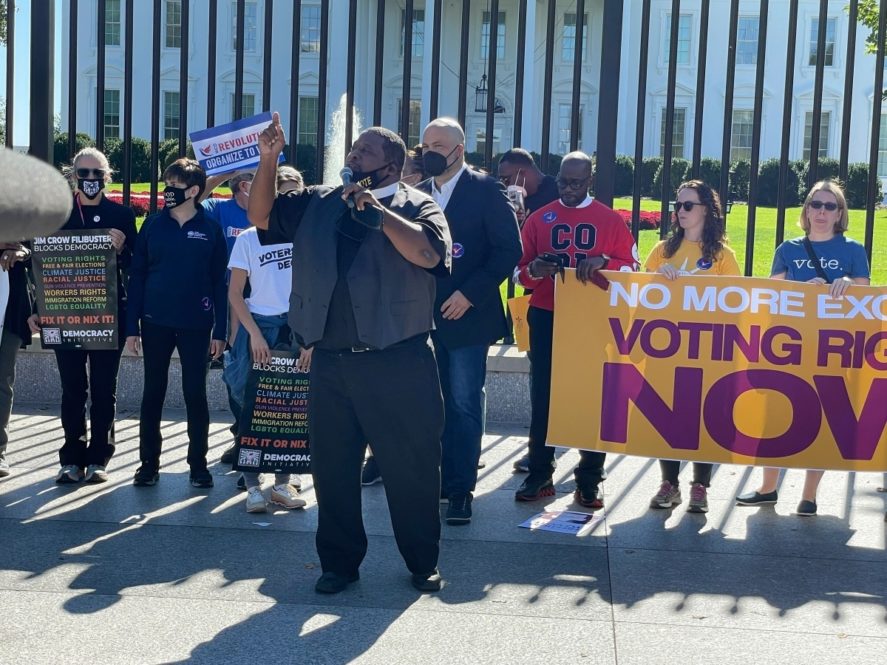
The Rev. Ferrell Malone speaks during a voting rights rally outside the White House on Tuesday, Oct. 19, 2021, in Washington. RNS photo by Jack Jenkins
But the real challenge for faith groups, which nearly uniformly affirm democracy, is the Republican Party’s regression on voting rights over the past decade.
In particular, Republican judges, legislatures and governors have largely agreed that civil rights-era provisions allowing scrutiny of political jurisdictions with a history of racist voting restrictions are no longer necessary.
Republicans also support stricter voter ID laws, felon disenfranchisement and restrictions on the availability of early, absentee and mail-in voting — all of which aim to depress the turnout of poor and minority voters.
Democrats seek measures to protect and expand access to the ballot box, which faith leaders such as the Rev. Martin Luther King Jr. fought to guarantee. Predictably, religious organizations have become more vocal about the need for activism on voting issues, especially those that align with Democrats, who increasingly support voting rights measures. Faith groups that support Republicans tend to deny there is a problem at all, or at least not one with a religious impulse to address.
This difference reveals two questions that Americans of faith must urgently consider and respond to. First, is there a problem? And second, is there a religious justification for addressing it?
Right-leaning religious leaders tend to trump any talk of voting rights by pointing out that the Bible does not say anything about voting, but their affection for the status quo surely is influenced by the fact that undemocratic institutions like the Electoral College and the Senate have given social conservatives long-sought legislative and judicial victories on abortion restrictions and religious liberty.
As a result, the Southern Baptist Convention’s public policy arm, the Ethics & Religious Liberty Commission, despite expanding its issue portfolio somewhat in recent years, does not find American democracy threatened. The conservative Washington-based Institute on Religion & Democracy, despite literally including the word ‘democracy’ in its name, does not speak out on issues related to the electoral system.
As much as they benefit from Republican electoral policies, however, it would be unseemly for groups like the IRD and the ERLC to actively support Republican voter suppression efforts.
Luckily, they have a large and well-funded arm of the religious right to do their dirty work for them. Groups such as the Family Research Council and the Faith & Freedom Coalition provide religious cover to Republican voter-suppression efforts, marketed as “election integrity” laws.
These organizations, more shameless and more transparently aligned with Donald Trump and promoters of his lies about voter fraud and stolen elections, regularly praise Republican voter-suppression legislation.
On the progressive side, Sen. Raphael Warnock of Georgia, a minister who holds King’s former pulpit in Atlanta, recently said on the Senate floor, “As a man of faith, I believe that democracy is the political enactment of a spiritual idea.”
The Rev. William Barber, whose Poor People’s Campaign has led the fight for federal voting legislation, has assembled an interfaith coalition that includes leaders across Protestant denominations as well as longtime progressive advocate Sister Simone Campbell, and Jewish, Muslim and Sikh leaders.
Their faith argument is clear: state-based efforts to restrict voting will disproportionately impact poor and nonwhite people. Only federal legislation can adequately defend against these measures. As for biblical precedent they point to the Hebrew prophets: “Woe to those who make unjust laws,” said Isaiah, “to those who issue oppressive decrees, to deprive the poor of their rights and withhold justice from the oppressed.”
As these diverse leaders refine the scriptural and theological foundations for their activism, they are moving ahead with the difficult work of building a coalition to protect voting rights. Barber, who has taken a leading role in speaking to the moral rot in our political-economic system, consistently frames his preaching and activism around the poor, and he and others in the movement consciously center Black Americans’ experiences.
This approach stands squarely in contrast to white evangelicals’ self congratulatory but largely empty efforts on racial reconciliation, which had a brief moment before Trumpism seduced conservatives to trade decency on race and much else for a few anti-abortion judges.
At times, progressive faith activists have run ahead of the Democratic Party, prophetically calling it to urgent action. Conservative Christian political engagement, meanwhile, has from time to time resisted the ugliest impulses of the GOP’s decadeslong dependence on white race-grievance.
But for now the religious politics of voting rights and suppression look a lot like the usual suspects doing what their allies in the two major parties expect of them. Patriotic citizens across the religious landscape can only hope that a faith-led consensus on voting rights will rise above party to banish measures that any believer can recognize as gross, anti-democratic and racist.
(Jacob Lupfer is a writer in Jacksonville, Florida. The views expressed in this commentary do not necessarily reflect those of Religion News Service.)