As part of its civic strategy, Interfaith America hosts conversations with faith and civic leaders about their perspectives on religious pluralism and religious freedom – two values that IA empowers leaders to support and promote.
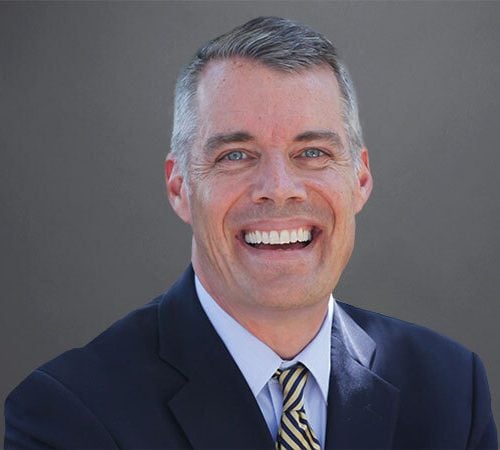
Interfaith America Senior Director of Civic Strategies Chris Crawford interviewed Pete Peterson, the Dean of Public Policy at Pepperdine University and a Senior Fellow of The Davenport Institute. He was the first executive director of the bipartisan organization Common Sense California, which in 2010 joined with the Davenport Institute at the School of Public Policy to become the Davenport Institute for Public Engagement and Civic Leadership.
Editor’s note: This interview has been edited for length and clarity.
Chris Crawford: You have a unique view in multiple ways. At Pepperdine University, you have the beautiful view of the Pacific Ocean… You also have an interesting view as a self-identified conservative dean of a public policy school – which is not all that common! I would love to start by having you tell us a little bit about your work at Pepperdine.
Pete Peterson: I’m entering my 10th year as dean. Before that, I headed up a nonpartisan state and local government institute here at the policy school called the Davenport Institute for Public Engagement. We’ve had this long-standing commitment to viewpoint diversity. I think that’s especially important for institutions like ours who are preparing leaders specifically for the field of politics to be able to understand not only why they think what they think, but to understand how the other side thinks as well.
Crawford: Some of the things we focus on at Interfaith America are religious liberty and religious pluralism. I’m interested in what religious pluralism and religious liberty mean to you.
Peterson: We’re one of maybe a handful [of public policy schools] that are based at a Christian university. In that, we really do take that element of our identity seriously. Now, I wouldn’t necessarily call us a Christian policy school, but on issues where there’s an intersection of faith and policy – like on some of these religious liberty and religious freedom issues, both domestically and globally, on the importance of faith in shaping ethical and moral leaders or when it comes to preparing our students to go work in faith-based nonprofits that are engaged somehow in the fields of policy or politics – we see ourselves as having that unique role as an academic institution, [and] one that is engaged in preparing public leaders and still grounded at a faith-based university.
Crawford: [In some of my recent conversations with leaders in the civic space,] I’ve had people ask me, “What’s the conversation like about the topic of Christian nationalism?”[Personally,] I think we can get in trouble if we broaden what we call “Christian nationalism.” It can make it seem like a larger movement than it is and accidentally marginalize conservative Christians who are not adherents to Christian nationalism. But I do think this idea of policy that prioritizes one faith over the other or tries to say that you have to be Christian to be a real American – I see problems with that. What do you think?
Peterson: I think we are in danger, especially people of faith, to see this as a bigger challenge than I think it actually is. I know for our part at Pepperdine, one of our core texts is Alexis de Tocqueville’s “Democracy in America,” and he calls the faith of Americans as, “one of America’s great political institutions.” And what he meant by that was not that it was acting in an exclusionary way, but actually quite the opposite. It was in an inclusionary way – both from a multiplicity of faith perspective and the importance of religious liberty, but also the civic engagement component of our churches…. This remains distinctive [to] America, the importance of people and organizations motivated by their faith, who are prompted to respond to some of America’s great challenges. From a policy school and one that prepares people to go work in the political and policy space, to know the role of faith-based nonprofits, again, across the faiths that are engaging in these very important issues that they can bring this unique dimension, this unique motivation to not just addressing, say, an issue like homelessness from a, dare I say, technocratic perspective, but they can bring a real personal perspective and approach to these very human problems, which are [also] public policy problems
Crawford: On the topic of your public policy curriculum, I’d be interested in how those terms, religious liberty and religious pluralism, show up in the day-to-day of how you view public policy.
Peterson: One of our core courses is a constitutional history course, taught from a perspective of connecting the Constitution and the variety of debates, Supreme Court cases, and so on that have happened over the course of centuries, [and] how they’re relevant to today’s public policy issues. Certainly, the issue of the First Amendment and related questions of religious liberty have been addressed in different ways over the course of America’s almost 250-year history, but in ways that are very topical. For example, both here in California and around the country, the state government does put a lot of hurdles in front of faith-based organizations, at least here in California, that make it very difficult for well-intentioned people with a degree of expertise in addressing homelessness. [They] are nonetheless running into barriers that are created by public policy and legislation. So, addressing those public policies, understanding how they are actually in some cases hindering people of faith, that’s one perspective and one lens. The second is the speakers that we bring to campus and the relationships that we have with faith-based organizations addressing the issue[s] [like the] First Amendment [or] religious liberty.
We are connecting our graduates and alumni with positions in what I would call the faith sector and addressing issues of significant public policy concern. And then, we have a religious liberty scholar that’s affiliated with the policy school. Knox Thames has done some incredible work in this particular field. And he is somebody that we look to to both teach mini seminars, but also to lead seminars and events on the intersection of the more global view of religious liberty.
Crawford: I frequently hear that bridgebuilding and cooperation are happening much more at the local level than nationally. You do some of this work through your Davenport Institute. What are you seeing?
Peterson: One of the things I’ve found over doing this work at the local level for now almost 20 years has been [that] issues can still be very polarizing at the local level, but they’re not as partisan. I’ll often see is you’ll have people on the same side of an issue at the local level who will never have voted in the same way in a presidential election. So, you see those opportunities for people to collaborate again across larger national partisan divides when the issue obviously has this deep local resonance. But that’s still not to say that the issues cannot be polarizing… What we hope to provide through the training and consulting work we do with the Davenport Institute is people recognizing the things that they do hold in common and then look at what is the best way to address the issue.
Crawford: That’s a great point. It reminds me of when I was the student member of the local board of education in Nashua, N.H. One of the most conservative members of the board of education on state issues was one of the biggest opponents of funding cuts that would harm teachers or paraprofessionals.
Peterson: But we see that here, right? I lived for about a dozen years in Santa Monica – a very progressive city of about 110,000 people. I was asked to give a talk to a community organization there about some of this public engagement work. I began with, “Well, it’s great to be here in Santa Monica, one of California’s most conservative cities.” And I could tell as I looked out at the audience, they’re like, “Where did this guy come from? He has no idea where he is.” And I said, “Well, I call you conservative because when it comes to actually building housing or, much less, what could be called moderate- or low-income housing, chances are there’s going to be a group of a couple hundred people showing up at the Planning Commission meeting saying, ‘Not in my backyard.’” And [they are] seeing [an issue] a different way [and] detaching political perspective from partisan labels.
We try to get at ways in which people actually are more connected than sometimes they recognize. Sometimes we really do stop too much at the label as opposed to saying, “Do you love your community? What do you love about it? What are things worth conserving versus progressing?” When you can get into those kinds of conversations, a lot of those labels and barriers tend to slip away, and you can address difficult and polarizing policy issues.
Crawford: You have led a program called “The American Project” on the future of conservatism. And that project had a strong focus on a “conservatism of connection” and communitarian conservatism. How are you thinking about the name of that project and that idea of connection and community now – especially as we near the 250th anniversary of [America’s] founding.
Peterson: One of the great phrases [from de Toqueville] is, “At the start of every great undertaking in America, where you’ll see a Lord of the Manor in Great Britain or a government official in France… count on it: You’ll see an association in America.” Americans really thought not just [at] the community level from a local government perspective, although that was very important, but also, at the community level when it came to working through associations and civic organizations to address real public policy issues.
Sometimes we look back on that era and think they never really had to deal with homelessness, poverty, crime, or illness. Of course they did, but that was the thing that I think really made America great, dare I say. And as we head towards the 250th, I think a reawakening, a new appreciation of that element of what makes America exceptional. And I mean that in the sense that it is different. This importance placed on the local level for civic engagement and participation.
For example, the challenges facing the city of Los Angeles are civic challenges. They’re not just financial challenges; they’re civic challenges. And again, I think as we look at so many of these issues facing America today that are very local – whether it’s homelessness or crime or cost of living issues – these are housing [and] are very local issues, even though they’re discussed in a very national, federal way. It’s my hope that we can get back to that appreciation of the importance of the local and the importance of the civic.
Crawford: Is there anything else you’d want to add about just this moment of reflection as a country about the 250th?
Peterson: I’ve just come out of a meeting of the senior leadership here at Pepperdine in part talking about this issue: American education is under significant change. I mean that from the kindergarten level all the way up to higher education. And it’s not just what’s coming out of Washington, D.C. We’ve seen some events over the last five, six years. I would argue that COVID-19 was a watershed moment in American education. And I think a reawakening of the civic purpose of our schools is going to be an important part about how we understand America’s 250th.
There was a time when the civic purpose of our schools [was] not just preparing people professionally and from a career perspective, but also to be engaged citizens in all ways. For that to be available to all Americans is a significant and outstanding question right now; where we’re going to be not just leading up to our 250th, but really 10 years from now. How are our schools going to respond to the civic purpose of schools, and can we do that in a way that’s both inclusive but also inspiring and challenging to our students and future citizens?
Crawford: I really appreciate your time today. Thank you!