White House Affirms Religious Diversity
May 10, 2022
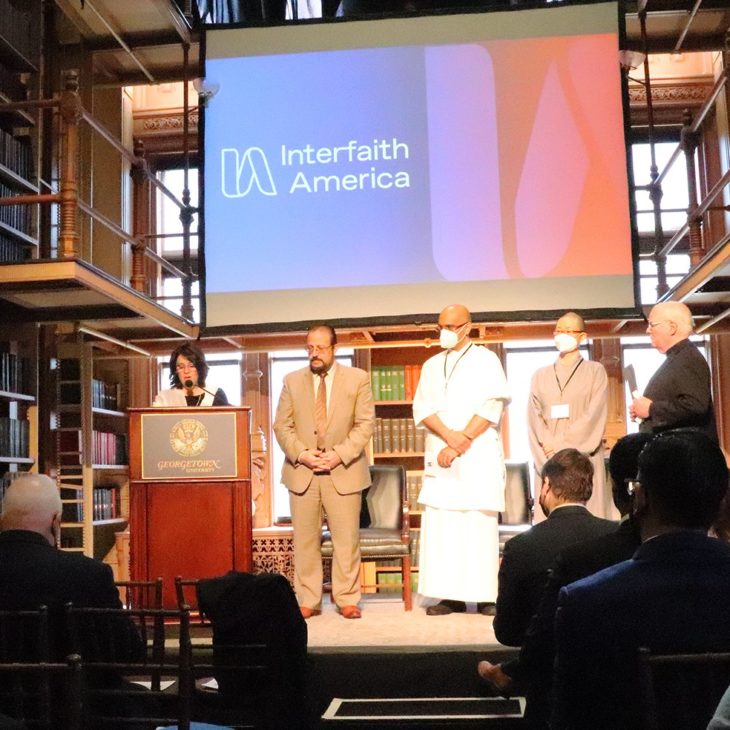
WASHINGTON (RNS) — Interfaith leaders, including a top White House official, gathered at Georgetown University on Tuesday (May 10) to affirm engagement across faiths and urge more multireligious action to enhance democracy and diminish polarization.
“Especially at a time of deep division and threats to our constitutional democracy, governmental leaders, for one, must demonstrate both in word and deed that they are committed to equal rights to religious liberty, religious liberty for everyone in equal measure,” said Melissa Rogers, executive director of the Office of Faith-Based and Neighborhood Partnerships, at the launch of Interfaith America.
The organization’s name is new, after 20 years as Interfaith Youth Core, a Chicago-based organization that has grown to include programs and service projects on more than 600 college and university campuses.
Eboo Patel, who founded IFYC in 2002, pointed back to when “Judeo-Christian” work began in the wake of antisemitism and anti-Catholicism and “did good work for nearly a century.” Now, he hopes a broader array of people of faith will seek common good together rather than become further divided.
Interfaith America, which partners with Religion News Service on a journalism fellowship, is expanding its work with upcoming events that Patel said will include former Vice President Al Gore in an initiative about the intersection of environmental stewardship and racial equity, and another with former President George W. Bush called “Our Vote is Sacred.”
“Will we become an ever-expanding city on a hill?” Patel asked, referencing the words of Jesus often invoked by politicians to symbolize America’s moral leadership. “Or will we be at each other’s throats?” He noted that his vision of that moral leadership includes mosques, gurdwaras, temples and secular humanist societies, in addition to Christian churches.
Assembled in a library at the Jesuit university that houses old church periodicals, representatives of the interfaith organization marked the new phase of its work with an array of blessings from officiants of Christian, Jewish, Muslim, Dharmic and Buddhist faiths.
Rogers noted that Patel’s organization worked with her office on building interest and participation in COVID-19 vaccinations among religious communities, where sometimes hesitation or resistance was higher.
“I don’t think any of us thought that this work would be easy — none of us did,” she said, speaking to a room including dozens of attendees, some of whom have been committed to interfaith relationships and projects for decades. “But I think we all know now that this work has never been harder. It’s also never been more important.”
Share
Related Articles
American Civic Life
American Civic Life
Eboo Patel and Wajahat Ali: Is “Interfaith America” Even Possible?
American Civic Life
The List: Interfaith America’s Top 9 Interfaith Stories of 2022
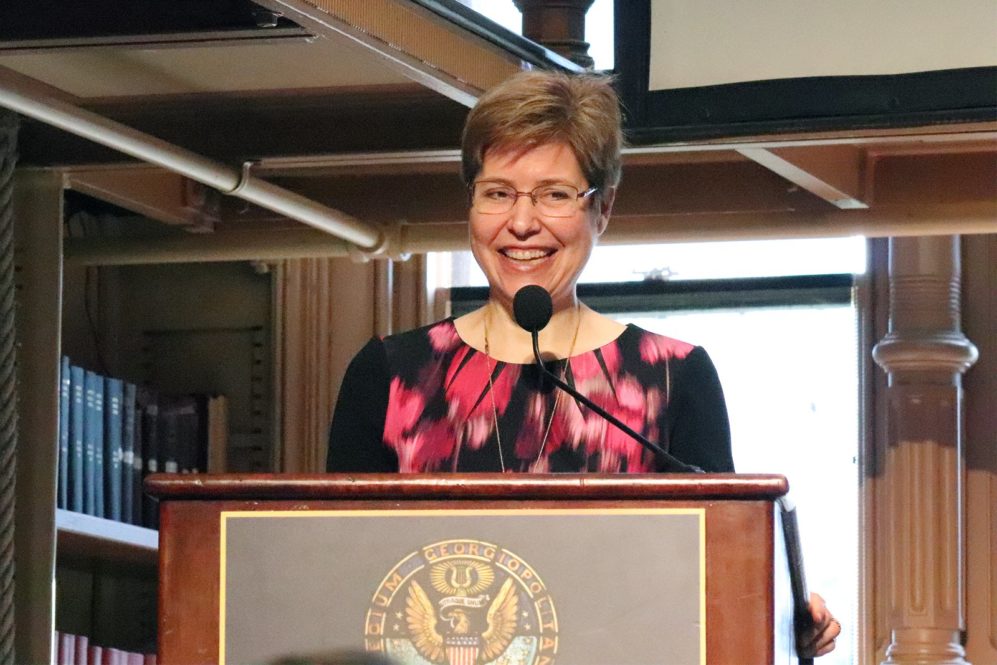
Melissa Rogers, executive director of the Office of Faith-Based and Neighborhood Partnerships, speaks during an Interfaith America launch event at Georgetown University on Tuesday, May 10, 2022, in Washington. (Adelle M. Banks/RNS)
Acknowledging that she was “preaching to the choir,” Rogers added: “There’s so much that unites us if we are only willing to look for that unity and work side by side. At a time of too much polarization — far too much — thank you for continuing to defend each other’s rights, no matter the climate.”
The Rev. Jim Wallis, chair of Georgetown’s Center on Faith and Justice, challenged the participants to work toward new goals of interfaith cooperation, from addressing global vaccinations and immigration to reversing climate change.
“Religion can be the biggest block to a peaceful, multiracial, multicultural, multifaith future,” he said. “Or we could be what enables that to happen. And at our best we could even lead the way.”