When a Priest Gets a Rite Wrong
February 18, 2022
(RNS) — Uh-oh.
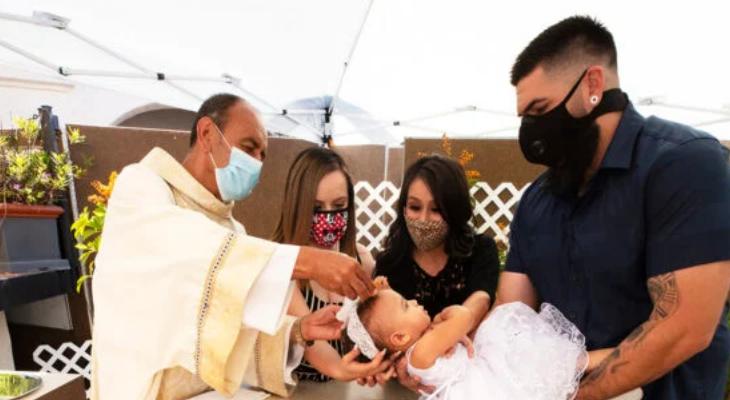
That is probably what the Rev. Andres Arango of Phoenix is saying right now — as well as the hundreds of people whom he welcomed into the Roman Catholic Church through the rite of baptism.
For years, the priest had been performing baptisms with these words: “We baptize you in the name of the Father and of the Son and of the Holy Spirit.”
To which the church has said: “What do you mean, ‘we’? The proper word is ‘I.’”
Arango’s shift — from first person singular to first person plural — has invalidated his baptisms. As a result, he has resigned from his position at St. Gregory Parish.
It gets worse. Because his baptisms were invalid, other sacraments, such as confirmation and marriage, might also be invalid and might have to be redone.
This is serious stuff. As an Episcopal priest said to me: “Willful changes in the words of the ritual are not taken lightly.” To say “we” is presumptuous, because it is not the “we” who baptizes, but rather, it is the priest — “I” — as in “I baptize you in the name of the Father, the Son and the Holy Spirit.”
In other words, there is no “we,” and the “I” is not the “I” of the priest. The “I” of the priest is merely a vessel, because he is doing it in the name of the Trinity.
So, big deal, you might be saying.
But, these are not mere words. As I learned from my teacher Lawrence Hoffman, such liturgical words have a performative value. They do not report on a fact; they create the fact. They shape the reality.
Language matters. God created the world through language: “And God said, ‘Let there be light.’” The magical term “abracadabra” means “I shall create according to the word.” Language builds worlds. When we use language imprecisely and violently, it can destroy worlds as well.
As Rabbi Hoffman wrote in “The Art of Public Prayer: Not for Clergy Only“:
Baptism occurs only if we care to assent to the convention by which it is said to happen … Each worship service is a rereading of a sacred script and the establishment of a new sacred reality, a world which did not exist until we willed it to, one that we establish anew with each sacred performance.
This is not mere language. This is something higher and deeper.
That being said: Non-Orthodox Jews constantly “play” with the liturgy. We change language all the time — not whimsically, but to reflect historical, sociological and ethical realities. We include the names of the matriarchs in our prayers. We make our prayers more reflective of gender diversity. As far back as the early 1800s, reformers changed the words of prayers, excising references to sacrifices, a rebuilt Temple in Jerusalem and the idea of a personal messiah.
And yet, Arango might have been on to something.
I spent the last few hours going through the traditional wording of each Jewish life cycle ritual — brit milah/baby namings; weddings; conversions; funerals.
I wanted to see where the rabbi or other officiant says the word “I.”
The answer: Hardly ever.
For example, in a brit milah — ritual circumcision — the officiant, whether rabbi and/or mohel/mohelet, does not utter the word “I.”
Weddings: The officiant does not utter the word “I.” The only “I” is “I now pronounce you … ” according to the laws of the particular state, in which the rabbi is the legally solemnized representative of the state.
Conversions: The officiant never says “I.”
Funerals: The officiant never says “I.”
The “I” of the officiant does not make an appearance in those rituals.
Why does the officiant have no “I”? Because, in biblical Judaism, when there were priests, the pedigree and the personhood of the priest mattered — a lot.
But, ever since 70 CE, the Jewish priesthood has disappeared, and has become little more than an occasional liturgical memory.
But, in each life cycle moment, there is a role for those who are there: as participants, and/or as Jewish legal (and in the case of weddings, civil) witnesses, and as representative of the entire Jewish people and of Jewish history.
I feel sorry for Arango and his parishioners, whose baptisms spanned the decades.
And yet, his error might have caused me to rethink how I perform weddings.
Take that “I pronounce you … ” in the wedding ceremony.
It does not appear in the traditional, Orthodox ceremony. The wedding is legally binding, because the couple has signed a civil wedding license.
More than that: Again, there are the witnesses, the community that is present, who testify to the couple’s love.
So, I have decided that when it comes to weddings, I am following the (failed) example of Arango.
I am now going to say: “We pronounce you … ” This affirms the presence of the participants and their role in the couple’s life. And it is quite in keeping with my newly revived understanding that the Jews are a tribe. “We” affirms the presence of the local version of the tribe (and even those who are there and who are not “members of the tribe” become “honorary members,” if only for a few moments).
If modern religion is to have any new or renewed role in our society, it will be to restore the “we” to the American conversation. To remind us we are all wrapped up in this thing together — that what one person does can affect everyone.
Arango said “we” when he should have said “I.”
I am going with “we.”
His error might just be my new truth.
Share