
Water Fights, Magical Decapitated Heads and Family Reunions – the Southeast Asian Festival of Songkran Has It All
April 12, 2022
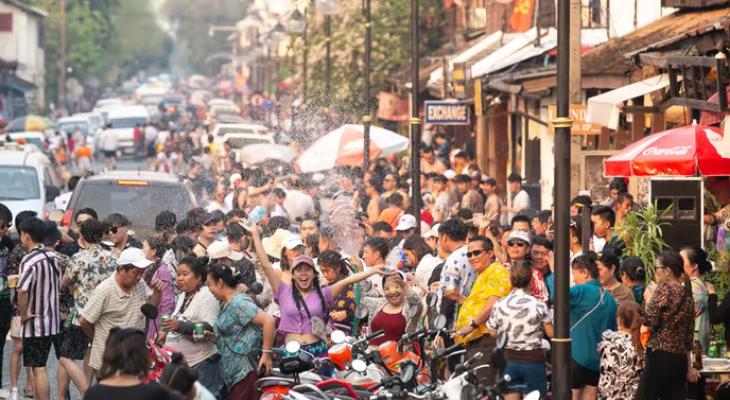
(The Conversation) — In many countries in Southeast Asia, such as Myanmar, Thailand, Laos and Cambodia, the arrival of spring also marks the beginning of the new year. Songkran (สงกรานต์), as the festival welcoming in the new year is called in Thai, is often celebrated with playful water fights on city streets over the course of three chaotic days.
In 2022, Songkran will begin April 13 and last until the evening of April 15. The dates are calculated via the lunisolar calendar, which accounts both for the movement of the sun through the zodiac and the moon’s cycles. Specifically, the dates mark the period when the Sun’s leaving the constellation of Pisces and entering Aries.
Over these days, cities turn into playful battlegrounds. Children emerge armed from their houses and bands of revelers gather on the sides of the roads ready to waylay passersby. This, though, is a war with water.
As a scholar of Thai religion and culture, I have done fieldwork in Bangkok and Chiang Mai off and on for many years. I first encountered Songkran in Bangkok in 2010, and it was shocking for me. After sustaining a few discreet squirts from children in my neighborhood I emerged into a full melee; staying dry was simply out of the question.
In Theravada Buddhism, the religion practiced from Sri Lanka to Laos, this is the most significant holiday of the year. The day is known as Sangkren in Cambodia, Thingyan in Myanmar, or simply Pi Mai in Laos.
In the diaspora, Songkran festivals happen wherever there is a Theravada temple, most notably in Los Angeles and Washington, D.C.
The festival is a clear display of “sanuk,” the Thai emphasis on making activities fun, when many hierarchies of class and generation are suspended, at least during the water war.
In the days before the beginning of Songkran, roadside stalls start to sell cheap plastic water guns – many of which break by the first pull of the trigger – to “armed” groups of children, who wait to soak adults whom they previously obeyed and respected. The most creative children fill their water tanks with ice, ensuring that the victims wince when they’re hit.
Along major streets in Bangkok, or around the city moat in Chiang Mai, groups gather, firing water pistols and lifting goopy handfuls of chalk powder to slap on each other’s faces – the chalk, incidentally, being a traditional sunscreen, often promoted as a natural beauty aid.
In the past two years, concerns over COVID-19 have put a damper on the festivities, as governments try to limit the number of participants and contact between them.
Having spent a significant part of the past 20 years living in and writing about the region, I am struck by how Songkran mixes a public carnival and family connections. In rural villages, Songkran means reunions as well as parties. Many families are supported by remittances from members working in Bangkok or abroad, and the holiday provides a chance to return home with gifts, money and temple donations.
Here, too, things turn into a party. In 2015 I spent Songkran in a fishing community near Nong Khai, in northeast Thailand. The town was suddenly full of new faces – people who had been working in factories in Korea, had married overseas, or simply lived and worked in Bangkok. In the mornings of each day, a tent was set up alongside the road, with dishes of spicy som tam papaya salad, minced pork larb and copious amounts of beer.
A hose fed constantly into a series of buckets, and as cars came down the highway, each of us would carry a fully laden bucket of cold water out into the road to soak the drivers.
Of course, this mix of chaos and alcohol can have dire consequences. The numbers of traffic fatalities spike during Songkran week each year – in 2018, there were 418 deaths linked with drunken driving in Thailand alone.
There is more to the holiday than just a water fight. In Thai versions of Hindu-Buddhist myth, the day draws from the rituals surrounding the severed head of Kapila Brahma, or Kabila Phrom in Thai, a Hindu sage who challenged a poor child with a riddle. A child who guessed incorrectly would lose his head, and the confident sage announced that he himself would suffer the same fate if the child guessed right. But the child could understand the speech of animals and overheard the correct answer. The sage lost his head, but his magic was so strong that his severed head would make the rains end if tossed into the sky, or cause the seas to dry if it touched the ground.
In the Burmese version, this myth stems from a conflict between two groups of divinities, and the headless Brahma’s body was granted a new elephant’s head and thus transformed into the Hindu God Ganesh.
In each version, a group of divine women – daughters of the sage in some versions, daughters of the god Indra in others – then took the original head and enshrined it in a cave on Mt. Kailash in western Tibet. Each year, one of the daughters would mount a different beast depending on the day of the week on which Songkran falls and take the severed head in a procession.
This year, the appointed daughter rides a donkey, carries a champaka flower, and wears green – something which everyday believers can do, too, to increase their fortunes. In Bangkok, this divine procession takes the form of a parade and beauty contest to elect “Miss Songkran.”
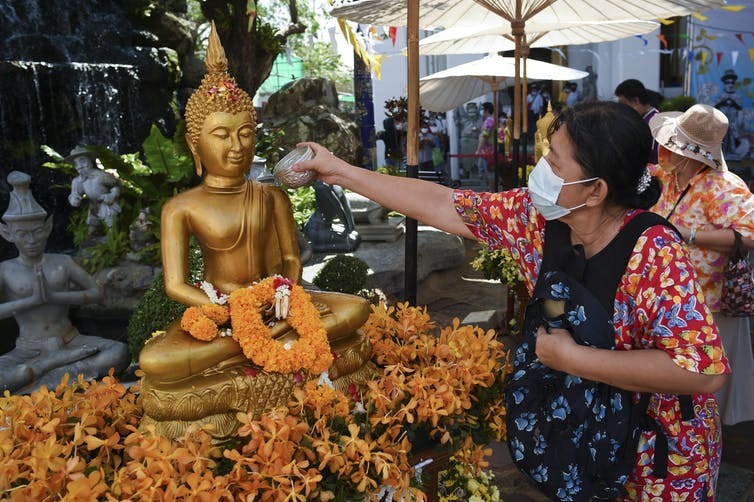
A woman pours scented water on a Buddha statue during Songkran at the Wat Pho temple in Bangkok, Thailand. Anusak Laowilas/NurPhoto via Getty Image