
The crown may be heavy, but it’s also the most illest, dopest, flyest headpiece you’ll ever wear. Whether it’s a fitted cap, head scarf, braids, hijab, dreadlocks, high ponytail, weave, wig, or even a shaved head, the crown holds infinite possibilities. Like many cultural practices rooted in underrepresented communities, it symbolizes identity and pride.
As I write this, I’m still moved by the energy of “Passing the Crown,” a new commission by Lincoln Center Performing Arts. This 90-minute experience, conceived by Juliette Jones and co-curated by a powerful all-woman team — Randi Freitas, Monique Brooks Roberts, and DJ Reborn — celebrates the spirit of hip-hop and the women who have shaped its legacy.
“Passing the Crown” is not just a performance; it’s a journey. Blending a 20-piece orchestration with the pulsating energy of hip-hop, it highlights the contributions of female and gender-expansive artists to the genre. The immersive performance, set to a playlist ranging from MC Lyte to Leikeli47, honors the queens of hip-hop, paying tribute to their impact on culture, art, and activism.
So why write about a hip-hop production for Interfaith America’s Magazine? Because, like interfaith communities, hip-hop is a space where generations come together to uplift the spirit. It’s about joy, connection, and collective healing — just like the gatherings we hold in our religious communities. In the same way that a faith leader fosters unity, a DJ in hip-hop plays music that unites people, creating a shared space for emotional and spiritual expression.
While “interfaith” hasn’t always been associated with the arts, I believe the two are deeply connected. Storytelling in all forms — be it music, dance, or art — allows us to see each other’s humanity and build empathy. It connects us across perceived differences, allowing us to witness each other’s spirits. Just as oral traditions, song, dance, and community form the backbone of hip-hop, they also bridge cultural and religious divides, helping us pass on wisdom and resilience to future generations.
The arts have always been a crucial part of interfaith dialogue, even if it’s not always acknowledged. Art transcends language, religion, and identity, creating spaces for people to connect, reflect, and heal. A painting, poem, dance, or song can bring people together, enabling them to experience the vulnerability and strength of the human spirit. In Black traditions, we use art as a practice for our community joy. From line dancing, double-dutch, creating beats and rhymes, singing, cracking jokes, our connection through the art of joy is ever-present in our daily lives. The Black Interfaith Project of which I am a proud fellow, is doing this work. Using what has given us our liberation, to bring forth our interfaith connections when our struggles of just surviving in America is task of faith.
As someone deeply involved in both the interfaith and arts communities, I often reflect on how we can uplift younger generations while bridging gaps between different faith-based groups. When I shared “Passing the Crown” with Kevin Coval, a senior consultant for Interfaith America and a mentor for my project Black Interfaith project, “The Movement of Joy,” I knew he’d appreciate it not only as a hip-hop head, but also as an artist and interfaith ambassador. His response affirmed the idea that art and culture are powerful tools for healing and connecting across faiths and generations.
The crown in hip-hop symbolizes liberation, much like the cypher — a sacred space where artists gather to express their emotions, thoughts, and prayers through improvisation. The cypher is hip-hop’s version of the ring shout, a spiritual practice that has deep roots in Black history, dating back to enslaved people on plantations. Both the cypher and the ring shout offer a space for collective healing, providing moments of freedom and expression in a world fraught with division and conflict.
We became a part of the performance, releasing fears and finding joy in the moment — just like we do in our religious and spiritual spaces.
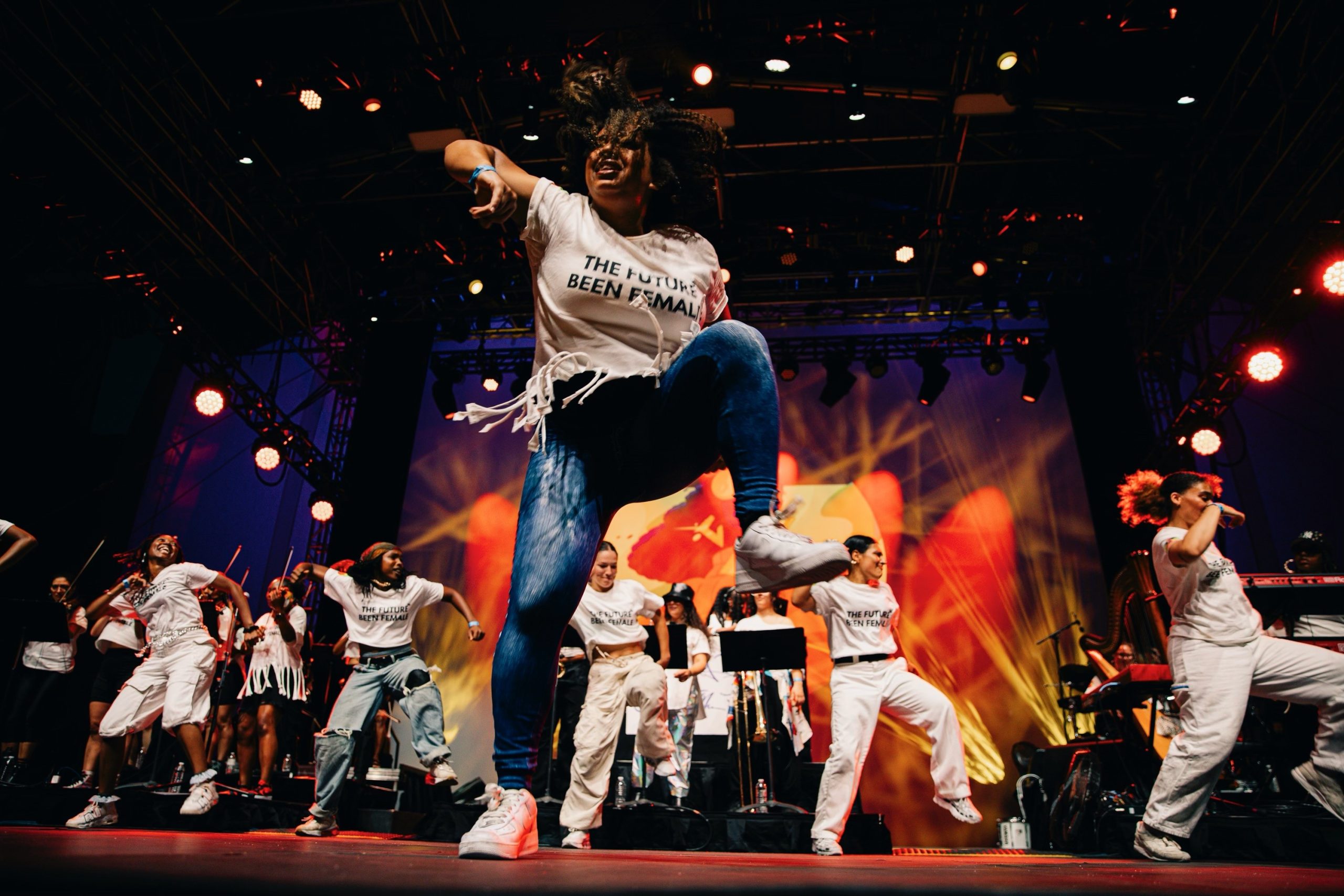
At “Passing the Crown,” DJ Reborn ignited the energy with her beats, setting the stage for a performance that brought over 2,000 people together in New York City. Dancers moved fluidly with ease and articulation across the stage, showing some of the most genius B-girl dancing. Graffiti artists tagged the set, and the orchestra elevated the experience, creating an atmosphere of collective liberation. As the crowd sang along to hip-hop classics, we became a part of the performance, releasing fears and finding joy in the moment — just like we do in our religious and spiritual spaces.
“Passing the Crown” is more than a performance; it’s a vision of how art can lift our spirits and bring people together across differences. As April Walker, the production’s costume designer and founder of Walker Wear, boldly stated with her designs, “The Future Been Female.” After witnessing this powerful display of unity and creativity, I’d add that the future is also interfaith.

Naila Ansari
A native of Buffalo, New York, Naila Ansari is a Cum Laude graduate of Point Park University’s Conservatory of Performing Arts program and is a distinguished M.F.A. from the University at Buffalo. Ansari is a SUNY Buffalo State University Assistant Professor in Theater and Africana Studies.
Ansari merges artistry and scholarship to tell Black stories in America. Her research and performance project “The Movement of Joy” archives stories of Black women’s joy nationwide. In addition to the film documentary of these stories, Ansari works with various foundations to build Arts and Culture programming. For more information, follow @naila_moves_joy on Instagram and movementofjoyllc.com.