• About Us
    • Mission & Vision
    • Team
    • Eboo Patel
    • Adam Nicholas Phillips
    • Board of Directors
    • Reports & Financials
  • Where We Work
    • Higher Education
      • Senior Leaders
      • Faculty
      • Students
    • Workplace
    • Civic Life
    • Health
    • Emerging Leaders
  • Get Involved
    • The Learning & Action Bridge
    • Courses, Curricula, and Tools
    • Grants & Leadership Awards
    • Events
    • Campus Training & Consulting
    • Corporate Training & Consulting​
    • Speaking
  • Magazine
    • Interfaith America Magazine
    • Voices of Interfaith America
    • Money, Meet Meaning
    • Press
  • Contact Us
    • Subscribe
    • Support Us
    • Our Supporters
    • Careers
    • Contact Us
  • About Us
    • Mission & Vision
    • Team
    • Eboo Patel
    • Adam Nicholas Phillips
    • Board of Directors
    • Reports & Financials
  • Where We Work
    • Higher Education
      • Senior Leaders
      • Faculty
      • Students
    • Workplace
    • Civic Life
    • Health
    • Emerging Leaders
  • Get Involved
    • The Learning & Action Bridge
    • Courses, Curricula, and Tools
    • Grants & Leadership Awards
    • Events
    • Campus Training & Consulting
    • Corporate Training & Consulting​
    • Speaking
  • Magazine
    • Interfaith America Magazine
    • Voices of Interfaith America
    • Money, Meet Meaning
    • Press
  • Contact Us
    • Subscribe
    • Support Us
    • Our Supporters
    • Careers
    • Contact Us
Subscribe
Support Us
Campus

The Future of Chaplaincy and How to Heal

By
Multiple Authors

November 16, 2020

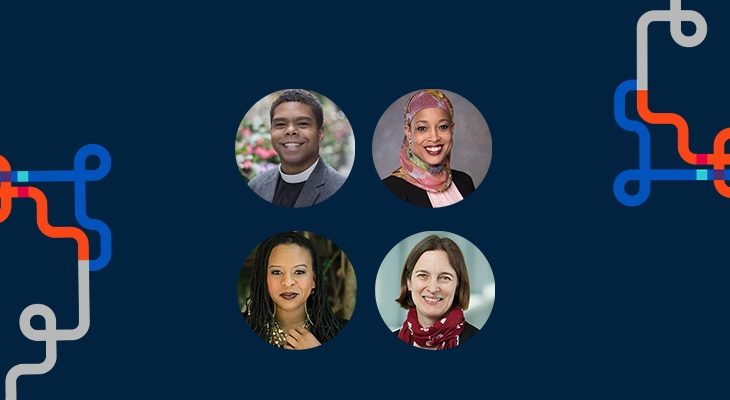
The religious, spiritual, and secular demographics of the US are changing and, with them, the role of chaplaincy. How can any one person support the spiritual needs and development of college students? How does a chaplain serve patients and their families, from Atheist to Zoroastrian, dealing with life and death? How does the history of chaplaincy in the military and the emergence of chaplains for social justice activists inform what preparation for this role entails? After months of protests against systemic racism, bitter partisan battles, and social distancing amidst an ongoing global pandemic, how can we heal? Join in this rich conversation with:

Tahara Akmal: “So we’re a stranger, we’re a companion, we accompany people. And most of all, from my tradition, we’re taught – every chapter of the Quran starts in the name of the divine, the most compassionate, the most merciful. So for me as a chaplain, what I’m doing as I’m walking in the room, I’m thinking to be compassionate. And one of the ways we do that is by respecting people and their beliefs, whatever people find meaningful and is giving them comfort or hope, however they describe it, is what we want to respect and be curious about. So we start with this idea that a chaplain is coming there not to change things, fix things, or to tell people what they should or shouldn’t do. We are there as a stranger invited into their space. And if they choose to share with us, that’s a gift. And that’s a blessing.”

Micky ScottBey Jones: “When I talk to other movement chaplains, or I talk to activists and organizers and clergy that are involved in faith-rooted organizing, and, you know, they really struggle with if they are allowed to stay home this weekend from the March that’s happening. They feel guilty if they don’t show up every time. And so I’ve been having this kind of vision lately – of this rotating ability. Like you pull forward for a while and then you’re able to pull back and there’s another group of people that are able to pull forward. And, you know, what if we actually had kind of that, you know, ability to – if we honored the rest and the resilience and the healing as much as the activism part, right? If healing, if care were so interwoven in everything, but in my, you know, context, particularly in, you know, social change movements so that we saw that as part of being able to stay in the work long-term.”

Wendy Cadge: “to me, the most important first transformative power of chaplaincy is to help us grieve. And, you know, I’m hopeful that in the coming months and days, there will be more opportunities for sort of public collective naming of grief, naming the names of people who have died as a result of all of these pandemics.”

Access the full conversation here.

Share

Related Articles

  • Civic Life

    Announcing the 2025-2027 Sacred Journey Fellows

  • Civic Life

     A Soundtrack to Liberation

  • Campus

    Imagining the Role of the University Chapel in the Year 2171

Interfaith America Magazine seeks contributions that present a wide range of experiences and perspectives from a diverse set of worldviews on the opportunities and challenges of American pluralism. The opinions expressed herein do not necessarily reflect those of Interfaith America, its board of directors, or its employees.

Latest Articles

Rockford Area Habitat for Humanity and the Team Up Project hosted the city’s first-ever Interfaith Build on Sept. 23, 2025.
  • Civic Life

Best of America: Building Homes and Bridges in Rockford, Illinois

Oct 30, 2025
The Rev. Eric Manning, center, speaks on a panel with Rabbi Hazzan Jeffrey Myers, right, moderated by the Rev. Jacqui Lewis, left, during the 2025 RNS symposium at Trinity Commons, Wednesday, Oct. 22, 2025, in New York City. (Photo by Kisha Bari)
  • Civic Life

Tree of Life Rabbi and Mother Emanuel Pastor: 7 Years of a Friendship Forged in Tragedy

Oct 28, 2025
Ithaca, New York - July 13, 2024: Photo of stone Ithaca College entrance sign (Shutterstock/TW Farlow Media)
  • Campus

The Next Chapter of Faith: Lessons from Ithaca and a Generation Unbound

Oct 22, 2025
Mahnoor Iftikhar, Pacific Lutheran University, speaks on a panel entitled “BRAID-ing Together Student-led Interfaith Projects" at the 2025 Interfaith Leadership Summit.
  • Campus

BRAID Student Fellows Speak on Their Bridgebuilding Projects

Oct 22, 2025
End of content
No more articles to load
Interfaith America, 141 W. Jackson Blvd, Suite 3200, Chicago, IL 60604, US

© 2024 Interfaith America

Instagram Youtube Facebook X-twitter Tiktok
  • Privacy Policy
  • Terms of Use

Copyright @ 2024 Interfaith America. All Rights Reserved. Interfaith America is 501 (c)(3) non-profit recognized by the IRS. Tax ID Number: 30-0212534