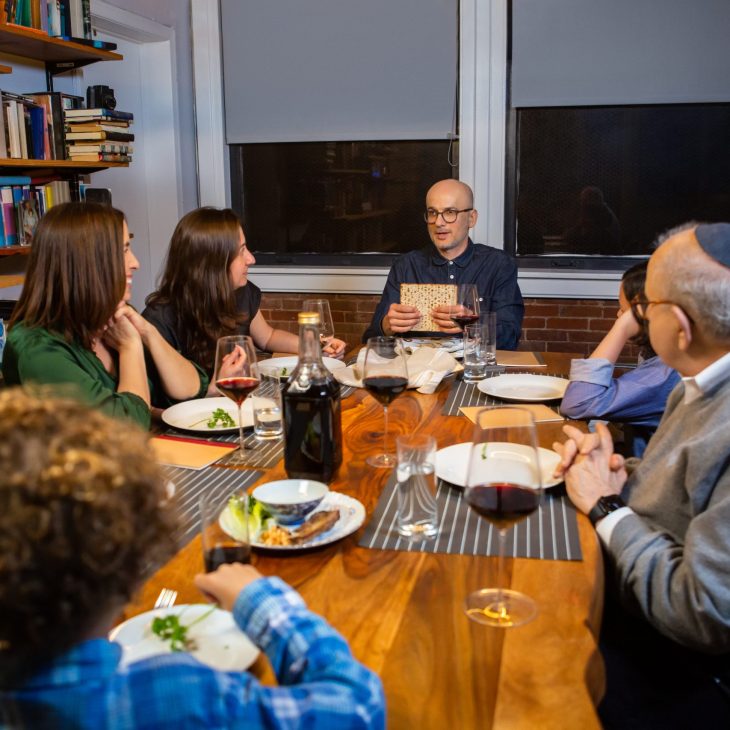
Next Wednesday night, Jews around the world will gather in their homes to celebrate Passover. We begin the holiday with a Seder, a festive meal where we recount the ancient story of the People of Israel’s exodus from Egypt and celebrate their transition from slavery to freedom.
Passover is a multisensory experience, the physical sensations of its rituals imbued with symbolic meaning that can help awaken our spiritual selves. When I think of Passover, I can taste the bitterness of the horseradish, symbolizing the horrors of slavery. I can smell my grandma’s inimitable chicken soup and hear the cadence of her voice singing Hallel, the blessings of praise. I feel the sensation of wine on my pinky finger, which we use to remove drops of wine from our glasses, representing our sorrow at the impact of the ten plagues on the Egyptians, despite the fact that they were our ancestors’ oppressors. I can see the faces of the friends, family, and acquaintances my grandparents would assemble each year for the Seder.
This year, my extended family will gather for our first Seder together in four years, since before the pandemic. It will also be our first Seder together without my Grandpa Saul, our family patriarch who led our family Seder for decades with his booming voice and dramatic reenactments. Although my grandpa will not be physically present this year – and I can already feel the sharp pain of his absence – his presence will most certainly be felt. Because Passover is a holiday that celebrates story and memory, that creates space for our ancestors and their stories to live on in our hearts and our collective consciousness long after they are physically gone.
The very name of the book that guides us through the Passover seder is the Haggadah, meaning “telling.” We spend less time in the Haggadah telling the story of the exodus from Egypt than we do recounting the stories that our ancestors told about that story – the way they debated it, intellectualized it, interpreted it, internalized it. This retelling of the retelling enables us to connect our stories across generations. We recite from the Haggadah, “In every generation a person is obligated to see one’s self as if they themselves had left Egypt.” Each year, we have the responsibility and opportunity to inhabit our texts once again and connect our own stories to our families’ stories and to the story of the Jewish people, and ultimately to the story of humanity.
The Passover story of transition from slavery to freedom is one that resonates with many other stories throughout history. The modern story that was central in my family’s Passover narrative was the freeing of Soviet Jewry from religious repression in the Soviet Union. My grandparents were proud activists in that movement, which drew inspiration from the story of Passover, using the line, “Let my people go” from Exodus 9:1 as their clarion call. Years later, my grandparents would often speak about it during our Seder, reminding us that our freedom should not be taken for granted. The message was especially powerful with our distant Russian cousins sitting with us at the Seder table, knowing they were only able to be here in the United States because of my grandparents and others who lobbied for their freedom. I imagine my ancestors in Eastern Europe and how grateful they would have been to have the religious freedom we have here today. While imperfect, our religiously diverse democracy is an inheritance for which I am endlessly grateful – and for which I continue to work.
The power of Passover, and of interfaith work, is that we can weave these different stories together in pursuit of our collective redemption.
The power of Passover, and of interfaith work, is that we can weave these different stories together in pursuit of our collective redemption. Rabbi Naamah Kelman, in the Women’s Seder Sourcebook, identifies that in the Passover story, “Two remarkable women met by the water: Pharaoh’s daughter and Miriam, the sister of Moses … Pharaoh’s daughter defied her father’s evil decree and risked his wrath by taking Moses into her home. She and Miriam together began the cycle of love, hope, and ultimately redemption.”
What a beautiful observation. It is the interfaith encounter between these two women from vastly different backgrounds, both of whom demonstrated extraordinary courage in the face of oppression, that begins the virtuous cycle of love and compassion, ultimately leading the People of Israel to freedom.
This year, I will continue the act of telling and retelling. I will tell the story of my ancestors’ exodus from Egypt. I will highlight the stories of the courageous women who came together despite all odds to embody love and hope. I will tell the stories my grandparents told me about modern day freedom movements in their time. And I will share those stories – weaving them together anew with my own interpretations – with my own children. Whichever holidays you may be celebrating this spring, whether religious or secular, I hope you have the opportunity to weave together the stories of your past to tell your own story, too.
Share
Related Articles
American Civic Life
American Civic Life
Passover is Here. Why are Some Christians Celebrating this Jewish Ritual?
Higher Education