Running Thread: Art, Iconoclasm, and Religious Diversity
January 23, 2023
One of my favorite pieces of art is a bold creation of the Jewish artist Marc Chagall. It bewilders and vexes.
Initially, it hit home but I couldn’t say fully what it meant. Was it Keats or Yeats who said good poetry connects in transcendent meaning and then we seek to articulate what we can of our understanding in mundane language? That can be said of all good art, and that’s how I felt about the “White Crucifixion.” It’s a counterpoint, for me, of another great cruciform piece from a different master of color and line: Georgia O’Keeffe’s “Black Cross, New Mexico.” Both pieces are held, luckily for Chicagoans, at the Art Institute of Chicago — a short walk from IA’s offices.
Chagall is lush in detail, and plain in the integration of Jewish persecution throughout the piece. Pogroms, refugees, burning villages, advancing troops, a fearful mother clutching her babe, the Biblical patriarchs and a sole matriarch in mourning, the Torah in flames. And then of course, Jesus, in a Jewish prayer shawl for his loincloth and a headcloth for his crown of thorns. Appropriation? I don’t think so. My own Christianity welcomes such depiction – and Jesus, I believe, is appropriately situated in his Jewishness. O’Keeffe’s piece emerges out of the sparse New Mexican desert, unadorned and regal.
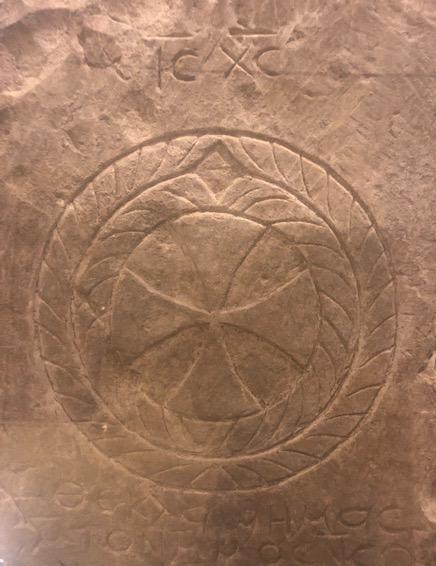
Thinking about these pieces in light of recent conversations around the uses of religious imagery, I couldn’t help but think of a historical intra-Christian tension and continued practices around depictions of Jesus on (or absent from) the cross. The Catholic crucifix is defined by its inclusion of Jesus dying on the cross, emphasizing his torture and death. That bodily depiction is largely absent in renditions of the cross in the Churches of the Reformation. I have seen both in Orthodoxy, but my favorite and most ancient Coptic Orthodox crosses do not include Jesus – they mimic the aridity O’Keeffe saw in a different desert. Here’s one from my personal photos taken from a 3rd century headstone in Luxor, Egypt.
As for the raging intra-Christian tension, consider iconoclasm in Byzantine Christianity in the 8th and 9th centuries. Imperial and religious authorities literally smashed images – icons – of saints and religious figures. Reasons for this are debated by historians, who often see imperial and economic interests intersecting with theological interpretations of foundational precepts. Take, for example, the Ten Commandments and the prohibition of “graven images or likenesses” in Deuteronomy 5:8.
The work of IA emphasizes that religious diversity matters in a unique way because it deals with the different things people hold most sacred. I believe that this lies at the root of religious difference and differentiates religious diversity from other forms of diversity. Religious difference overlaps with other forms of identity and belief but remains different in kind from gender, sexuality, race, or ethnicity. And, of course, debates over what is and is not sacred are present within traditions themselves. Some would say that those debates actually constitute traditions.
So what are we talking about when we talk about religion? Should you choose to go further I would recommend the ongoing column by that title in Criterion, by The University of Chicago Divinity School. It is more than meets the eye, stirs the heart, beckons the conscience, captures the imagination … and then some.
Share
Related Articles
American Civic Life
American Civic Life
American Civic Life