Ken Burns Portrays The Multitudes Of Muhammad Ali
September 24, 2021
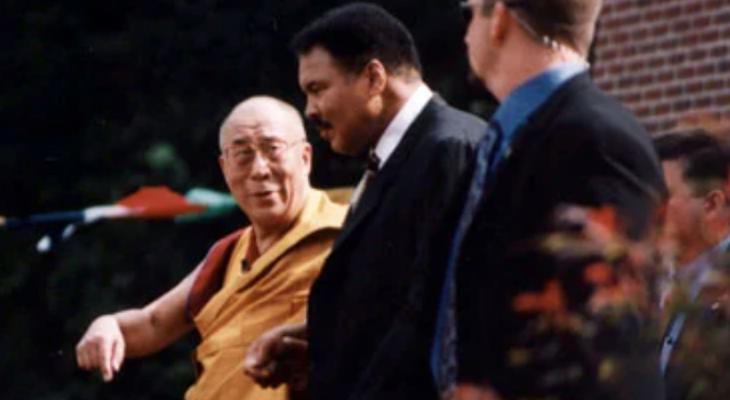
(RNS) — There are rare individuals whose lives are so vast and extraordinary that they reveal a nation to itself, who are at once a mirror to America and who are themselves America in miniature. The 19th century gave America Walt Whitman. The 20th, Muhammad Ali.
Ali, like Whitman, contained multitudes. He was cocky and cruel, full of deep principles and flagrant hypocrisy, lightning quick to make decisions, too obstinate to change them and reflective enough to speak openly of his regrets years later.
The epic eight-hour documentary by Ken Burns, his daughter Sarah Burns and her husband, David McMahon, airing now on PBS, is worthy of the man. Don’t miss a minute of it. In fact, take a full day and watch it straight through. The pacing, the photos, the music, the fight scenes, the expert interviews amount to a work of art; the raw, brutal and beautiful honesty in which it deals with a raw, brutal and beautiful human being.
Anybody who thinks they know Ali will learn a dozen new details that add complexity to both the man and the myth. Perhaps you know that Ali rejected Malcolm X, but did you know that Elijah Muhammad cast Ali out of the Nation of Islam and withdrew the Muslim name he gave the fighter?
Ali never changed his name back to Cassius Clay, but he never spurned the Nation of Islam leader, either, maintaining his allegiance to Elijah Muhammad until the end.
Perhaps you know that boxing is cruel, but you will want to cover your eyes during the scenes where Ali deliberately toys with Ernie Terrell, punching hard enough to hurt but not to knock him out, ensuring that his rival suffers pain and humiliation for a full 15 rounds, shouting, “What’s my name?” at Terrell until the end.
And you will want to cover your ears as Ali taunts his rival Joe Frazier with insults unmistakably tinged with both racism and classism, all while presenting himself as a model of Black dignity.
We have an image of Ali as stubborn about everything. On some matters, that was true. Ali never changed his stance on the Vietnam War. He lost three prime years of his boxing career to that stance and was ready to serve five years in jail for standing by his position.
But in so many other ways Ali evolved. “A wise man changes but a fool never changes. And I’ve changed because I’ve become wiser,” said Ali in an interview with his chief verbal sparring partner, the broadcaster Howard Cosell.
The most moving parts of the film, for me, are the sections that chronicle those changes. No longer quick with his feet in the ring, Ali needed to be quick with his mind, crafting strategies that help him win the heavyweight title back from younger fighters such as George Foreman and Leonard Spinks.
It’s the role of his Muslim faith in those changes that I found most moving of all. There is more than a whiff of hypermasculinity in Ali’s conversion to Islam as a young man — even toxic masculinity you might say. For the Ali of the 1960s, Islam is not just the Black man’s religion, it is the strong man’s religion. None of this ‘Lie back while they hit me with their police batons’ crap. None of this ‘Please let me integrate with you’ garbage. The film even quotes Ali expressing admiration for George Wallace. He’s a fellow separatist, Ali points out. He doesn’t want to integrate with us, and we don’t want to integrate with him. That’s a logic that Ali could live with.
But as his boxing career ends, as his marriages, one after another, fail, it is Islam that holds Ali up and guides him. Ali prays regularly, studies Sufi poetry, participates in exhibition bouts to build mosques, personally distributes pamphlets about Islam being a religion of peace.
I met Ali at this stage of his life. It was in the early 2000s, and college students from my organization, Interfaith Youth Core, were doing a presentation for Chicago’s annual Leadership Prayer Breakfast. Our group was waiting at the elevator banks at the Hilton Hotel on South Michigan Avenue when the doors opened and there he was. His face was stiff, he needed help walking out of the elevator, but his whole being glowed. Ali stopped and greeted us and asked what we were doing.
“Praying for peace,” one of the young people said.
The champ’s body shifted, I saw his hand move ever so slightly toward us. I think he was giving us a blessing.
Religion is for the imperfect. It is machinery for improvement. If you were cruel, it can help you become gentle. If you were hypocritical, it can help you be honest. If you shake while you stand, it can straighten out your soul, if not your spine.
Some people were lucky enough to have a ringside seat for what Islam did for Ali. The rest of us, we have this documentary.
Sherman Jackson, the great African American scholar of Islam, said of Ali: “Whatever one’s background is, Ali belongs to America. All of us. And he belongs to all of us because he affected all of us.”
May his model make us better.
Share
Related Articles
American Civic Life
The Interfaith Legacy of Muhammad Ali: “The Wise Man Changes”
American Civic Life
Eboo Patel and Wajahat Ali: Is “Interfaith America” Even Possible?
Interfaith Inspiration