What I Learned about Interfaith at a Black Church Conference
March 2, 2023
To sing or not to sing. It’s not usually a dilemma I face. After all, I was raised in a church with a strong music program. I sang in choirs from age six through seminary. Not so long ago, I joined voices in song at an interfaith Thanksgiving service that felt in my bones like a foretaste of heaven this side of the dirt.
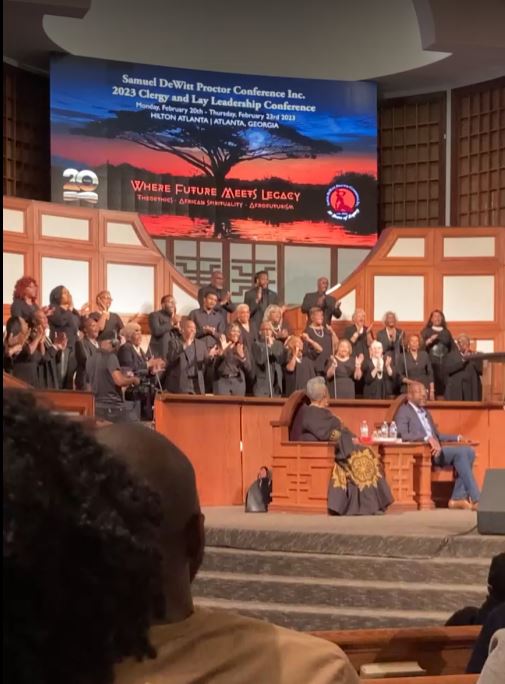
Yet here I was, at the Samuel DeWitt Proctor Conference in Atlanta, worshiping with a sanctuary full of mostly Black clergy and lay leaders at the historic Ebenezer Baptist Church, just three pews behind its pastor Senator Raphael Warnock. It was time to sing the Black National Anthem, “Lift Every Voice and Sing,” a hymn we sing at my own (mostly white) church every February.
But this time, in this place, I found myself mostly dumbstruck, lifting my own voice only in fits and starts.
We have come, over a way that with tears has been watered,
We have come, treading our path through the blood of the slaughtered
Who am I, I wondered deep within, to sing a story that is not my own—worse still, a story whose legacy still benefits me while imperiling God’s beloved children?
I found myself at Proctor because of Interfaith America’s work to destigmatize HIV and AIDS in the South through campus partners with strong ties to the Black community. The program is funded through Wake Forest Divinity’s Faith Coordinating Center, whose Executive Director Dr. Allison Mathews was a featured speaker at the conference. Between honest conversations about health equity and impassioned, Womanist preaching, I found myself humbled and simply grateful for the gift of “listening in” on a community’s faithful response to issues of the day.
Who am I, I wondered deep within, to sing a story that is not my own—worse still, a story whose legacy still benefits me while imperiling God’s beloved children?
To sing or not to sing. With all my heart, I wanted to join my voice in solidarity with a movement designed to unleash the Black church’s formidable spiritual resources in service to justice and equity throughout our land. Yet I couldn’t help but wonder if my voice, as a woman of privilege on so many levels, might not be quite “pitch perfect” for the chorus.
To sing or not to sing. It strikes me now that this unresolvable tension lies at the heart of what we do at Interfaith America. As I unpack from Proctor, I’m sitting with this question: How does our mission to unlock the positive potential of religious diversity relate to our commitment to racial equity? And though I don’t have clear answers, Proctor shed important light on the through lines connecting our work.
For one thing, both the conversations and the worship at Proctor modeled strident truth-telling anchored in God’s empowering love for ALL of God’s children. “More than speaking truth to power,” said one speaker, “we must speak truth with power.” We talk a lot about “asset framing” at Interfaith America—about finding “the good” and elevating it. Proctor rooted that approach in the abiding conviction that our power comes from a divine love that is deeper and wider than we can begin to fathom.
For another, I was struck by the wide diversity of traditions represented at Proctor—from Pentecostal to Lutheran to United Church of Christ to African Methodist Episcopal Zion. That means some were dancing in the aisles and crying out, while others swayed gently to the stirring music. Their theologies and even views of scripture don’t necessarily align. Yet as one new friend put it, “There’s nothing like Proctor. We come from all these backgrounds, but we all sing the same songs.” At Proctor, difference didn’t turn into division; it introduced texture and beauty to the shared story.
We come from all these backgrounds, but we all sing the same songs.
Finally, Proctor resounded with hope. Don’t get me wrong: there was no hint of naïve optimism to be found. We lamented the sin of “politicians, police, pastors, and politicians.” We reflected on our own part in the system. We listened intently to a sermon on the Biblical story of Jephthah’s vow, which our preacher called a “complicated and terrorizing text.” Yet woven throughout Proctor was the strong claim that God’s Spirit is up to something good, that we’re called to get in God’s “way,” to be part of God’s redemption of this world.
At Interfaith America, we’re committed to bridgebuilding across all kinds of difference. But at our core lies the conviction that what matters most is the religious or spiritual or philosophical foundation that inspires us and connects us to one another. In other words, our bridges can’t hold the weight of our messy humanity unless they’re anchored in a deep sense of being and belonging that comes from something greater than ourselves.
To sing or not to sing. I’m still not sure, but I’m okay about that. Proctor reminded me that it’s okay, or even a good thing, to sit with my discomfort, to grapple with my own sin, to own up to uncomfortable truths, because I am a beloved child of a God whose spirit is at work to make all things new.
Sing a song full of the faith that the dark past has taught us,
Sing a song full of the hope that the present has brought us;
Facing the rising sun of our new day begun,
Let us march on ’til victory is won.
Suzanne Watts Henderson is a Senior Consultant at Interfaith America.
Share
Related Articles
Higher Education
What Does Interfaith Engagement Mean from an Evangelical Perspective?
Higher Education
American Civic Life
The Interfaith Legacy of Muhammad Ali: “The Wise Man Changes”