Florence Nightingale and Holism in Healthcare
May 6, 2021
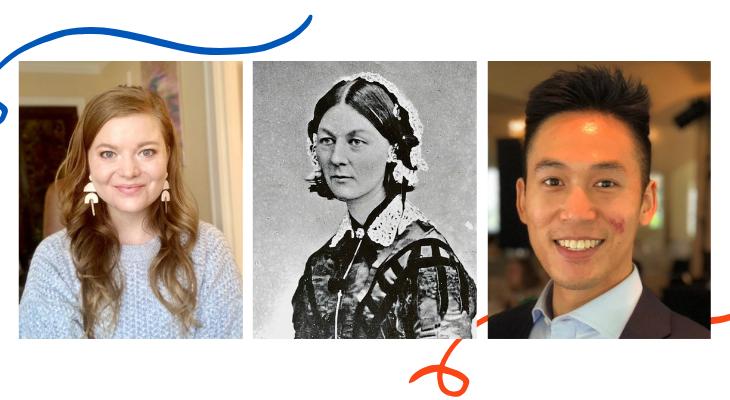
Florence Nightingale – the originator of modern nursing – wrote in Notes on Nursing that, “It is often thought that medicine is a curative process. It is no such thing…nature heals the wound…medicine, so far as we know, assists nature to remove the obstruction, but does nothing more. And what nursing has to do in either case, is to put the patient in the best condition for nature to act upon him.”
Nightingale perfectly describes the interdependence of medicine and nursing. The reliance of a physician on a nurse and vice versa. In this fashion, Anastasia – a nurse and future Doctorate of Nursing Practice-nurse practitioner – and I – a physician by training and a future pediatric plastic surgeon – were the ideal tandem to address interfaith and its intersection with healthcare.
Both interfaith leaders by passion, we found our calling through our experiences as university undergraduate students. Anastasia first experienced inter-religious cooperation in India between communities of Muslim and Hindu women who co-created a health clinic for their most vulnerable community members. I experienced interfaith dialogue and exploration as a mentor for a cohort of high school students in an experiential course visiting varied sacred sites of worship throughout greater Houston. Our paths crossed as Anastasia created the Interfaith in Healthcare Cohort with IFYC, and I became an active member, trying to increase my tangible contributions to the field of religious and spiritually competent medicine.
As a nurse and a physician occupying different spheres in relation to the patient, Anastasia and I held comparable but also differing views about the role of religion and interfaith in the realm of patient care. I was concerned about how my treatments may disrupt or detract from my patients’ spiritual and religious self, and Anastasia was concerned about creating an environment where the patient could personify their spiritual or religious beliefs and practice their rituals. However, we did agree that far too often the aspect of faith and spiritual well-being is left out of the general wellness of healthcare practitioners.
As a medical student, I saw that there is collective energy towards incorporating faith, religion, and spirituality into the thoughtful, empathetic care of patients. However, this passion to meet patients with holism (the treating of the whole person, taking into account mental and social factors, rather than just the physical symptoms of a disease) does not extend towards how we see our fellow nurses, scrub technicians, healthcare social workers, and physicians – to name a few members of the overall healthcare team. Anastasia echoed a similar personal distance she experienced with her fellow healthcare practitioners.
With this need in mind, Anastasia and I wanted to create an experience for healthcare practitioners and healthcare-adjacent professionals to explore their spiritual and religious well-being amongst one another. Our timeline was upended by the COVID-19 pandemic, but the harrowing experience we have all faced as a collective healthcare union uncovered how important it is that we commiserate, reflect, and improve from trying episodes together rather than separately.
Anastasia experienced how colleagues who had felt and continue to experience the heaviness of caring for patients during this pandemic needed a space to connect with others. It became so much more transparent than we all occupied many roles in and out of the hospital. Some healthcare professionals are caretakers of young children displaced from the physical classroom. Some healthcare professionals are caretakers for vulnerable parents with pre-disposing conditions. Ultimately, Anastasia and I were inspired to design a workshop that would not only allow primary and healthcare-adjacent workers to explore spiritual and religious well-being with others but also explore “wholeness” and the various roles we each play in the hospital, the home, and the place of worship.
We recently led a workshop with a group of twelve passionate interfaith leaders in the healthcare space exploring two exercises that asked the cohort to reflect on what makes them whole and how they can influence their professional and interfaith communities. Through this initial experience, I learned we can only enact change and be interfaith leaders when we are fully present and cognizant of who our colleagues are in the professional and personal settings. The COVID-19 pandemic has taken a toll on our healthcare union; however, I can clearly see how we take earnest steps to overcome, integrate, and better ourselves from this experience as both interfaith and healthcare leaders.
Share
Related Articles
American Civic Life
American Civic Life
American Civic Life
How My Interfaith Friendship Helped Me Better Support Healthcare Workers