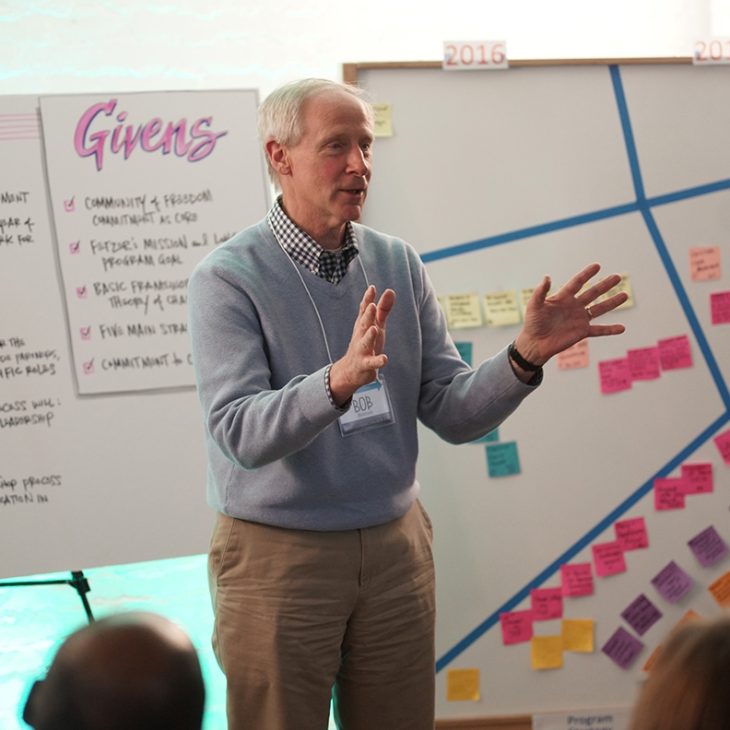
It was in elite higher education where Bob Boisture, the President of the Fetzer Institute, first encountered what he calls ‘the cultural operating system of the enlightenment’. It was an approach to the human condition that seemed to dismiss everything from moral intuition to meaning-making. “It was atoms and molecules all the way down,” Boisture said.
He remembers it being a thin gruel compared to the rich faith-filled world in which he was raised.
He remembers a professor he had at Oxford, a world-class philosopher, who once asked him: “Bob, why do you keep insisting that there are objective moral standards in the world?”
Bob almost didn’t understand the question. It just seemed clear as day that love is right and inflicting harm is wrong and that if we don’t learn to live more by the love we lose something very deep, namely, what it means to be human.
The funny thing, Bob noted, was that the philosopher didn’t live his life by his own Enlightenment-oriented precepts. He loved his kids. He made sacrifices for his spouse. He had empathy for people’s anxieties and struggles. At the level of anthropology, even the humans that professed a deep faith in the ways of hyper-rationalism, were more like the rest of us than they were like their ideas.
Bob’s work as President of the Fetzer Institute allows him to nudge the world closer to this worldview. Fetzer partners with a range of organizations, ranging from significant media outfits like Krista Tippett’s ‘On Being’ to major civil society players like the Independent Sector, to run programs that model wholeness.
He has a lot of hope for religious traditions, especially when they work together. Faith traditions give very different first-order accounts of the mystery of existence, he noted to me, but they all hold up the idea that there is a bigger story of the human family, that life is infused with sacredness, moral meaning, and purpose.’
Interfaith work is crucial to Bob’s vision of new world order because it encourages diverse faith communities to stand shoulder to shoulder for the sacredness of reality, of human beings, and of the natural world.
And just because he critiques the enlightenment cultural operating system doesn’t mean that he eschews it all together. Science and rationalism are hugely important when they stay in their proper domain. It’s when they seek to rule everything that we have problems ranging from people losing confidence in their own moral intuition to the total desertification of the natural world.
In Bob’s view, the Covid-19 moment is full of both possibility and peril. He calls it a stress test for our social system in real-time. The heart patient – which is to say, modern civilization – is on the treadmill and not doing well.
But when the failure is so obvious, it opens up opportunities to build new and better ways of living, including a more complementary relationship between science and spirituality. At the same time that medical science is doing its best work in racing towards treatments and vaccines, people are reaching deep inside their spiritual core and finding ways to care for one another and hope to endure.
Nothing is inevitable, Bob emphasizes. We may well come out of this worse off than we were before. But he is seeing a new energy around a paradigm-shift. He is seeing lots more people recognize the nature of the crisis we are in and saying things like, “We need a sober recognition that on our current course our system fails and our way of life dies. It’s time for a different way of living. I want to look my grandkids in the eye and say I did everything I could do to make that better civilization a reality.”
What might be the fountainhead institution for that kind of work? It turns out that it is the very place where Bob encountered his initial frustrations about the enlightenment cultural operating system – the college campus. Colleges, Bob likes to say, contain the best of our humanistic impulses. They preserve wisdom, they help young people find their purpose, they attempt a balance between science and spirituality that models wholeness.
This crisis may well turn out to be a breakthrough moment for a new way of thinking in higher education. Bob cites evidence from the IDEALS survey, which found that an overwhelming number of incoming first-year students say that they expect college to engage them in questions of meaning and spirituality. And there’s plenty of evidence from IDEALS and elsewhere about courses and other campus-based programs that nurture what Bob calls, “a holistic notion of flourishing that is centered on a reciprocal commitment to hold each other in love.”
What if, out of this crisis, colleges nurtured a rising generation committed to making that ethic the center of a new cultural operating system?
Share
Related Articles
American Civic Life
American Civic Life