Biden Recalls the Democratic Charity of Abraham Lincoln
November 11, 2020
(THE CONVERSATION) On Nov. 7, in his hometown of Wilmington, Delaware, Joe Biden delivered his first speech as president-elect. In declaring victory, Biden spoke directly to those who didn’t support him.
“And to those who voted for President Trump, I understand your disappointment tonight. I’ve lost a couple of elections myself. But now, let’s give each other a chance. It’s time to put away the harsh rhetoric. To lower the temperature. To see each other again. To listen to each other again. To make progress. We must stop treating our opponents as our enemy. We are not enemies. We are Americans.”
I am a scholar of democracy and ethics, and Biden’s words call to mind Abraham Lincoln’s second inaugural address. Delivered on March 4, 1865, after his reelection and at a time when Union victory was in sight, that speech – like Biden’s – called for a new beginning after a time of extreme division.
Both speeches also reflect an idea of democratic charity – that we all deserve to be heard, respected and given the benefit of the doubt.
Opponents, not enemies
Biden’s words, “We are not enemies. We are Americans,” also recall Abraham Lincoln’s first inaugural speech, delivered in 1861. Lincoln used the occasion to make a poignant but vain appeal to his fellow citizens to forgo the looming American Civil War. Ending his speech, Lincoln said:
“We are not enemies, but friends. We must not be enemies. Though passion may have strained it must not break our bonds of affection. The mystic chords of memory, stretching from every battlefield and patriot grave to every living heart and hearthstone all over this broad land, will yet swell the chorus of the Union, when again touched, as surely they will be, by the better angels of our nature.”
But to me, the more important part of Biden’s speech was his plea that we “give each other a chance.” These words summon Lincoln’s second inaugural address. That speech ended with these words:
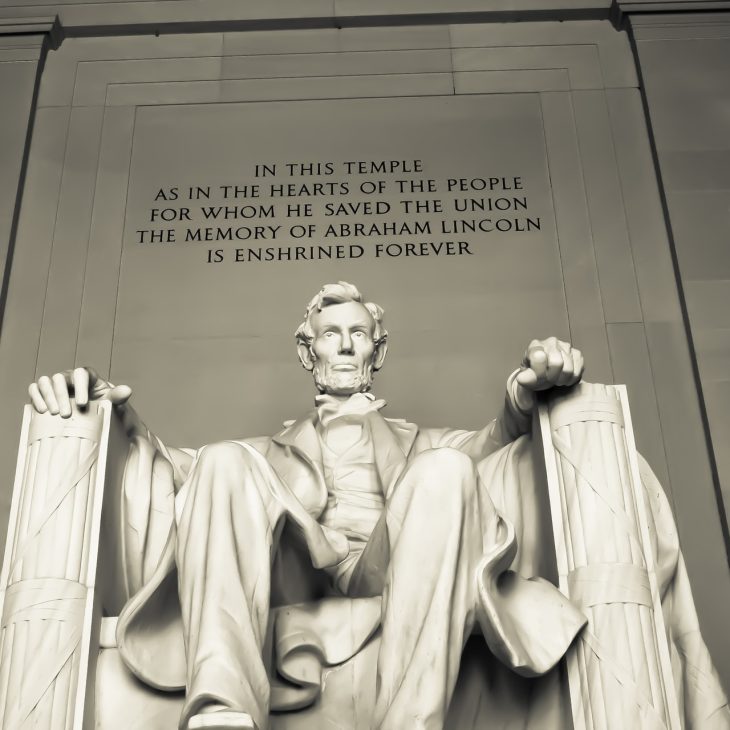
“With malice toward none, with charity for all, with firmness in the right as God gives us to see the right, let us strive on to finish the work we are in, to bind up the nation’s wounds, to care for him who shall have borne the battle and for his widow and his orphan, to do all which may achieve and cherish a just and lasting peace among ourselves and with all nations.” These words are carved on the wall of the Lincoln Memorial in Washington, D.C.
Both Lincoln’s speech and Biden’s call for a new beginning after a time of extreme division. And both reflect a specifically democratic idea of charity that all Americans ought to strive for.
Democratic charity
For most people, charity refers to instances when someone gives away something that the other person needs: food, shelter, or just a cash donation. There is usually, therefore, a power imbalance between the giver and the receiver.
Scholars and philanthropists alike acknowledge that paternalism and even condescension are always risks associated with such an unbalanced relationship.
Democratic charity is different. It doesn’t start with an unequal relationship. Instead, it reflects the idea that in a democratic society we are equal. And all citizens are both givers and receivers.
Democratic charity means assuming, at least to start, that just like me, my opponent is a person of goodwill, who loves his or her country, and conveys beliefs honestly.
Lincoln’s call for charity rested on the Christian notion that all Americans have fallen short of God’s judgment. While he plainly believed that slavery was an affront to God, he also encouraged those in the North to “judge not, lest we be judged.”
That phrase comes from the Gospel of Matthew, in which Jesus admonishes his followers that they should concern themselves more with their own sin and less with the sins of others.
The point is that all people have fallen short. And knowing that, Lincoln says, ought to make Americans more likely to practice charity toward those on the other side, even the other side of a bloody civil war.
Charity starts with humility
For Lincoln, charity starts with humility. Contemporary research by Julie Exline and Peter Hill confirms this insight. In three separate studies, their results show that humility is “a consistent and robust predictor of generosity.”
What’s more, this is a common refrain within Christian, and especially Catholic, theology. St. Bernard of Clairvaux, a monk, and doctor of the Catholic Church, argued in the 12th century that it is only after the monk fully understands his own sinfulness that he can genuinely serve others. In 2019, Pope Francis echoed this sentiment when he said that charity without humility is “sterile.”
But while humility readily stems from the Christian concept of sin, that is not the only foundation. In my own work, I have argued that humility can start from the fact that all human beings are subject to motivated reasoning and confirmation bias.
Just like sin, these effects too are universal and inescapable. As a result, no one sees the world just as it is. When one recognizes this fact, it is likewise possible to develop a more generous perspective toward those on the other side. Here too, democratic charity toward others begins with a democratic sense of humility about the self.
[Insight, in your inbox each day. You can get it with The Conversation’s email newsletter.]
How we move forward
The end of an election can be an opportunity to reaffirm a shared commitment to one another as Americans. This is no small thing. Accepting a loss in which one has invested so much hope, time and treasure are never easy.
But right now, as with the end of the civil war, divisions are deep and fraught with distrust, rancor, and, in many cases, outright hatred. Baseless and reckless claims of voter fraud are perhaps the latest manifestation of that condition. To many, Biden’s words may therefore seem woefully insufficient to the task.
But as it was true for Lincoln, the effort itself is worthy. The democratic charity offers Americans the opportunity to take a step back from hatred and give one another a chance.
The Conversation is an independent and nonprofit source of news, analysis and commentary from academic experts. The Conversation is wholly responsible for the content.
************************************
If you are looking for a way to become an interfaith leader, work for racial equity and build bridges, please check out our free curriculum “We Are Each Other’s” and start your interfaith leadership today.
Share
Related Articles
American Civic Life
American Civic Life
American Civic Life
Biden DHS Nominee Meets With Faith Groups On Immigration, Refugees