Applying Interfaith Skills to Politics
April 27, 2021
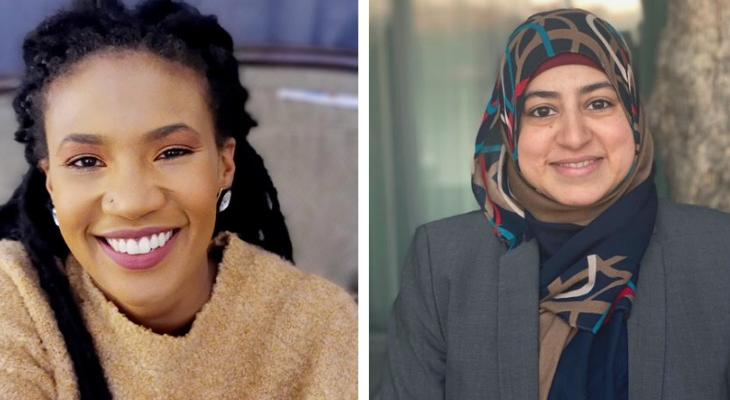
Jasmine Whaley is a minority rights advocate and digital communications specialist from Greensboro, North Carolina. Her career has included experience in social entrepreneurship, tech for social good, and ethical policy design. She believes that the core work of organizing exists at the intersections of our identities and lived experiences, because of this she’s coordinated political actions with Muslim and Jewish communities and has organized several anti-racism efforts across Europe and the United States. Jasmine is currently a National Organizer with Unemployed Workers United and is a 2020 IFYC Race Equity and Interfaith Cooperation Awardee.
Usra Ghazi is a Senior Advisor at America Indivisible, a nonprofit coalition addressing anti-Muslim bigotry by strengthening neighbor-to-neighbor ties in local communities across the United States. She has worked as an interfaith leader and organizer in various capacities over the past decade including work with IFYC, Kids4Peace, and the Pluralism Project at Harvard University. She has also served as a commissioner on D.C. Mayor Muriel Bowser’s Interfaith Council and as a policy fellow for the City of Boston in the Mayor’s Office for Immigrant Advancement. She holds a master’s degree from Harvard Divinity School in Religion and Politics.
As early and mid-career professionals, we have found that the skills and knowledge gained through our interfaith work while college students have made a significant impact on our current work in the community organizing and nonprofit sectors. Some might assume that there is little application in the real world of campus-based interfaith and justice-oriented organizing. This assumption is compounded by another one; that Religion and Politics are divisive factors of social life and must be avoided in polite conversation. We former college interfaith organizers beg to differ.
The past four years have devastated communities across the United States with issues including police violence, climate change and environmental degradation, racism, anti-Semitism anti-Muslim bigotry, and political upheaval. These have also been years when religiously diverse communities have stepped up to organize across faith and race by engaging civic institutions, and speaking truth to power. This kind of work requires an understanding of how religion operates in public life. Each of us has approached this intersection in our own ways; Usra, through civic health in local governance and Jasmine, through popular education in community organizing.
In its work to address racialized anti-Muslim bigotry, America Indivisible has found that communities impacted by this form of hate, Muslims, Arabs, Sikhs, South Asians, communities of African descent and others, tend to be least supported by their local governments. For Muslims in particular there have been concerted attempts to institute anti-Muslim legislation in states across the country and explicitly anti-Muslim rhetoric used in election campaigns at all levels of government. It’s not surprising then, that Americans of Muslim faith are least connected to their elected representatives according to a 2019 report by the Institute for Social Policy and Understanding. This is why America Indivisible works to build the civic health of Muslim Americans and communities perceived to be Muslim who also bear the brunt of anti-Muslim sentiments.
Civic health is not just about registering to vote and showing up at the polls. This concept, adapted from the National Conference on Citizenship, includes various behavioural factors such as the extent to which individuals are connected to their neighbors, aware of local issues, and engaged in local community projects. We have found that communities with higher degrees of civic health tend to be more resilient in the face of hate. When elected officials know the local Islamic center and have the number for the local Synagogue’s leaders on speed dial, they are better equipped to respond when these communities are targeted. Furthermore, they are able to build proactive ties with the religiously diverse communities that make up their constituents. Muslims, Sikhs, and other minority faith groups are increasingly active in these civic arenas. Christian Americans and other groups with privilege and political influence are also stepping up as interfaith allies. This project of building the civic health of religiously diverse Americans is a long-term project, and early career professionals with interfaith skills will be critical in making it successful.
Another way to think about the intersection of Religion and Politics is through the concept of Popular education, an educational model that was designed with a political purpose. The Oregon Community Health Workers’ Association describes popular education, or the People’s education, as “…an approach to education and organizing that…is based on the ideas that (1) the knowledge gained through life experience is just as important (and sometimes more important) than the knowledge gained through formal education, and (2) people — especially people who are most affected by inequities–are the experts about their own experience.”
Popular educations springs from the lived experience of its founder, Paulo Freire. Freire was born into the Brazillian middle class and lived a comfortable life until the political and economic struggles pushed his family into poverty. He recalls not being able to study or focus in class because of starvation. Freire used that experience to make some links to oppression and educational praxis. How can students be expected to succeed in class, he wondered, when they can’t think because they haven’t eaten? If the true goal of education is to educate then why wouldn’t we provide everything necessary for the students to learn? And if the goal isn’t education, then what is it?
Is education meant to lift oppression or to oppress?
These questions aren’t coincidental. They come directly from Freire’s lived experience as the son of a middle-class family who experienced the violence of social and economic oppression first-hand. Likewise, the first step on the path towards popular education begins with drilling into our own lived experiences.
Friere argues that the current state of education is designed to continue the oppression of oppressed peoples. He states that the only way to overcome this oppression is to organize. And the way that we organize must create an educational praxis that practices liberation.
We’ll write that again for the folks who are skimming this article: The way that we organize must create an educational praxis, or theory of change, that challenges us to unpack the roots of oppression. Many of us live our lives at the intersections of our identities. Those identities can cause conflict and contradictions that are nearly impossible to reconcile. You may find that you occupy the role of the oppressor in some spaces while identifying with an oppressed community.
Popular education and civic health address an intersection of policy and faith in action. Both of them call us to explore those intersections in ways that call our full selves into being as we build a more just world.
Share
Related Articles