As an Act of Activism, One Church Started Sending Postcards
September 20, 2022

After 10 years of being intentionally involved with Interfaith America (formerly Interfaith Youth Core), I have come to have a much deeper love and critique for my religious belief because of the conversations I have had in interfaith spaces.
In those spaces my conversation partners often asked what my religious community says about service to and with my community, about hospitality, and about my personal favorites: advocacy, activism and politics.
For many years I wrestled with politics and church; however, what I have come to know is that for me, the Christian Gospel is inherently political — political, not partisan. I want to be clear that I am not suggesting left or right here.
In his book, “In the Midst of the City: The Gospel and God’s Politics,” the Very Reverend Barkley Thompson writes, “What is politics? It is commentary and action that affect the polis and the polis’s civitas: the citizens for whom the polis is home. God claims the whole world as the polis in which the Gospel’s alternative story becomes reality. God claims the whole creation as God’s creation as God’s kingdom … It is the central role of the church to be the Body of Christ: to be Christ’s voice, hands, feet; to enact the commentary and action that proclaim the advent of God’s kingdom in the world. Without politics, there is no church.”
This struck me very hard. It was the missing puzzle piece for me in the marriage between politics and faith, particularly in the case of matters of justice. “[‘God’ politics is] the narrative of liberation, of peace, of reconciliation, and of grace,” Thompson writes. It brought me back to our tradition’s Book of Common Prayer and the last two questions any candidate for Baptism in the Episcopal Church answers upon the day of their Baptism:
Will you seek and serve Christ in all persons, loving
your neighbor as yourself?
I will with God’s help.
Will you strive for justice and peace among all
people, and respect the dignity of every human
being?
I will with God’s help.
This is what I tell people when they ask me about the intersection of faith and politics. I believe we must strive for justice, peace, and respect the dignity of all persons and make decisions with the love of God in our hearts. As the Most Rev. Michael Bruce Curry, Presiding Bishop of the Episcopal Church, says, “If it’s not about love, it’s not about God.”
Share
Related Articles
American Civic Life
American Civic Life
Faith Based Efforts Work in Vaccine Uptake: Now Let’s Make it Easy
American Civic Life
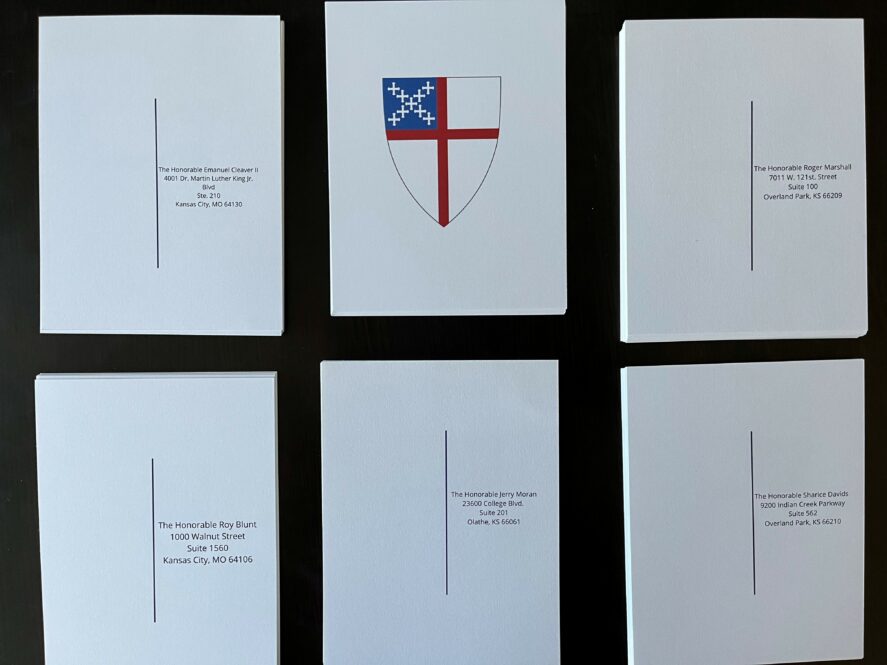
Postcards created as a part of the Grace and Holy Trinity Cathedral project to write to elected officials. Photo courtesy of Stern-Burbano.
Shortly after the shooting at Robb Elementary School in Uvalde, Texas, like many of you I was heartbroken and angry, and I felt called to work for a common good, a concept I learned from interfaith organizing that has deeply impacted my faith and career. I was reminded of one of the older interfaith cooperation models from Interfaith Youth Core: VOICE, ENGAGE, ACT.
The Episcopal Public Policy Network (EPPN) has been doing work similar to the VOICE, ENGAGE, ACT model for quite some time. Encouraging fellow (American) Episcopalians to voice their faith and values, engage in advocacy that is “driven by strong relationships, nurtured over time, and across differences, emphasizing the role each of us plays in our common life together” and act for a common good. One of the resources that they offer is the Postcard Project, a means of “slow advocacy” that encourages Episcopalians to write to their elected officials and voice their faith, values, and concerns.
I recently used the basic framework of the Postcard Project to organize an offering at Grace and Holy Trinity Cathedral to write to elected officials to advocate “in the honor and memory of the lives lost to gun violence, to respectfully call upon those in elected office to support common sense bipartisan gun violence reform. The time for thoughts and prayers has passed. The time for action is now.”
We had postcards that were preaddressed to elected officials on both sides of the state line (Kansas and Missouri), since the Cathedral draws residents from both states. The response was much more positive than I anticipated. We had so many age groups represented and appreciate the offering and more than that, I have since been asked to provide feedback on the program design. I was recently selected as an ambassador to represent both the Diocese of Kansas and the Diocese of West Missouri for the Episcopal Public Policy Network.
I wouldn’t have gotten to this place of advocacy and activism, had it not been for interfaith organizing and leadership development. In order to see another person, see their inherent dignity as a human being, as the creation of God, we must be willing to stay curious, be patient, listen and work across lines of difference.
It’s not always easy. It helps to take breaks in conversations in order to preserve the relationships and allow time to process what you have heard. At the end of the day, it’s all about relationships. Listening, learning, and working together. This is how we will work towards an America where everyone can thrive, flourish, and live up to their highest potential.
Clare Stern-Burbano (she/her/hers) is the Cathedral Youth, College, and Young Adult Minister at Grace and Holy Trinity Cathedral in Kansas City, Missouri.