What Does January 6 Mean for Bridgebuilders?
January 5, 2022
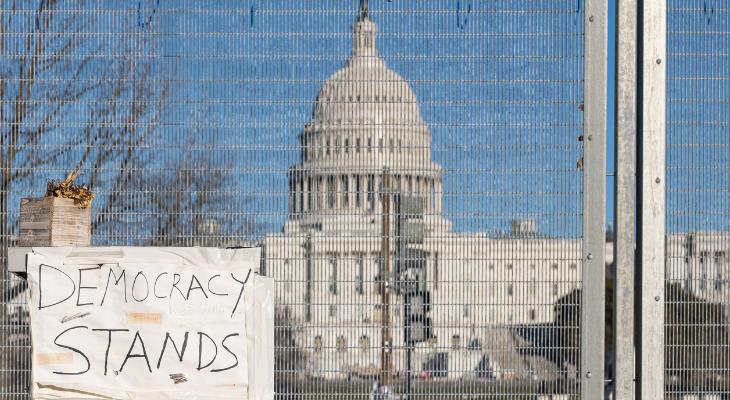
One year ago I sat in prayer with my fellow members of the leadership team at a national interfaith organization. Believe it or not, this was my only experience of impromptu prayer in my thirteen years with the organization. Interfaith Youth Core (IFYC) focuses our efforts on civic interaction, so prayer is not typical in our workspace. But, in a way that may feel familiar for many Americans, January 6 compelled us to do something different. The weightiness of that day seemed to call us into a prayerful reflection on the significance of the events for American democracy.
The attack on the U.S. Capitol on January 6, 2021, viscerally illuminates America’s divisions and looms over our national understanding of the present American moment. While our nation was already divided, the ferocity of January 6 illuminates the terrifying possibilities of where our polarization might lead. For those committed to strengthening the civic fabric of our nation, how ought we think about, talk about, navigate this vivid event – an event that continues to divide Americans?
A national bridgebuilding field has flourished over the past decade to confront the profound dangers posed by American polarization. These field leaders, comprised of academic researchers, individual civic actors, philanthropists, and organizations like IFYC, are committed to bridging our deep divides and building civic strength. Individuals and field leaders have grappled with the questions that January 6 poses over the course of the year. I’ve personally wrestled with the importance of integrity, accountability, and drawing firm lines to preserve our democracy, while also understanding that bridging divides more often involves curiosity, listening, and seeking to understand divergent perspectives. I’ve noticed these competing instincts in individual and large-group conversations within the field, as well; these two distinct approaches are somewhat at odds with one another yet still shed light on the larger bridgebuilding efforts in our country today.
The first approach I’ve experienced emphasizes the importance of accountability and truth-telling. It underscores the need to have an honest appraisal about why, and how, the events at and around the Capitol occurred. The Rev. Jennifer Bailey, founder and executive director of Faith Matters Network as well as a co-founder of the People’s Supper, emphasized the importance of starting with accountability, sharing, “It’s impossible to do deep bridgebuilding about what happened without first interrogating how power was operative in pushing a particular agenda…there were institutions and systems complicit in a lie.” One of her most compelling insights is the fact that bridgebuilders often focus on individual-to-individual relationships and undervalue the role that systems and social conditions play in driving particular events. Zeenat Rahman, executive director of the Institute for Politics at the University of Chicago, underscored this dynamic, “We need to get to the root causes of this event, and understand that this was an organized strategy. Look at the religious symbols that were used – the approach was intentionally devised to cleave communities and drive us apart.”
Bailey and Rahman’s clarion call for honesty and truth provide a bedrock foundation for any effort to bridge divides. Simultaneously, bridgebuilders also understand that 1 in 4 Americans believe that those involved in the events at the Capitol were actually protecting democracy. Telling these folks that they’ve been lied to doesn’t appear to be an effective way to change minds. Justin Gest, an associate professor at George Mason University’s Schar School of Policy and Government, suggests that these beliefs are actually being sacralized within certain communities, and “trying to dispel sacred myths is not a way to reach people.” Emerging from this understanding, the second approach to navigating January 6 emphasizes the importance of listening with curiosity and seeking to understand. Pearce Godwin, founder and CEO of the Listen First Project, shares his own perspective on this: “As a conservative and someone who has worked in Republican politics and the Capitol building, I empathize with some of the fears that have gripped my fellow conservatives … as hard as it may be for other people to see, I feel the depth and sincerity of their love for America even if it is coming out in a way that I view as misguided and destructive.” Godwin saw many people at the Capitol on January 6 with “sincerely held fear and desperation for their country,” and cautions us to separate those committing violence from those who were there, in their mind, to peacefully protect democracy. While our instinct may be to lump January 6 participants and adjacent communities together, Godwin urges us to be cautious not to paint with a broad brush. Rahman makes a similar point about understanding dynamics within communities: “As an American Muslim who lived through 9/11, I understand the frustration that your religion is being co-opted by political actors. We should be thoughtful in our categorization of people, so as not to villainize an entire community.”
These two approaches, these two instincts – this is precisely the challenge bridgebuilders face today, not just when it comes to January 6 but in navigating our country’s deep divides more broadly. The reality is that we need both curiosity and truth. But how do you prioritize them? Do we lead with empathy or do we lead with truth-telling, and can we even do both with integrity?
Believing that we can and must do both is the beating heart of bridgebuilding work. One of the greatest skills in bridgebuilding is the ability to hold two seemingly contradictory thoughts side by side with care for both. It is the ability to deeply disagree with one another but maintain curiosity and care despite that disagreement. To make these points is not to say that this work is simple. Indeed, some psychological research shows that we’re hard-wired to do the opposite, to categorize people into various identities and tribes, “in” groups and “out” groups to better understand the world around us. Bridgebuilding work, especially in this moment, is profoundly challenging, and these challenges, alongside larger social power dynamics at work, means that bridgebuilding is not for everyone – as the Greater Good Science Center’s Bridging Differences Playbook puts it, “not everyone can or should be a bridgebuilder, or feel compelled to build bridges in every situation.”
However, the gravity of our polarization indicates that the need for bridgebuilding is stronger than ever. As I reflect on the one-year anniversary of January 6 and its implications for our nation, I revisit our prayer from one year ago today: May we help build a nation of bridgebuilders, with the tenacity and skill to hold both truth and curiosity side by side.
Share
Related Articles