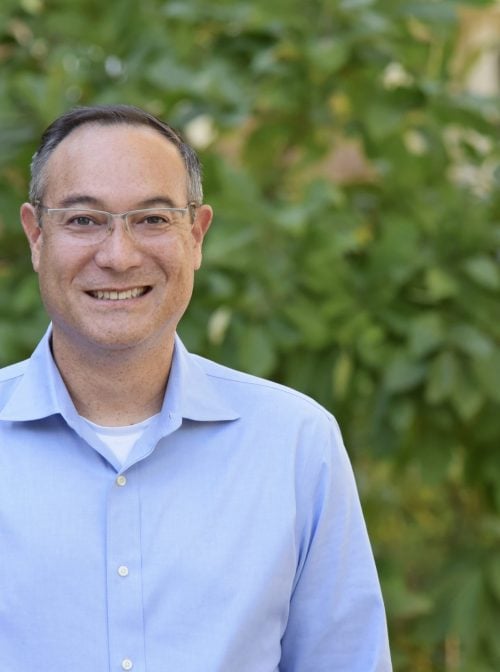
John Inazu is the Sally D. Danforth Distinguished Professor of Law and Religion at Washington University in St. Louis. In addition to his extensive legal scholarship which focuses on First Amendment freedoms, Inazu is also the author of Learning to Disagree: The Surprising Path to Navigating Differences With Empathy and Respect (2024) and Confident Pluralism: Surviving and Thriving through Deep Difference (2016).
As an IA Senior Fellow, John is an ideal person to offer expertise on pluralism in the midst of a challenging and changing legal landscape. He spoke with IA’s Chief Program Officer Mary Ellen Giess on civil liberties and building pluralism in contentious times.
Editor’s note: This interview has been edited for clarity and length.
Mary Ellen Giess: John, thanks so much for your willingness to speak with me. Given your unique position as both a legal scholar and a pluralism expert, I wanted to get your help parsing both the challenges and potentially the opportunities for pluralism in the current moment with a specific attention to civil liberties and other legal dimensions that might be relevant right now. Can you start by defining what you mean by the idea of “confident pluralism?”
John Inazu: With confident pluralism, I want people to take both words seriously. The focus on confidence means that we have a commitment to our own beliefs, which means we understand those beliefs, we take them seriously, and we recognize that they’re going to have significance in the world around us. Pluralism means we recognize that other people will also have their own beliefs, and those beliefs will be very different from, and sometimes incompatible with, our own commitments. The way that confident pluralism works together is being able to hold your own convictions firmly and then recognizing that others will also have their own convictions. This relates to your comment about civil liberties, because none of this works without a baseline commitment to civil liberties. You have to have the basic right to dissent, and you have to have basic conditions that include in the polity. We’re going to have lots of debates about what the boundaries of those terms mean. But when the basic premises are rejected themselves, then we’re in big trouble.
Giess: It was striking to me that your first chapter in Confident Pluralism focuses on the rights enshrined in the Bill of Rights. You were just speaking to this, but [can you] say a little bit more about why you chose to start there in a book about pluralism?
Inazu: One of the biggest questions that the conditions of pluralism force us to address is the extent to which we can find common ground in the absence of a shared common good. That’s a very hard political question to answer, which is why I focus on the idea of a “modest unity.” It’s not asking a lot, but it does insist that part of our common ground is the shared commitment to civil liberties. I sometimes say that civil liberties are for losers, and by this, I mean, you need them the most when you’ve lost in the political process. If you’ve won, if you’re in the majority, then you either write the laws you want, or you write in exceptions for your own interests. It’s when you are in the minority, the political minority, that you need to fall back on basic protections for speech, assembly, religion, and related notions of protest and dissent. The challenge, then, is, how do you honor those convictions when you’re in power, and you don’t need them as much, and, in fact, your political opponents need them more than you do, and that’s the commitment to a broader democratic project.
Giess: It also assumes a certain level of diversity within the community that you’re working within – civil liberties protections assume a range of different and competing notions around identities, beliefs, etc.
Inazu: I think that’s right. The project of pluralism would be a lot easier to pull off in a place like,Sweden. It’s going to be harder in this country where we have so many basic disagreements about our visions of the good, our understanding of human flourishing, and various background commitments.
Giess: Is it fair to say, strong civil liberties protections are the basic infrastructure for pluralism, or how else would you define the relationship? I get that you’re saying that they’re deeply interconnected. But which one needs to come first? What do we do when civil liberties, as you write about in the book, may not be well protected, but we still need to be pursuing pluralism. How do you think about those things sequentially?
Inazu: It’s a really interesting question. I would say that civil liberties are part of the infrastructure. The other necessary part is our own formation as citizens, what I call the civic aspirations of confident pluralism. You could have all the civil liberties and protections in the world, but if you have malformed citizens that are not committed to the project of pluralism, it won’t matter. But your question is interesting because it asks what happens if one or both of those is currently in jeopardy, or in bad health. What do you do then? My answer would be to focus on strengthening institutions at all levels–– the institutions that protect civil liberties, the institutions that teach civil liberties, and the institutions that teach civic formation and provide the opportunities to have and model disagreements across difference.
Giess: You have a brief description in Confident Pluralism of the ways that our nation has fallen short on including all citizens in the political process, including a really moving section about racial disparities in the criminal justice system, disparities in wealth, detentions in the immigration system, and talking about your own family history of Japanese-American internment at Manzanar. How does that history shape your view of the current moment? Does the historical view change how you look at what’s happening right now and how concerned we should be about the strength of pluralism? Or does it put this moment in the context of a long trajectory of ups and downs that we’ve had around the inclusion premise?
Inazu: I think that history is extremely important to highlight the significance of the protections of civil liberties and the costs of losing those liberties––we forget history at our own peril. In the past few weeks I’ve been writing some about the erasure of the Japanese-American internment by the Trump administration, closing access to some of the prison camps where people go to experience and try to confront some of the injustices of that era, purging websites that tell the stories of not only Japanese-Americans, but many other citizens and people in this country who faced abuses and injustices by the government. An honest accounting of our history is important for knowing what is at stake, but also for knowing who we are.
An honest accounting of our history is important for knowing what is at stake, but also for knowing who we are.
Giess: For people who care about pluralism and care about the infrastructure within a democracy, that’s necessary to further pluralism, what do you think are the greatest concerns that people should be attending to right now?
Inazu: For the last few years one of the biggest concerns has been how we engage with one another, and how we get our news through social media and online. Our online interactions are encouraging snark and caricature and misinformation, and it’s only going to be worse in the future. President Trump exacerbates this problem. I think what a lot of people, even defenders of the Trump administration minimize, is the expressive significance of the office of the President, the words that the President says, and the ways in which those words normalize or empower a lack of respect and civic equality.
Giess: One last question. One thing that we think a lot about at IA is the importance of maintaining relationships with a truly wide and diverse coalition of leaders, organizations which, of course, includes ideological diversity. As we’ve just talked about it, it feels like there are real threats to the infrastructure that pluralism requires to thrive. How do you authentically maintain and sustain truly diverse coalitions in a way that reflects the nation, while also being clear–eyed and principled on the value and the current threats to pluralism?
Inazu: One piece of guidance I would give to any organization is to be clear on your mission and your purpose. Another suggestion is to recognize your blind spots. What are the voices that you’re not hearing? What are the perspectives that you could invite into your organizations that might actually make you see things differently or more comprehensively? There are too many echo chambers in our country––conservative echo chambers and progressive echo chambers––and those lead to a kind of sanctimony and self-reliance that assumes we can do better without those other people, whoever they are. How can you be an engaged institution or an informed citizen without having any clue about how half of the country thinks about issues or sees the world? That just seems like almost like citizenship malpractice.
Giess: So if you want to protect pluralism, the solution is also pluralism?
Inazu: It’s being able to see and empathize with someone on the other side of the political aisle who might be discontented with the last four years or dismayed by the political abuses that happened in the last administration.
Giess: I think to be able to do that does not require pretending they’re morally equal right? But you can still be clear–eyed about various perspectives, and genuinely curious about how different communities have viewed our political climate for the past several years.
Inazu: Yes, that’s a great point. You don’t have to make a moral equivalence here. This isn’t a kind of both-sideism, but you’re going to have to prepare yourself for the kinds of arguments that come from people who see the world quite differently from you. The challenge is to recognize and empathize with the harms that other people have experienced without validating those as exactly the same as what you might be experiencing now.
Giess: Where are you finding hope right now?
John Inazu: I’m encouraged by people who are investing in institution building. I’m often asking people, ‘what are you envisioning not just for today but 10 years from now?’ The kind of change that many people want to see will take a long time. It will take a lot of sacrifice. It will take partnering with others who have different political and religious beliefs. But plenty of people are ready to do that work.
Giess: Thank you. John. I appreciate it.