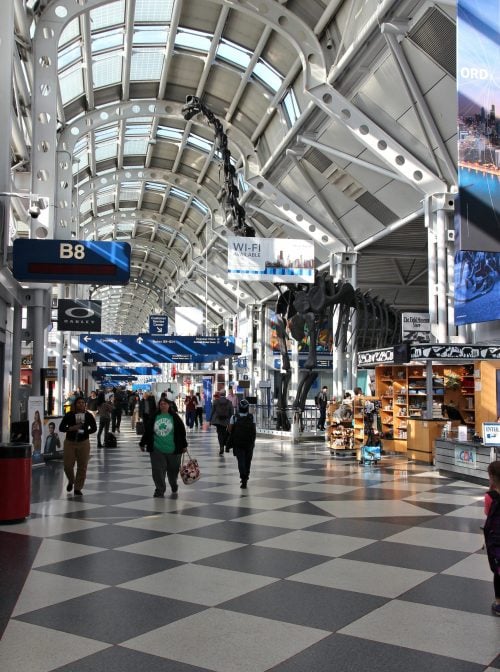
In the hustle and bustle of two of the country’s busiest airports, you’ll see travelers from all over the world: rushing through security, eating at the food courts and running to catch their flight.
What you may not expect is that Chicago’s two airports, O’Hare and Midway, are home to the only interfaith chapels in the country, unexpected and beautiful examples of interfaith cooperation.
The success of the interfaith chapels in these airports is largely credited to the dedication and passion of Airport Chaplain Father, Michael Zaniolo, also known as Father Mike. He is a Roman Catholic priest from Chicago with a welcoming demeanor and warm smile that immediately puts you at ease.
Father Mike has been serving as the full-time Airport Chaplain since 2001 and believes, strongly, in the power of having this interfaith space.
“People are very respectful about each other. I remember when I started here in 2001, I walked past [the chapel] one day, and I saw someone Catholic praying. I saw somebody reading a Bible. I saw a Muslim with their prayer rug, and I saw a Jewish person with all their prayer accouterments, and each was in different sections of the chapel. Everybody recognized that it was a sacred space for everybody…
And I just looked at it, and I thought, why can’t the rest of the world be like this?,” said Father Mike.
The creation of the interfaith chapels wasn’t planned when Chicago’s airports first opened. However, in the 1960s, when the airports started to get busy, Catholic employees who worked at the airport and were unable to make it to church, asked a priest at a nearby parish to host mass for them. Over time, more employees began to attend, and the chaplain became officially appointed by the archdiocese.
In the 1980s, a Protestant chaplain came by and dedicated a Protestant ministry. As more Muslim employees began to work in the airport, they would also come to the chapel to pray.
In the early 1990s, it became formalized as an “interfaith” chapel within the airport.
The interfaith chapels currently serve as a sacred space for the 54,000 employees who work at the airports, as well as all travelers, and are open twenty-four hours a day.
There are dedicated services for Catholic, Protestant and Muslim employees and anyone is welcome to use the space to engage in their own spiritual practice and speak with any of the chaplains.
Father Mike reflects, “That’s what impressed me most about these chapels. They’re sacred. You can feel it as soon as you walk in. It’s a holy spot.”
Throughout his tenure as airport chaplain, Father Mike has made it his mission to ensure he is present for airport employees. He holds office hours and regularly goes on his “rounds” to walk the halls of the airport and check in on how employees are doing.
He laughs, “I don’t really get to walk much, because I stop and talk to people. My doctor keeps saying, ‘Well, you work at the airport. You should walk around more, and you’ll lose some weight.’ I tell him if I could lose weight, just standing and talking to people, I’d weigh a hundred pounds. Just the nature of this job.”
While Father Mike gets to celebrate happy moments with employees such as a recent wedding or the birth of a child, he also has the challenging job of supporting travelers when unexpected tragedies occur; like commemorating the life of a fallen soldier.
“When there’s a fallen soldier that comes through, they will transfer the body from the airplane typically at the gate to a hearse…during this ceremony, I’ll usually say a prayer and find out from the family a little more about religion, you know, so I don’t inject even more pain by, you know, saying prayers from the wrong tradition,” said Father Mike.
Director of Airport Media Relations, Karen Pride, felt compelled to share her interfaith experience with Father Mike as well, as she navigated through a difficult time. She further emphasized his supportive and caring nature.
“A little over five years ago, my sister was very ill, and I traveled out of state to where she lived. She was on life support, and I had talked to Father Mike about her situation previously. When we were at the hospital with my family, I called him when they were taking her off life support. He was the first person I called. In fact, he was the only person I called, and he was at least familiar with the situation. I called him because of all the things that he said – he is the person,” said Pride.
As we approach this holiday season, we may be navigating conflict or tension in this divisive time, especially with family gatherings on the horizon. If you plan to fly through Chicago’s airport, there is a haven for you waiting there – a communal space to be with yourself: to pray, to reflect, to breathe. It can serve as a reminder that even in a challenging time, we can still make space to pray and care for each other.
Anu Gorukanti, MD, is a public health practitioner and pediatric hospitalist. She is also the co-founder of Introspective Spaces, a social venture committed to building reflective space and community for women in healthcare. She was a member of the Sacred Journeys and Witness fellowships. She cares deeply about the well-being of her colleagues in healthcare and is passionate about healthcare reform to create equitable and compassionate care for patients and communities. In her free time, she loves to photograph landscapes, learn to dance, and spend time with her wonderful husband, friends, and family.