“Now is the time for dialogue and building bridges.”
These words, from Pope Leo XIV during one of his first speeches as pope, struck a chord with me as a Catholic with deeply held beliefs and as someone who seeks common ground and common action with people of other faiths. I’ve been inspired by how the first American pope has spoken in ways that align with the very best of American pluralism and Catholic social teaching: A commitment to unity, love, human dignity, and an ability to find understanding across differences.
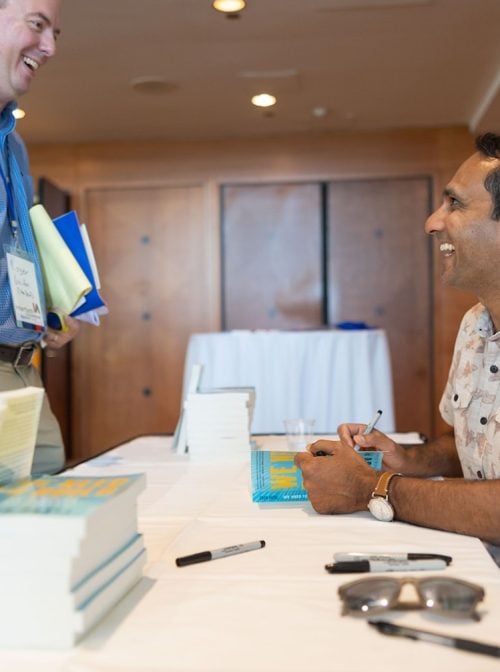
Perhaps these words resonated with me because they were similar to words on the cover of a book sitting near me, “We Need to Build” by Eboo Patel, Interfaith America’s founder and president.
Indeed, building is central to all of Interfaith America’s work, and I am proud to be joining this effort in my new role as Senior Director of Civic Strategies. In a divided country, where so many people feel isolated and angry, the only way forward is to build connection and understanding – and to build coalitions that can safeguard and strengthen our democracy and society.
As Mary Ellen Giess, IA’s Chief Program Officer, recently wrote in a “Faithful Fight” toolkit on bridgebuilding, “In a time when many communities are under threat, some argue that bridgebuilding and dialogue is irrelevant or insufficient — or worse, that it is cooperating with the enemy — and instead suggest direct activism is more impactful.
Despite legitimate concerns, bridgebuilding remains a valuable strategy. In this moment, strengthening democracy requires a variety of approaches, contributing to outcomes that bring society more together than apart.”
The truth is we need a wide variety of leadership and action to meet this moment. To bring our democracy to higher ground there will be times where we need to dig in and call out injustices and harmful actions for what they are. There will be times when we need to extend empathy and understanding to people who are different from who we are. And, ultimately, we can be more successful in building the pro-pluralism, pro-democracy coalition if we do these two things together.
I have spent much of the last decade trying to build coalitions that can preserve and strengthen our democracy. As a program associate at Democracy Fund, we built a religious pluralism portfolio that empowered grantees from a wide range of faith traditions to support pluralism and belonging in ways that reflected their deeply held values. At Protect Democracy, we worked with partner organizations to ensure free and fair elections – bringing together people who might have voted differently in the election itself, but who understood that we all have much to lose if our democratic institutions cannot hold.
We need to build communities that can act together, strengthen our democracy and civic infrastructure, and ensure that our rights are respected and our republic can deliver on its promise to the people.
I’ve seen this work in the context of protecting the will of the people in our elections, as well as in everyday efforts to improve the lives of people in our communities. We’ve partnered with poll chaplain networks to ensure a safe, accessible, peaceful voting experience. In the tumultuous days following the 2020 election, rabbis, pastors, and lay leaders held joyful celebrations of our democracy outside of vote-counting centers. And multifaith coalitions have stopped harmful payday lending procedures by engaging in advocacy and creating their own alternative loan programs.
At Interfaith America, we are embracing the power of pluralism and seeking to empower leaders who can create positive change in their communities and foster new narratives about pluralism and interfaith work. These leaders can increase understanding and decrease prejudice, strengthen civic cohesion, and create communities that are better equipped to tackle the real challenges that they face.
Democracy is about more than elections. Building a multi-faith, multi-racial democracy where everyone can thrive requires constant effort. This is a moment for each of us to commit to this effort, and to strategize to do so effectively.
Pope Leo and Eboo are right – now is the time to build.

Chris Crawford
Chris Crawford is the Senior Director of Civic Strategies at Interfaith America. He previously served as a policy strategist at Protect Democracy, where he led staffing for The National Task Force on Election Crises and partnered with Interfaith America in developing the Faith in Elections Playbook during the 2024 election. He previously worked as a senior program associate at Democracy Fund, where he managed a portfolio of faith-based initiatives focused on promoting pluralism in the United States. Chris began his career at Susan B. Anthony List (Now Susan B. Anthony Pro-Life America), the nation’s largest pro-life political organization. He has a bachelor’s degree in political science from The George Washington University and a master’s degree in nonprofit administration from The University of Notre Dame. In addition to his work at Interfaith America, Chris is a founding board member of The Center for Christianity and Public Life and serves on advisory committees for A More Perfect Union: The Jewish Partnership for Democracy, The Initiative on Catholic Social Thought and Public Life at Georgetown University, and served on the thought leaders advisory committee for Interfaith America’s “Vote is Sacred” program. Chris’s writing and speaking has been featured on The Christian Broadcasting Network, America Magazine, Our Sunday Visitor, and a variety of other secular and religious outlets.