Contemplating Complexity and Coexistence on The Steps of St. Peters Square
March 3, 2021
Gianluca Avanzato (he/him/his) is a writer, poet, and polyglot from Upstate New York. He is a recipient of Interfaith Youth Core’s Alumni Interfaith Leadership Fund and a student of interreligious dialogue at the Pontifical University of St. Thomas Aquinas in Rome, Italy.
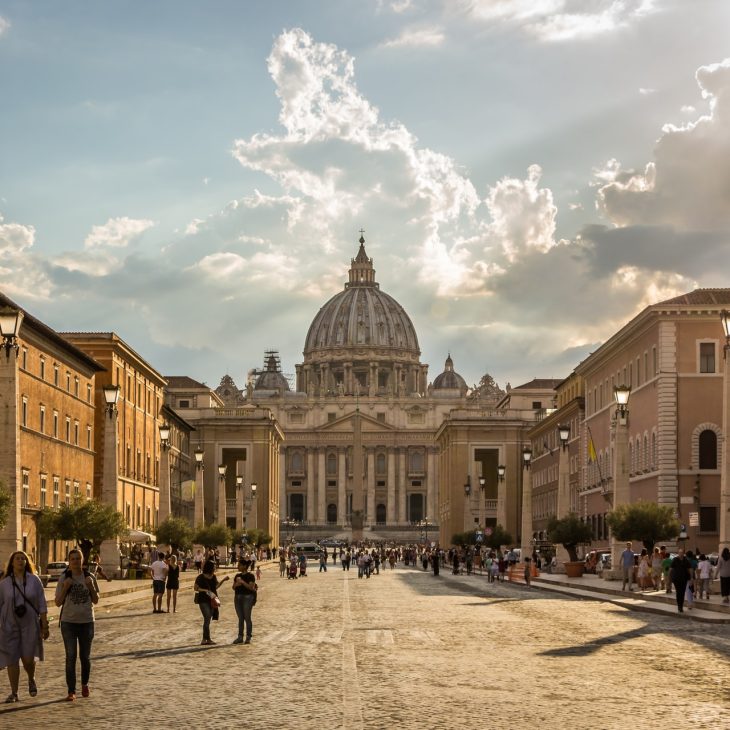
I pass the Vatican every day on the way to class.
During the day, the broad steps of the colonnades that embrace Saint Peter’s Square are bright with sunlight and tourists. When I return home in the evening, they are blanketed with tents and tarps and bodies. As pilgrims flock to Saint Peter’s during the day, the homeless gather there by night.
For the past six months, I have regularly witnessed the suffering of those who lack even the most basic necessities in direct juxtaposition to the wealth, power, and privilege of the Roman Catholic Church.
I pointed this out to my friend and colleague, Ana, as we walked together through Saint Peter’s Square. “They come here,” she replied after acknowledging and considering my observation, “because this is the only place in Rome where the police don’t bother them.”
Ana is right. I’ve discovered that Pope Francis, the Bishop of Rome and chief pastor of the Catholic Church, has taken significant actions to care for Rome’s homeless population. Besides inviting homeless people for exclusive visits and celebrations, Pope Francis arranged for the conversion of one of the Vatican’s palaces into a homeless shelter. He also had public restrooms and showers created near Saint Peter’s Square, where professional volunteers regularly offer haircuts and shaves to those in need.
This truth, however, does not invalidate my initial critical observation. Instead, the two truths coexist: Yes, there are extreme disparities between the Vatican’s resources and those of the homeless around Saint Peter’s Square; and yes, the Roman Catholic Church has been proactive, to varying degrees, in ameliorating these deep-rooted inequities.
The coexistence of truths is a principle paramount to dialogue. To acknowledge that a reality is complicated is not necessarily a cop out; instead, such an acknowledgement can often serve as a critical foundation to fruitful inquiry and conversation, especially when discussing truth(s).
What does it mean to possess truth? To profess truth?
It’s complicated.
As a student of interreligious dialogue at a pontifical university, I am constantly grappling with the tension between exclusivity and inclusivity. As Rabbi Jack Bemporad put it in a recent talk: “How can I be true to my faith and not be false to your faith?”
This question is relevant everywhere, especially when we understand faith as a dynamic term, something more than simply a groundless religious belief.
United States President Joe Biden is a devout Catholic. He is also pro-choice. To some, these overlapping beliefs may seem antithetical or hypocritical—perhaps even heretical. To me, they illustrate the complexity of identity, including the interpretation of one’s faith tradition and the translation of beliefs into action (or non-action).
That is to say, it’s complicated.
And it’s also not. While Biden acknowledges and accepts the Catholic Church’s doctrine on abortion, he refuses to render this judgement into a political imposition on others, especially since such a verdict asserts further control over women’s bodies. In this instance, the definitions of Biden’s faith do not violate the liberty and truth of the individual, who is thus allowed to make a decision based on her own volition and reality.
Too often, however, beliefs are exercised in a way that creates barriers. In his latest encyclical, Fratelli Tutti, Pope Francis discusses “the temptation to build a culture of walls, to raise walls, walls in the heart, walls on the land” (no. 27). Such an attitude and approach do not allow for respectful and equitable encounters that might allow for growth, clarity, and peace. Indeed, Pope Francis concludes that “those who raise walls will end up as slaves within the very walls they have built…left without horizons” (no. 27).
Limits and limitlessness. Walls and permeability. How can we slacken the boundaries of exclusivity without sacrificing our security? Our identity? Our faith?
“Meet your edge and soften,” Tara Brach, a prominent American teacher of Buddhist meditation, often says. This is what dialogue demands—what life demands. Not everything is black and white; edges are often blurred. To reconcile a diversity of truths, we must encounter both the other and ourselves with dignity and respect: acknowledge our boundaries and allow them to open up to other truths.
This is where love comes into play—compassion, patience, friendship, trust. We need mindful observation, honest conversation, and gentle contemplation. Our definition of ourselves does not have to be threatened by complication and investigation. Instead, our faith and identity—complex and multi-dimensional—can be enriched and expanded when we’re able to meet our edge and soften.
Share
Related Articles